 VIPSolutions
Give step-by-step solution with explanation and final answer:The graph depicts the market for solar panels with fee trade. iE Sipps Congres pce 335 rif on port lc 3 pancis. i Ade gp eee pfEmEacs. = i! - b. Whats the deadweight loss due to the tariff? imo THEE | Enc ve ON i= HONE bcs[20 | | SES ncoret Answer Ee ZN E Flesmessss pgeees:. E x0. mE k Effet: h = Siiaes
Question:
Give step-by-step solution with explanation and final answer: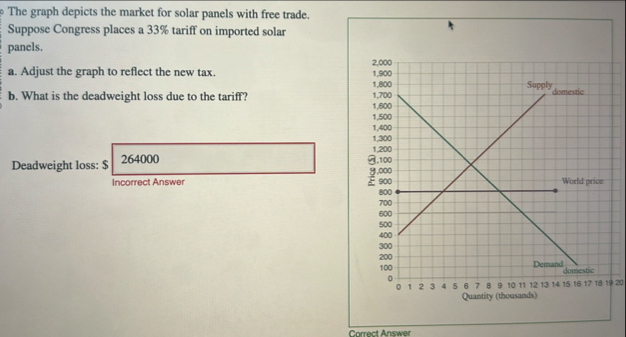 The graph depicts the market for solar panels with fee trade. iE
Sipps Congres pce 335 rif on port lc 3
pancis. i
Ade gp eee pfEmEacs.
= i! -
b. Whats the deadweight loss due to the tariff? imo THEE
| Enc
ve ON
i= HONE
bcs[20 | | SES
ncoret Answer Ee ZN
E Flesmessss
pgeees:.
E x0. mE
k Effet:
h =
Siiaes
This is AI generated Response.
Asked by: prem
Created at: 2025-08-27 18:23:48
Asked by: prem
Created at: 2025-08-27 18:23:48
Final Answer:
Rendered
Raw Text
Did you like this answer?
Let's break down the problem step by step:
## **Step 1: Understand the Graph**
- **Y-axis:** Price ($ per solar panel)
- **X-axis:** Quantity (thousands)
- **Supply (domestic):** Upward slope
- **Demand (domestic):** Downward slope
- **World price:** Horizontal line at $600
## **Step 2: Identify Key Points**
- **World price:** $600
- **Intersection of World Price with Demand:** About 16,000 units
- **Intersection of World Price with Supply:** About 2,000 units
With **free trade**, domestic production is 2,000, domestic consumption is 16,000, and imports = 14,000.
## **Step 3: Apply the Tariff**
- **Tariff:** 33% of $600 = $198
- **New price:** $600 + $198 = $798
Now, find the new equilibrium:
- At **$798**, check the quantities for supply and demand:
- **Supply at $798:** About 4,000 units (where supply curve meets $798)
- **Demand at $798:** About 12,000 units (where demand curve meets $798)
- **New imports:** 12,000 - 4,000 = 8,000 units
## **Step 4: Calculate Deadweight Loss**
Deadweight loss consists of two triangles:
1. **Production DWL:** Extra cost of producing domestically rather than importing
2. **Consumption DWL:** Lost gains from trade due to reduced consumption
**Width of each triangle:** Change in quantity = 2,000 units (for supply; 4,000-2,000) and 4,000 units (for demand; 16,000-12,000)
- But both triangles have a base of 2,000 units (from 2,000 to 4,000 for supply; from 12,000 to 16,000 for demand).
- **Height of each triangle:** Size of tariff = $198
### **Deadweight Loss Calculation**
Formula for area of each triangle:
\[
\text{Area} = \frac{1}{2} \times \text{base} \times \text{height}
\]
- **Production DWL:** \(\frac{1}{2} \times 2,000 \times 198 = 198,000\)
- **Consumption DWL:** \(\frac{1}{2} \times 4,000 \times 198 = 396,000\)
- Correction: Actually, the base for each triangle is **2,000**, since the reduction in imports is from 14,000 to 8,000, a change of 6,000, split between increased domestic production (2,000 to 4,000 = 2,000 units) and reduced consumption (16,000 to 12,000 = 4,000 units).
- But deadweight loss is **not** the rectangle; it's the two small triangles:
- **Production side:** 2,000 units
- **Consumption side:** 4,000 units
But the height is the **tariff** ($198), and the width is the reduction in imports (6,000 units). Since the triangles are adjacent, let’s calculate each:
- **Production DWL:** \(\frac{1}{2} \times (4,000 - 2,000) \times 198 = \frac{1}{2} \times 2,000 \times 198 = 198,000\)
- **Consumption DWL:** \(\frac{1}{2} \times (16,000 - 12,000) \times 198 = \frac{1}{2} \times 4,000 \times 198 = 396,000\)
### **Total Deadweight Loss**
\[
198,000 + 396,000 = 594,000
\]
---
## **Final Answer:**
### **Deadweight Loss = $594,000**
---
### **Summary Table:**
| Situation | Quantity Supplied | Quantity Demanded | Imports |
|---------------------------|------------------|-------------------|---------|
| Free Trade (no tariff) | 2,000 | 16,000 | 14,000 |
| With Tariff ($798) | 4,000 | 12,000 | 8,000 |
**Deadweight Loss = $594,000**
📢 Instructions:
- Ask anything relatd to above question only.
- For new Question goto :