This is AI generated Response.
Asked by: Md Israrul Haque
Created at: 2025-08-23 22:41:05
Final Answer:
RenderedRaw Text
Did you like this answer?
Let's break down the solution step by step for each part (**a**, **b**, and **c**):
## **Given Data:**
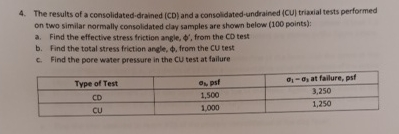
| Type of Test | σ₃ (psf) | σ₁ - σ₃ at failure (psf) |
|--------------|----------|-------------------------|
| CD | 1500 | 3250 |
| CU | 1000 | 1250 |
Where:
- **σ₃** = minor principal stress (confining pressure)
- **σ₁** = major principal stress at failure
- **σ₁ - σ₃** = deviator stress at failure
---
## **a. Find the effective stress friction angle, φ', from the CD test**
**For the CD test:**
- The test is drained, so pore water pressure is zero at failure, and total stresses = effective stresses.
### **Step 1: Find σ₁ at failure**
\[
σ₁ = σ₃ + (σ₁ - σ₃) = 1500 + 3250 = 4750~\text{psf}
\]
### **Step 2: Use Mohr-Coulomb Failure Criterion (for normally consolidated clay, c' = 0):**
\[
\text{At failure:}~ \frac{σ₁'}{σ₃'} = \frac{1 + \sin φ'}{1 - \sin φ'}
\]
Here, σ₁' = σ₁ and σ₃' = σ₃ for the CD test.
\[
\frac{σ₁'}{σ₃'} = \frac{4750}{1500} = 3.1667
\]
\[
\frac{1 + \sin φ'}{1 - \sin φ'} = 3.1667
\]
### **Step 3: Solve for sin φ'**
\[
1 + \sin φ' = 3.1667(1 - \sin φ')
\]
\[
1 + \sin φ' = 3.1667 - 3.1667 \sin φ'
\]
\[
1 + \sin φ' + 3.1667 \sin φ' = 3.1667
\]
\[
1 + 4.1667 \sin φ' = 3.1667
\]
\[
4.1667 \sin φ' = 3.1667 - 1 = 2.1667
\]
\[
\sin φ' = \frac{2.1667}{4.1667} = 0.52
\]
\[
φ' = \arcsin(0.52) \approx 31.3^\circ
\]
---
## **b. Find the total stress friction angle, φ, from the CU test**
**For the CU test:**
- Use total stresses (since undrained).
### **Step 1: Find σ₁ at failure**
\[
σ₁ = σ₃ + (σ₁ - σ₃) = 1000 + 1250 = 2250~\text{psf}
\]
### **Step 2: Use Mohr-Coulomb Failure Criterion (c = 0):**
\[
\frac{σ₁}{σ₃} = \frac{1 + \sin φ}{1 - \sin φ}
\]
\[
\frac{σ₁}{σ₃} = \frac{2250}{1000} = 2.25
\]
### **Step 3: Solve for sin φ**
\[
1 + \sin φ = 2.25(1 - \sin φ)
\]
\[
1 + \sin φ = 2.25 - 2.25 \sin φ
\]
\[
1 + \sin φ + 2.25 \sin φ = 2.25
\]
\[
1 + 3.25 \sin φ = 2.25
\]
\[
3.25 \sin φ = 2.25 - 1 = 1.25
\]
\[
\sin φ = \frac{1.25}{3.25} = 0.3846
\]
\[
φ = \arcsin(0.3846) \approx 22.6^\circ
\]
---
## **c. Find the pore water pressure in the CU test at failure**
The effective normal stresses at failure for the CU test:
- **σ₁' = σ₁ - u**
- **σ₃' = σ₃ - u**
From the CD test, recall that φ' ≈ **31.3°**.
For the CU test, at failure:
\[
\frac{σ₁'}{σ₃'} = \frac{1 + \sin φ'}{1 - \sin φ'} = \frac{1 + 0.52}{1 - 0.52} = \frac{1.52}{0.48} = 3.1667
\]
Let \( σ₁' = σ₁ - u \) and \( σ₃' = σ₃ - u \):
\[
\frac{σ₁ - u}{σ₃ - u} = 3.1667
\]
\[
σ₁ - u = 3.1667(σ₃ - u)
\]
\[
σ₁ - u = 3.1667σ₃ - 3.1667u
\]
\[
σ₁ - u + 3.1667u = 3.1667σ₃
\]
\[
σ₁ + 2.1667u = 3.1667σ₃
\]
\[
2.1667u = 3.1667σ₃ - σ₁
\]
\[
u = \frac{3.1667σ₃ - σ₁}{2.1667}
\]
Now plug in the values:
- \( σ₁ = 2250 \) psf
- \( σ₃ = 1000 \) psf
\[
u = \frac{3.1667 \times 1000 - 2250}{2.1667}
\]
\[
u = \frac{3166.7 - 2250}{2.1667}
\]
\[
u = \frac{916.7}{2.1667} \approx 423~\text{psf}
\]
---
## **Final Answers**
### **a. Effective stress friction angle from CD test:**
\[
\boxed{φ' \approx 31.3^\circ}
\]
### **b. Total stress friction angle from CU test:**
\[
\boxed{φ \approx 22.6^\circ}
\]
### **c. Pore water pressure in CU test at failure:**
\[
\boxed{u \approx 423~\text{psf}}
\]
If you need any more detail or explanation for any step, let me know!
Question:
A normally consolidated inorganic clay sample extracted from a depth of
15 m
in ground has a saturated unit weight of
18kN/m
3
and a plasticity index of 40 . Estimate the undrained shear strength, undrained elastic modulus, and effective friction angle of this clay.
This is AI generated Response.
Asked by: Md Israrul Haque
Created at: 2025-08-23 22:45:45
Final Answer:
RenderedRaw Text
Did you like this answer?
Let's analyze the problem step by step.
---
## **Given Data:**
- Depth of sample: \( z = 15\, \text{m} \)
- Saturated unit weight: \( \gamma_{sat} = 18\, \text{kN/m}^3 \)
- Plasticity Index: \( PI = 40 \)
---
## **Step 1: Calculate the in-situ effective vertical stress (\(\sigma'_v\)) at 15 m depth**
Since the soil is saturated, the total vertical stress:
\[
\sigma_v = \gamma_{sat} \times z = 18\, \text{kN/m}^3 \times 15\, \text{m} = 270\, \text{kPa}
\]
Assuming the soil is normally consolidated, the effective vertical stress (\(\sigma'_v\)) equals the total stress:
\[
\sigma'_v \approx 270\, \text{kPa}
\]
---
## **Step 2: Estimating the undrained shear strength (\(s_u\))**
In clay mechanics, for normally consolidated clay, the undrained shear strength can be estimated using empirical correlations with the plasticity index:
\[
s_u \approx 0.11 \times (PI) \times \sigma'_v
\]
*(This is a commonly used approximate relation; coefficients may vary depending on soil type.)*
Plugging in the values:
\[
s_u = 0.11 \times 40 \times 270 \approx 0.11 \times 10800 = 1188\, \text{kPa}
\]
**Final estimate:**
\[
\boxed{
s_u \approx 1190\, \text{kPa}
}
\]
---
## **Step 3: Estimating the undrained elastic modulus (\(E_u\))**
The undrained shear modulus is often related to the undrained shear strength by:
\[
E_u \approx 15 \times s_u
\]
*(Based on empirical correlations for soft clay)*
Calculating:
\[
E_u \approx 15 \times 1190 \approx 17,850\, \text{kPa}
\]
**Final estimate:**
\[
\boxed{
E_u \approx 17,850\, \text{kPa}
}
\]
---
## **Step 4: Estimating the effective friction angle (\(\phi'\))**
For normally consolidated inorganic clay, the effective friction angle is typically low but can be estimated based on the plasticity index:
\[
\phi' \approx 0.15 \times (PI) \quad \text{(in degrees)}
\]
Calculating:
\[
\phi' \approx 0.15 \times 40 = 6^\circ
\]
Alternatively, more refined correlations suggest \(\phi'\) ranges from 5° to 10° for such clay depending on other factors.
**Final estimate:**
\[
\boxed{
\phi' \approx 6^\circ
}
\]
---
## **Summary of Results:**
| Parameter | Estimated Value |
|----------------------------------|-------------------------------------|
| **Undrained shear strength (\(s_u\))** | **~1190 kPa** |
| **Undrained elastic modulus (\(E_u\))** | **~17,850 kPa** |
| **Effective friction angle (\(\phi'\))** | **~6°** |
---
## **Note:**
- These are approximate values based on empirical correlations for normally consolidated inorganic clay.
- Actual values can vary depending on the specific soil properties and testing conditions.
- For more precise estimates, laboratory testing data would be necessary.
If you'd like further explanations or details on the correlations used, feel free to ask!
VIPSolutions focuses on clear, step‑by‑step explanations so you can learn quickly. Whether you need an AI‑generated walkthrough or a short hint to get unstuck, each solution is organized for fast reading and easy review later.
Search similar questions, compare approaches, and bookmark the best answers for revision. Our goal is simple: quick, reliable study help that feels natural—not noisy.
 VIPSolutions
 4 The res oa coma rane DJ ads cored ried C1) ri 7d
a moral oan oy re en el (155
re cc so ton ge von Coe
Toa hed weet germ De rt
© er pent ne Coane
[SS roms ———— | o-oo
[Ce ————— — |
ET em —