This is AI generated Response.
Asked by: Veera manikanta
Created at: 2025-08-22 21:36:31
Final Answer:
RenderedRaw Text
Did you like this answer?
Let's break down the solution step by step:
### **Given Data**
- Mass of wheel assembly linkage (\( m \)): **50 kg**
- Radius of inertia (\( r_g \)): **0.4 m**
- Engine linkage angular speed (\( \omega \)): **3 rad/s (CCW)**
- Angular acceleration (\( \alpha \)): **10 rad/s²**
- Mass moments of inertia:
- \( I_2 = 0.263 \) kg·m²
- \( I_3 = 0.860 \) kg·m²
- \( I_4 = 6.063 \) kg·m²
### **Step 1: Calculate the Total Moment of Inertia**
The total moment of inertia (\( I_{total} \)) about the axis of rotation is the sum of all the links involved:
\[
I_{total} = I_2 + I_3 + I_4
\]
\[
I_{total} = 0.263 + 0.860 + 6.063 = 7.186 \text{ kg·m}^2
\]
### **Step 2: Calculate the Torque Required for Angular Acceleration**
The torque (\( \tau \)) needed to accelerate the system is:
\[
\tau_{acceleration} = I_{total} \times \alpha
\]
\[
\tau_{acceleration} = 7.186 \times 10 = 71.86 \text{ Nm}
\]
### **Step 3: Calculate the Torque Required to Overcome Rotational Inertia of the Wheel Assembly**
The wheel assembly mass is 50 kg and its radius of gyration is 0.4 m:
\[
I_{assembly} = m \cdot r_g^2 = 50 \times (0.4)^2 = 50 \times 0.16 = 8 \text{ kg·m}^2
\]
Add this to the total moment of inertia:
\[
I_{total, new} = 7.186 + 8 = 15.186 \text{ kg·m}^2
\]
\[
\tau_{acceleration, new} = I_{total, new} \times \alpha = 15.186 \times 10 = 151.86 \text{ Nm}
\]
### **Step 4: Calculate the Torque Required to Overcome the Gravity Force on the Wheel Assembly**
The force due to gravity:
\[
F_g = m \cdot g = 50 \times 9.81 = 490.5 \text{ N}
\]
This force acts at the center of gravity, which is 0.4 m from the axis.
\[
\tau_{gravity} = F_g \times r_g = 490.5 \times 0.4 = 196.2 \text{ Nm}
\]
### **Step 5: Calculate the Total Required Torque**
Sum the torque required for acceleration and to counteract gravity:
\[
\tau_{required} = \tau_{acceleration, new} + \tau_{gravity}
\]
\[
\tau_{required} = 151.86 + 196.2 = 348.06 \text{ Nm}
\]
---
## **Final Answer**
### **The torque required to be applied by the engine is:**
\[
\boxed{348 \text{ Nm}}
\]
### **Explanation:**
- We summed up the moments of inertia of all components, including the wheel assembly.
- Calculated the torque for desired angular acceleration.
- Added the torque required to hold the mass of the wheel assembly against gravity.
- The total is the required engine torque.
**If you need a more detailed force analysis through the mechanism or have a specific link where the torque is applied, let me know!**
VIPSolutions focuses on clear, step‑by‑step explanations so you can learn quickly. Whether you need an AI‑generated walkthrough or a short hint to get unstuck, each solution is organized for fast reading and easy review later.
Search similar questions, compare approaches, and bookmark the best answers for revision. Our goal is simple: quick, reliable study help that feels natural—not noisy.
 VIPSolutions
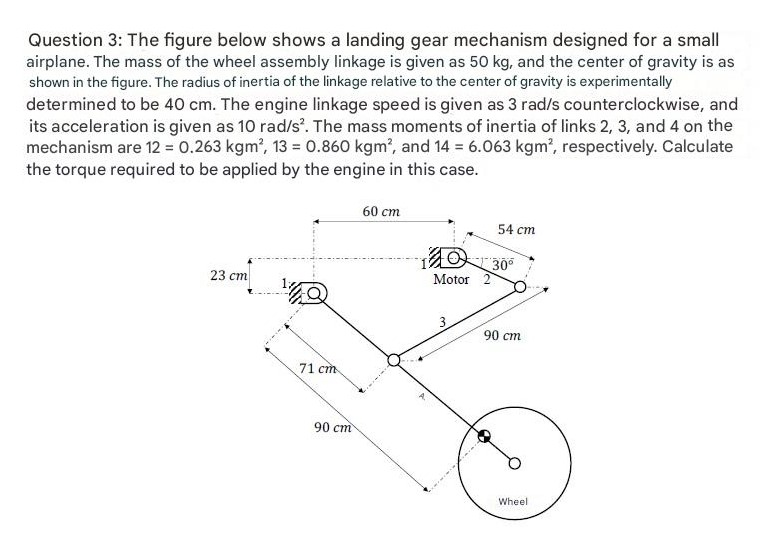 Question 3: The figure below shows a landing gear mechanism designed for a small
airplane. The mass of the wheel assembly linkage is given as 50 kg, and the center of gravity is as
shown in the figure. The radius of inertia of the linkage relative to the center of gravity is experimentally
determined to be 40 cm. The engine linkage speed is given as 3 rad/s counterclockwise, and
its acceleration is given as 10 rad/s’. The mass moments of inertia of links 2, 3, and 4 on the
mechanism are 12 = 0.263 kgm?, 13 = 0.860 kgm’, and 14 = 6.063 kgm?, respectively. Calculate
the torque required to be applied by the engine in this case.
60cm
he Co " ._ Stem
7 ~
fromm ene Fer gay
Bem Motor 25
«7a Or
i yr”
2 90cm
oe
a AK
90 = A
NL b ©