 VIPSolutions
Give step-by-step solution with explanation and final answer:Vapour compression refrigeration cycle using ammonia as refrigerant has a capacity of 30 TR. Evaporator and condenser temperatures are -16°C and 50 °C respectively. Ammonia enters the compressor in dry saturated state and leaves the condenser after complete liquefaction. Specific heat of ammonia vapour is 2.3 kJ/kg K. Sketch the cycle on T-s and P-h plots and Calculate the following : (a)Max. COP of the System (b)Mass flow rate of ammonia in kg/hr (c)Power supplied to compressor in kW (d) Heat Rejected in Condenser in kW
Question:
Give step-by-step solution with explanation and final answer: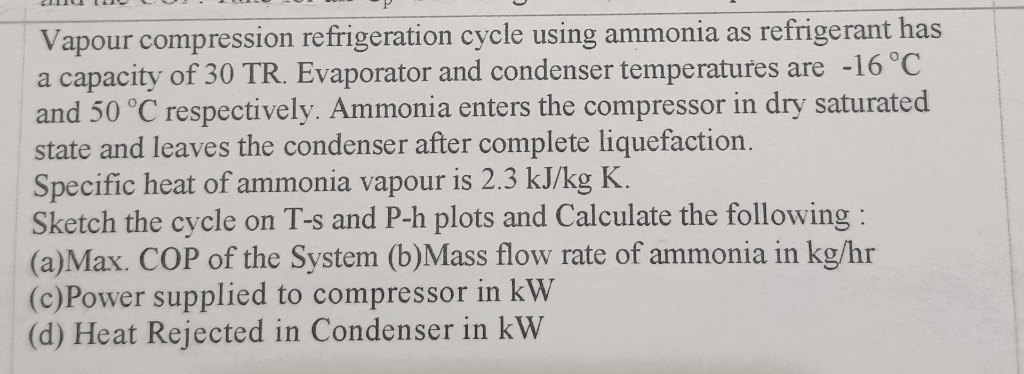 Vapour compression refrigeration cycle using ammonia as refrigerant has
a capacity of 30 TR. Evaporator and condenser temperatures are -16°C
and 50 °C respectively. Ammonia enters the compressor in dry saturated
state and leaves the condenser after complete liquefaction.
Specific heat of ammonia vapour is 2.3 kJ/kg K.
Sketch the cycle on T-s and P-h plots and Calculate the following :
(a)Max. COP of the System (b)Mass flow rate of ammonia in kg/hr
(c)Power supplied to compressor in kW
(d) Heat Rejected in Condenser in kW
This is AI generated Response.
Asked by: Veera manikanta
Created at: 2025-08-22 21:33:01
Asked by: Veera manikanta
Created at: 2025-08-22 21:33:01
Final Answer:
Rendered
Raw Text
Did you like this answer?
Let's solve the problem step by step:
---
### **Given Data**
- **Refrigeration capacity (\(Q_L\))** = 30 TR
\(1~\text{TR} = 3.517~\text{kW}\)
So, \(Q_L = 30 \times 3.517 = 105.51~\text{kW}\)
- **Evaporator temperature (\(T_{evap}\))** = \(-16^\circ C\)
- **Condenser temperature (\(T_{cond}\))** = \(50^\circ C\)
- **Specific heat of ammonia vapor (\(c_p\))** = 2.3 kJ/kg·K
- **Refrigerant: Ammonia (\(NH_3\))**
- **Ammonia enters the compressor as dry saturated vapor and leaves condenser as saturated liquid.**
---
### **Step 1: Sketch the Cycle**
#### **T-s and P-h diagrams**
- On the **T-s** diagram:
- 1 → 2: Isentropic compression (vertical line up)
- 2 → 3: Heat rejection at constant pressure (horizontal line to the left)
- 3 → 4: Throttling/expansion (vertical line down)
- 4 → 1: Heat absorption at constant pressure (horizontal line to the right)
- On the **P-h** diagram:
- 1 → 2: Vertical up (compression)
- 2 → 3: Horizontal left (condensation)
- 3 → 4: Vertical down (expansion)
- 4 → 1: Horizontal right (evaporation)
---
### **Step 2: Find Properties from Ammonia Tables**
Let’s use typical properties (approximate) for ammonia:
| State | Description | T (°C) | h (kJ/kg) | s (kJ/kg·K) |
|-------|----------------------------|--------|-----------|-------------|
| 1 | Sat. vapor at -16°C | -16 | 1320 | 4.98 |
| 2 | Superheated vapor at 50°C | 50 | ??? | ??? |
| 3 | Sat. liquid at 50°C | 50 | 323 | 1.12 |
| 4 | Mixture at -16°C (after exp)| -16 | ??? | ??? |
Values for ammonia (NH₃) at these states from standard tables:
#### At -16°C
- **Saturated vapor enthalpy (\(h_1\))** ≈ **1320 kJ/kg**
- **Saturated vapor entropy (\(s_1\))** ≈ **4.98 kJ/kg·K**
#### At 50°C
- **Saturated liquid enthalpy (\(h_3\))** ≈ **323 kJ/kg**
- **Saturated vapor enthalpy (\(h_g\))** ≈ **1468 kJ/kg**
---
### **Step 3: Find \(h_2\) (Isentropic Compression to 50°C)**
Since the compression is **isentropic**:
\(s_2 = s_1\)
At 50°C, use the specific heat to estimate \(h_2\):
\[
h_2 = h_1 + c_p (T_2 - T_1)
\]
Where,
- \(h_1 = 1320~\text{kJ/kg}\)
- \(c_p = 2.3~\text{kJ/kg·K}\)
- \(T_2 = 50^\circ C = 323~K\)
- \(T_1 = -16^\circ C = 257~K\)
\[
h_2 = 1320 + 2.3 \times (323 - 257)
\]
\[
h_2 = 1320 + 2.3 \times 66
\]
\[
h_2 = 1320 + 151.8 = 1471.8~\text{kJ/kg}
\]
---
### **Step 4: Find \(h_4\) (after throttling/expansion)**
Throttling is isenthalpic: \(h_4 = h_3\)
\[
h_4 = h_3 = 323~\text{kJ/kg}
\]
---
### **Step 5: Calculate COP (Coefficient of Performance)**
\[
\text{COP}_{\text{max}} = \frac{\text{Refrigeration~Effect}}{\text{Work~Input}}
\]
\[
\text{Refrigeration Effect} = h_1 - h_4 = 1320 - 323 = 997~\text{kJ/kg}
\]
\[
\text{Work Input} = h_2 - h_1 = 1471.8 - 1320 = 151.8~\text{kJ/kg}
\]
\[
\text{COP}_{\text{max}} = \frac{997}{151.8} = 6.56
\]
---
### **Step 6: Mass Flow Rate of Ammonia (\(\dot{m}\))**
\[
Q_L = \dot{m} \times (h_1 - h_4)
\]
\[
\dot{m} = \frac{Q_L}{h_1 - h_4} = \frac{105.51}{997} = 0.106~\text{kg/s}
\]
Convert to kg/hr:
\[
\dot{m}_{hr} = 0.106 \times 3600 = 381.6~\text{kg/hr}
\]
---
### **Step 7: Power Supplied to Compressor (\(W_{comp}\))**
\[
W_{comp} = \dot{m} \times (h_2 - h_1)
\]
\[
W_{comp} = 0.106 \times 151.8 = 16.1~\text{kW}
\]
---
### **Step 8: Heat Rejected in Condenser (\(Q_H\))**
\[
Q_H = \dot{m} \times (h_2 - h_3)
\]
\[
Q_H = 0.106 \times (1471.8 - 323) = 0.106 \times 1148.8 = 121.77~\text{kW}
\]
---
## **Summary Table**
| Quantity | Value |
|---------------------------------------------|---------------|
| (a) Max. COP of the System | **6.56** |
| (b) Mass flow rate of ammonia (kg/hr) | **381.6** |
| (c) Power supplied to compressor (kW) | **16.1** |
| (d) Heat rejected in condenser (kW) | **121.77** |
---
**If you need the cycle sketched, let me know for a diagram!**
📢 Instructions:
- Ask anything relatd to above question only.
- For new Question goto :