 VIPSolutions
Give step-by-step solution with explanation and final answer:= I. Problems 1 (0 Points) Two forces are applied at y the origin as shown on the figure. The forces are known: P=365lbandq= P 220 1b. a. (S points) Determine the 3 resultant R of the two forces P a 40° and Q. b. (5 points) Determine the angle 6 Q x the resultant makes with the positive x axis.
Question:
Give step-by-step solution with explanation and final answer: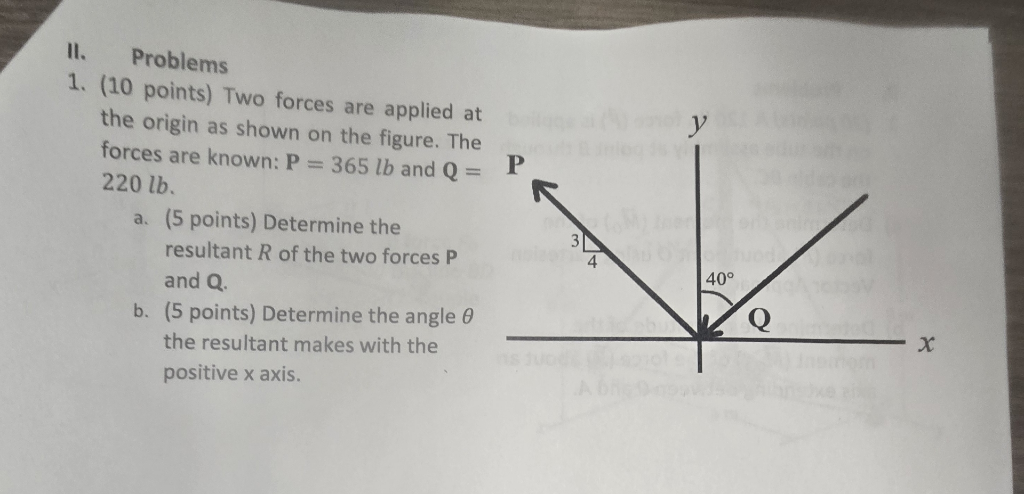 = I. Problems
1 (0 Points) Two forces are applied at y
the origin as shown on the figure. The
forces are known: P=365lbandq= P
220 1b.
a. (S points) Determine the 3
resultant R of the two forces P a 40°
and Q.
b. (5 points) Determine the angle 6 Q x
the resultant makes with the
positive x axis.
This is AI generated Response.
Asked by: Veera manikanta
Created at: 2025-08-22 20:48:43
Asked by: Veera manikanta
Created at: 2025-08-22 20:48:43
Final Answer:
Rendered
Raw Text
Did you like this answer?
Let's solve the problem step by step:
Given:
- \( P = 365 \) lb (force P)
- \( Q = 220 \) lb (force Q)
- Q makes a \( 40^\circ \) angle with the positive x-axis.
- P is in the second quadrant, direction given by a 3-4-5 triangle (i.e., angle with the negative x-axis).
Let's break each force into components.
---
### **Step 1: Resolve Force Q**
Force Q is \( 40^\circ \) above the positive x-axis.
- \( Q_x = Q \cos(40^\circ) \)
- \( Q_y = Q \sin(40^\circ) \)
Plug in values:
\[
Q_x = 220 \cos(40^\circ) = 220 \times 0.7660 = 168.52 \text{ lb}
\]
\[
Q_y = 220 \sin(40^\circ) = 220 \times 0.6428 = 141.42 \text{ lb}
\]
---
### **Step 2: Resolve Force P**
From the triangle on the diagram:
- The direction of P is up and to the left (second quadrant).
- The components are:
- \( x \): negative (to the left)
- \( y \): positive (up)
- From the triangle, for every 3 units left (x), 4 units up (y), the hypotenuse is 5 units.
- So,
- \( \cos(\theta_P) = \frac{-3}{5} \)
- \( \sin(\theta_P) = \frac{4}{5} \)
\[
P_x = P \cos(\theta_P) = 365 \times \left(-\frac{3}{5}\right) = 365 \times -0.6 = -219 \text{ lb}
\]
\[
P_y = P \sin(\theta_P) = 365 \times \frac{4}{5} = 365 \times 0.8 = 292 \text{ lb}
\]
---
### **Step 3: Find the Resultant Components**
Sum the x and y components:
\[
R_x = P_x + Q_x = (-219) + (168.52) = -50.48 \text{ lb}
\]
\[
R_y = P_y + Q_y = 292 + 141.42 = 433.42 \text{ lb}
\]
---
### **Step 4: Find the Magnitude of the Resultant \( R \)**
\[
R = \sqrt{R_x^2 + R_y^2}
\]
\[
R = \sqrt{(-50.48)^2 + (433.42)^2}
\]
\[
R = \sqrt{2548.19 + 187857.51}
\]
\[
R = \sqrt{190405.7}
\]
\[
R \approx 436.4 \text{ lb}
\]
---
### **Step 5: Find the Angle \( \theta \) with the Positive x-axis**
\[
\tan \theta = \frac{R_y}{R_x}
\]
\[
\theta = \tan^{-1} \left(\frac{433.42}{-50.48}\right)
\]
\[
\theta = \tan^{-1}(-8.59)
\]
This gives an angle in the second quadrant (since \( R_x \) is negative, \( R_y \) is positive):
\[
\theta \approx 96.6^\circ
\]
---
## **Final Answers**
### (a) The resultant \( R \) of the two forces is:
\[
\boxed{436.4 \text{ lb}}
\]
### (b) The angle \( \theta \) the resultant makes with the positive x-axis is:
\[
\boxed{96.6^\circ}
\] (measured counterclockwise from the positive x-axis)
Let me know if you want the answers in a different format or need a diagram!
📢 Instructions:
- Ask anything relatd to above question only.
- For new Question goto :