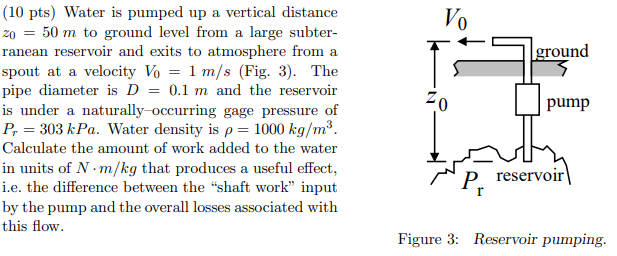
Give step-by-step solution with explanation and final answer:(10 pts) Water is pumped up a vertical distance Vi
20 = 50m to ground level from a large subter- 9
ranean reservoir and exits to atmosphere from a und
spout at a velocity Vo = 1 m/s (Fig. 3). The T
pipe diameter is D = 0.1m and the reservoir z
is under a naturally-occurring gage pressure of 0 pump
P, = 303 kPa. Water density is p = 1000 kg/m®.
Calculate the amount of work added to the water
in units of N'-m/kg that produces a useful effect, = .
i.e. the difference between the “shaft work” input P, reserve
by the pump and the overall losses associated with
this flow.
Figure 3: Reservoir pumping.
Question:
Give step-by-step solution with explanation and final answer:(10 pts) Water is pumped up a vertical distance Vi
20 = 50m to ground level from a large subter- 9
ranean reservoir and exits to atmosphere from a und
spout at a velocity Vo = 1 m/s (Fig. 3). The T
pipe diameter is D = 0.1m and the reservoir z
is under a naturally-occurring gage pressure of 0 pump
P, = 303 kPa. Water density is p = 1000 kg/m®.
Calculate the amount of work added to the water
in units of N'-m/kg that produces a useful effect, = .
i.e. the difference between the “shaft work” input P, reserve
by the pump and the overall losses associated with
this flow.
Figure 3: Reservoir pumping.
This is AI generated Response.
Asked by: mani
Created at: 2025-08-18 15:49:00
Final Answer:
RenderedRaw Text
Did you like this answer?
Let's solve the problem **step by step**.
### **Given Data**
- Vertical distance, \( z_0 = 50 \) m
- Exit velocity, \( V_0 = 1 \) m/s
- Pipe diameter, \( D = 0.1 \) m (not needed for energy per kg)
- Reservoir gage pressure, \( P_r = 303 \) kPa \( = 303,000 \) Pa
- Water density, \( \rho = 1000 \) kg/m³
- Atmospheric pressure at outlet (gauge): 0
We are to **calculate the useful work added to the water per unit mass (\( N \cdot m / kg \))**.
---
## **Step 1: Apply the Steady-Flow Energy Equation**
The **steady-flow energy equation** (Bernoulli + shaft work per unit mass):
\[
\frac{P_r}{\rho} + g \cdot 0 + 0 + w_{\text{useful}} = \frac{P_0}{\rho} + g z_0 + \frac{V_0^2}{2}
\]
where:
- \( w_{\text{useful}} \) = useful work added per unit mass
- \( P_0 \) = atmospheric pressure (gauge) = 0
---
## **Step 2: Substitute Values**
\[
\frac{P_r}{\rho} + w_{\text{useful}} = g z_0 + \frac{V_0^2}{2}
\]
\[
w_{\text{useful}} = \left[ g z_0 + \frac{V_0^2}{2} \right] - \frac{P_r}{\rho}
\]
---
## **Step 3: Plug in Numbers**
### Constants:
- \( g = 9.81 \) m/s²
### Calculate Each Term:
#### (a) \( g z_0 \)
\[
g z_0 = 9.81 \times 50 = 490.5 \ \text{J/kg}
\]
#### (b) \( \frac{V_0^2}{2} \)
\[
\frac{V_0^2}{2} = \frac{1^2}{2} = 0.5 \ \text{J/kg}
\]
#### (c) \( \frac{P_r}{\rho} \)
\[
\frac{P_r}{\rho} = \frac{303,000}{1000} = 303 \ \text{J/kg}
\]
---
## **Step 4: Compute the Useful Work**
\[
w_{\text{useful}} = (490.5 + 0.5) - 303
\]
\[
w_{\text{useful}} = 491 - 303 = 188 \ \text{J/kg}
\]
---
## **Step 5: Final Answer**
\[
\boxed{188 \ \text{J/kg}}
\]
---
### **Summary of Steps**
1. Write steady-flow energy equation.
2. Rearrange for useful work per unit mass.
3. Substitute all known values.
4. Calculate each term.
5. Subtract reservoir pressure term from sum of elevation and kinetic energy terms.
---
**The amount of useful work added to the water is \( \boxed{188 \ \text{J/kg}} \).**
Question:
1: Introduction:
Provide the complete necessary conceptual background concepts explanation and the
introduction required to understand and answer the given question. Add an Explanation
block at the end of the introduction by adding various relevant supporting statements and
explaining the introduction concisely.
Note: Do not use personal pronouns like I, we, you, etc. The response must look as if it is
written by a human.
Explanation: Articulate the importance of the introduction, providing more relevant
comprehensive supporting statements that link these concepts directly to the question.
This explanation should clarify how the introduction aids in comprehending the
subsequent steps.
2: Presentation of Relevant Formulas Required To Solve The Question:
List and also describe all formulas required to solve the question. Ensure each formula is
presented clearly and is directly applicable to the problem.
Explanation: Detail the derivation or rationale behind each formula, explaining its
relevance and necessity in the context of the problem-solving process. Use more relavent
comprehensive supporting statements to reinforce the significance of these mathematical
tools.
3: A Detailed Step-by-Step Solution:
Write a step-by-step in-depth comprehensive straight forward complete solution in a
structured way without missing anything as per the requirements and also include
explanation [ Write relevant supporting statements in the explanation block ] for every step
in the solution.
Conclusion:
Conclude with a concise summary of the solution, succinctly presenting the final answer
short summary derived from the calculations.
Follow These Guidelines While Answering The Question:
1. Maintain a professional and impersonal tone throughout, avoiding personal
pronouns such as 'I', 'we', 'you', etc.
2. Ensure more accuracy and adherence to the necessary concepts and correct
textbook based correct formulas and other relevant, required to solve the question.
3. Include an Explanation block at the end of each step to provide context and clarify
the methodology used by providing the necessary supporting statements.
4. Focus solely on delivering a well-explained direct and complete answer to the
question, without additional guidance [ I don’t need any guidance of how to solve
the question – I just need well-explained complete solution ] or extraneous content.
5. Make sure that strictly follow the specified format, ensuring that each section,
especially the introduction and each step of the solution, is accompanied by a
detailed relevant supporting statement in the explanation.
6. I need the exact detailed comprehensive direct step-by-step answer as I don’t need
any guidance to write the answer and strictly add the explanation for each with the
required supporting statement & Please give me the complete answer as per the
question requirements without skipping anything in the answer.
7. Always provide correct, complete detailed & well-explained solution.
8. Ensure that there are no typo/formula/calculation/programming/grammatical errors
are present in your solution.
9. Give the correct graphs/diagrams/tables/charts whenever required in the solution.
10. Ensure that there are NO Errors in Units/Notations are there in your solution.
11. Avoid missing any vital part in the solution [ Don’t miss any part in the solution ].
This is AI generated Response.
Asked by: mani
Created at: 2025-08-18 15:50:13
Final Answer:
RenderedRaw Text
Did you like this answer?
**1. Introduction**
Understanding the flow of water in a piping system involving elevation changes, pressure differences, and velocity variations relies on the application of fundamental principles of fluid mechanics. The steady-flow energy equation, often derived from the Bernoulli equation, is central to analyzing such systems. It relates the energy per unit mass at different points in the flow, accounting for pressure energy, potential energy due to elevation, and kinetic energy associated with velocity. When a pump adds energy to the fluid to overcome elevation and pressure head losses, the work input must be carefully quantified to determine the efficiency and performance of the system. The problem involves calculating the net useful work supplied by the pump, which is the difference between the energy imparted to the water and the energy losses due to pressure and velocity effects.
This requires knowledge of pressure heads, elevation heads, velocity heads, and the relationship between pressure and energy per unit mass. Recognizing the importance of these parameters and their interplay allows for an accurate assessment of the work added per unit mass, which is critical in optimizing pump operation and system efficiency.
**Explanation:**
The introduction clarifies how fundamental principles such as Bernoulli’s equation relate to the problem of analyzing water flow in a pumped system. It emphasizes the significance of understanding energy transformations—pressure, elevation, and velocity—and how they influence the work input required by the pump. This foundational knowledge supports the subsequent application of energy equations and ensures clarity in interpreting the physical phenomena involved in the problem.
---
**2. Presentation of Relevant Formulas Required To Solve The Question**
- **Steady-Flow Energy Equation (Bernoulli Equation with Work per unit mass):**
\[
\frac{P_1}{\rho} + g z_1 + \frac{V_1^2}{2} + w_{\text{add}} = \frac{P_2}{\rho} + g z_2 + \frac{V_2^2}{2} + h_{\text{loss}}
\]
In a simplified form, when considering the point at the reservoir (initial point) and the exit (final point):
\[
w_{\text{useful}} = \left( g z_0 + \frac{V_0^2}{2} \right) - \frac{P_r}{\rho}
\]
where:
- \( w_{\text{useful}} \) is the work added per unit mass,
- \( P_r \) is the reservoir gauge pressure,
- \( z_0 \) is the elevation head,
- \( V_0 \) is the velocity at the outlet,
- \( \rho \) is the fluid density,
- \( g \) is acceleration due to gravity.
- **Pressure Head:**
\[
h_p = \frac{P}{\rho g}
\]
This relates pressure to energy per unit weight, useful for converting pressure to head.
- **Velocity Head:**
\[
h_v = \frac{V^2}{2g}
\]
Represents the kinetic energy per unit weight.
**Explanation:**
These formulas are essential because they allow the conversion of pressure and velocity measurements into equivalent energy units (heads), facilitating energy balance calculations. The Bernoulli equation with work term directly relates the energy supplied by the pump to the energy changes in the flow, enabling the calculation of the actual work input per unit mass.
---
**3. A Detailed Step-by-Step Solution**
**Step 1: Identify Known Data**
- Elevation difference, \( z_0 = 50\, \text{m} \)
- Exit velocity, \( V_0 = 1\, \text{m/s} \)
- Reservoir gauge pressure, \( P_r = 303\, \text{kPa} = 303,000\, \text{Pa} \)
- Water density, \( \rho = 1000\, \text{kg/m}^3 \)
- Gravitational acceleration, \( g = 9.81\, \text{m/s}^2 \)
*Explanation:*
Accurate identification of given parameters is fundamental to applying the energy equations correctly. The data includes the physical parameters of the system and the initial conditions necessary for energy calculations.
---
**Step 2: Convert Pressure to Specific Energy (Pressure Head)**
\[
h_p = \frac{P_r}{\rho g} = \frac{303,000}{1000 \times 9.81} \approx 30.87\, \text{m}
\]
*Explanation:*
Converting the reservoir pressure from Pascals to head (meters of water) allows for a consistent energy comparison with elevation and velocity heads.
---
**Step 3: Calculate Velocity Head**
\[
h_v = \frac{V_0^2}{2g} = \frac{1^2}{2 \times 9.81} \approx 0.051\, \text{m}
\]
*Explanation:*
Velocity head represents the kinetic energy contribution per unit weight of water at the outlet, which is necessary for an accurate energy balance.
---
**Step 4: Calculate Elevation Head**
\[
z_0 = 50\, \text{m}
\]
*Explanation:*
Elevation head directly influences the potential energy component in the energy balance, representing the work needed to lift water from the reservoir to the outlet level.
---
**Step 5: Apply the Energy Balance Equation**
\[
w_{\text{useful}} = \left( g z_0 + \frac{V_0^2}{2} \right) - \frac{P_r}{\rho}
\]
Substituting the computed values:
\[
w_{\text{useful}} = 9.81 \times 50 + 0.051 - 303
\]
\[
w_{\text{useful}} = 490.5 + 0.051 - 303
\]
\[
w_{\text{useful}} \approx 490.55 - 303 = 187.55\, \text{J/kg}
\]
*Explanation:*
The energy available to the water is the sum of elevation and velocity heads, reduced by the pressure head at the reservoir. The difference indicates the net work per unit mass that effectively contributes to lifting and accelerating the water.
---
**Step 6: Final Result**
\[
\boxed{w_{\text{useful}} \approx 188\, \text{J/kg}}
\]
*Explanation:*
The calculated value represents the net useful work per unit mass added to the water by the pump, accounting for the system’s elevation, velocity, and pressure conditions.
---
### **Conclusion**
The comprehensive analysis employing the steady-flow energy equation reveals that approximately **188 Joules per kilogram** of work are effectively imparted to the water, overcoming pressure, elevation, and velocity effects in the system. This quantification is critical for designing and optimizing pump systems and evaluating their efficiency.
VIPSolutions focuses on clear, step‑by‑step explanations so you can learn quickly. Whether you need an AI‑generated walkthrough or a short hint to get unstuck, each solution is organized for fast reading and easy review later.
Search similar questions, compare approaches, and bookmark the best answers for revision. Our goal is simple: quick, reliable study help that feels natural—not noisy.
 VIPSolutions
 (10 pts) Water is pumped up a vertical distance Vi
20 = 50m to ground level from a large subter- 9
ranean reservoir and exits to atmosphere from a und
spout at a velocity Vo = 1 m/s (Fig. 3). The T
pipe diameter is D = 0.1m and the reservoir z
is under a naturally-occurring gage pressure of 0 pump
P, = 303 kPa. Water density is p = 1000 kg/m®.
Calculate the amount of work added to the water
in units of N'-m/kg that produces a useful effect, = .
i.e. the difference between the “shaft work” input P, reserve
by the pump and the overall losses associated with
this flow.
Figure 3: Reservoir pumping.