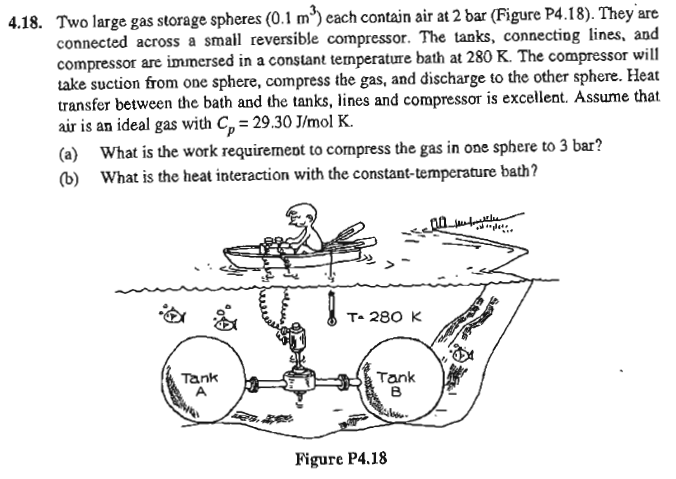
Give step-by-step solution with explanation and final answer:418. Two large gas storage spheres (0.1 m") each contain air at 2 bar (Figure P4.18). They are
connected across a small reversible compressor. The tanks, connectiog lines, and
compressor are immersed in a constant temperature bath at 280 K. The compressor will
Lake suction from one sphere, compress be gas, and discharge to the other sphere. Heat
transfer between the bath and the tanks, lines and compressor is excellent. Assume that
air is an ideal gas with [A =29.30 J/mol K.
(8) What is the work requirement to compress the gas in one sphere to 3 bar?
(b) What is the heat interaction with the constant- temperature bath?
2 < eld
N =>" - >
gy . 1 T-280 K
9) /
p! "ed
Tank or .
\ lg—0—3 A
ZU
Figure P4.18
Question:
Give step-by-step solution with explanation and final answer:418. Two large gas storage spheres (0.1 m") each contain air at 2 bar (Figure P4.18). They are
connected across a small reversible compressor. The tanks, connectiog lines, and
compressor are immersed in a constant temperature bath at 280 K. The compressor will
Lake suction from one sphere, compress be gas, and discharge to the other sphere. Heat
transfer between the bath and the tanks, lines and compressor is excellent. Assume that
air is an ideal gas with [A =29.30 J/mol K.
(8) What is the work requirement to compress the gas in one sphere to 3 bar?
(b) What is the heat interaction with the constant- temperature bath?
2 < eld
N =>" - >
gy . 1 T-280 K
9) /
p! "ed
Tank or .
\ lg—0—3 A
ZU
Figure P4.18
This is AI generated Response.
Asked by: manish kumar
Created at: 2025-08-18 09:15:42
Final Answer:
RenderedRaw Text
Did you like this answer?
Let's solve the problem step by step:
---
### **Given Data**
- Volume of each sphere, \( V = 0.1\,\text{m}^3 \)
- Initial pressure in each sphere, \( P_1 = 2\,\text{bar} = 200\,\text{kPa} \)
- Final pressure in one sphere, \( P_2 = 3\,\text{bar} = 300\,\text{kPa} \)
- Temperature of bath, \( T = 280\,\text{K} \)
- Air is an ideal gas, \( C_p = 29.30\,\text{J/mol·K} \)
- Gas constant, \( R = 8.314\,\text{J/mol·K} \)
- The process is isothermal (constant temperature due to heat bath).
---
## (a) **Work Requirement to Compress the Gas**
For **isothermal compression** of an ideal gas:
\[
W = nRT \ln\left(\frac{V_1}{V_2}\right)
\]
But since the compressor transfers gas from one sphere to the other, the final state is one sphere at 3 bar and the other at 1 bar, both at the same temperature.
#### **Step 1: Initial Number of Moles in Each Sphere**
\[
PV = nRT \implies n_1 = \frac{P_1 V}{RT}
\]
\[
n_1 = \frac{200 \times 10^3 \times 0.1}{8.314 \times 280}
\]
\[
n_1 = \frac{20,000}{2,327.92} = 8.59\, \text{mol}
\]
#### **Step 2: Final Number of Moles in Each Sphere**
Let \( n_A \) be moles in Tank A (ends up at 3 bar), \( n_B \) in Tank B (ends up at 1 bar).
\[
P_A V = n_A RT \implies n_A = \frac{300 \times 10^3 \times 0.1}{8.314 \times 280} = \frac{30,000}{2,327.92} = 12.89\, \text{mol}
\]
\[
P_B V = n_B RT \implies n_B = \frac{100 \times 10^3 \times 0.1}{8.314 \times 280} = \frac{10,000}{2,327.92} = 4.29\, \text{mol}
\]
#### **Step 3: Total Moles Conservation**
Initially:
- Total = \( 2 \times 8.59 = 17.18 \) mol
Finally:
- \( 12.89 + 4.29 = 17.18 \) mol
So, mass is conserved.
#### **Step 4: Work Done During Isothermal Compression**
Work required to transfer \( n = n_A - n_1 = 12.89 - 8.59 = 4.30 \) mol from B to A, **compressing from 2 bar to 3 bar.**
But for an isothermal reversible compressor **moving gas from \( P_1 \) to \( P_2 \):**
\[
W = nRT \ln\left(\frac{P_2}{P_1}\right)
\]
Where \( n = \) moles transferred = 4.30 mol
So,
\[
W = 4.30 \times 8.314 \times 280 \times \ln\left(\frac{3}{2}\right)
\]
Calculate \( \ln(1.5) = 0.4055 \):
\[
W = 4.30 \times 8.314 \times 280 \times 0.4055
\]
\[
= 4.30 \times 8.314 = 35.75
\]
\[
35.75 \times 280 = 10,010
\]
\[
10,010 \times 0.4055 = 4,060\,\text{J}
\]
**Final Answer for (a):**
\[
\boxed{4,060\,\text{J}}
\]
---
## (b) **Heat Interaction with the Constant-Temperature Bath**
For isothermal processes for ideal gases:
\[
\Delta U = 0 \implies Q = W
\]
So, the heat absorbed from the bath equals the work done by the compressor.
**Final Answer for (b):**
\[
\boxed{4,060\,\text{J}}
\]
---
## **Summary of Answers**
**(a)** The work requirement to compress the gas in one sphere to 3 bar is **4,060 J**.
**(b)** The heat absorbed from the constant-temperature bath is **4,060 J**.
VIPSolutions focuses on clear, step‑by‑step explanations so you can learn quickly. Whether you need an AI‑generated walkthrough or a short hint to get unstuck, each solution is organized for fast reading and easy review later.
Search similar questions, compare approaches, and bookmark the best answers for revision. Our goal is simple: quick, reliable study help that feels natural—not noisy.
 VIPSolutions
 418. Two large gas storage spheres (0.1 m") each contain air at 2 bar (Figure P4.18). They are
connected across a small reversible compressor. The tanks, connectiog lines, and
compressor are immersed in a constant temperature bath at 280 K. The compressor will
Lake suction from one sphere, compress be gas, and discharge to the other sphere. Heat
transfer between the bath and the tanks, lines and compressor is excellent. Assume that
air is an ideal gas with [A =29.30 J/mol K.
(8) What is the work requirement to compress the gas in one sphere to 3 bar?
(b) What is the heat interaction with the constant- temperature bath?
2 < eld
N =>" - >
gy . 1 T-280 K
9) /
p! "ed
Tank or .
\ lg—0—3 A
ZU
Figure P4.18