 VIPSolutions
Give step-by-step solution with explanation and final answer:The solid A992 steel shaft has a diameter of 50 mm and is subjected to the distributed loadings shown. (a) Determine the internal torque as a function of x. (b) Determine the angle of twist (in radians) of the shaft as a function of x, i.e., the rotation angle of the section at x with respect to the fixed end A, and plot it versus x. a 500N-m/m 1000 N-m/m x > - "~
Question:
Give step-by-step solution with explanation and final answer: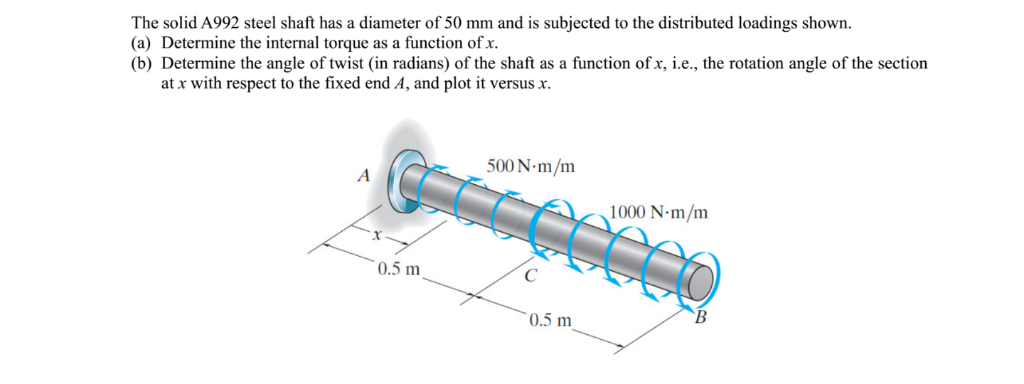 The solid A992 steel shaft has a diameter of 50 mm and is subjected to the distributed loadings shown.
(a) Determine the internal torque as a function of x.
(b) Determine the angle of twist (in radians) of the shaft as a function of x, i.e., the rotation angle of the section
at x with respect to the fixed end A, and plot it versus x.
a 500N-m/m
1000 N-m/m
x >
- "~
This is AI generated Response.
Asked by: manish kumar
Created at: 2025-08-18 08:03:58
Asked by: manish kumar
Created at: 2025-08-18 08:03:58
Final Answer:
Rendered
Raw Text
Did you like this answer?
Let's solve the problem step by step.
---
### **Given Data**
- Diameter of shaft, \( d = 50 \) mm \( = 0.05 \) m
- From \( A \) to \( C \) (0 to 0.5 m): distributed torque \( w_1 = 500 \) N·m/m
- From \( C \) to \( B \) (0.5 to 1.0 m): distributed torque \( w_2 = 1000 \) N·m/m
- Material: A992 steel (but modulus of rigidity \( G \) not given, we'll use \( G \) symbolically)
---
## **(a) Determine the internal torque as a function of \( x \).**
We'll use the **method of sections**. Cut the shaft at location \( x \) from the fixed end \( A \).
### **For \( 0 \leq x < 0.5 \) m ("Region 1")**
- The distributed torque is \( w_1 = 500 \) N·m/m.
- The internal torque at section \( x \): Let \( T(x) \) be the internal torque.
Sum of distributed torque to the left of section at \( x \):
\[
T(x) = w_1 \cdot x = 500x \quad \text{(N·m)}
\]
---
### **For \( 0.5 \leq x \leq 1.0 \) m ("Region 2")**
- For \( x > 0.5 \), left of \( x \) includes two regions:
- From 0 to 0.5 m: \( w_1 = 500 \) N·m/m
- From 0.5 to \( x \): \( w_2 = 1000 \) N·m/m
So,
\[
T(x) = (w_1 \cdot 0.5) + [w_2 \cdot (x - 0.5)] = 500 \cdot 0.5 + 1000(x - 0.5)
\]
\[
T(x) = 250 + 1000x - 500
\]
\[
T(x) = 1000x - 250 \quad \text{(N·m)}
\]
---
### **Summary: Internal Torque Function**
\[
\boxed{
T(x) =
\begin{cases}
500x & 0 \leq x < 0.5 \\
1000x - 250 & 0.5 \leq x \leq 1.0
\end{cases}
}
\]
---
## **(b) Angle of Twist as a Function of \( x \) (\( \theta(x) \))**
The angle of twist for a shaft subject to torque:
\[
\frac{d\theta}{dx} = \frac{T(x)}{GJ}
\]
where \( J \) is the polar moment of inertia for a solid shaft:
\[
J = \frac{\pi}{32} d^4 = \frac{\pi}{32} (0.05)^4 = 6.136 \times 10^{-6} \text{ m}^4
\]
Let \( G \) be the modulus of rigidity (use symbolically).
### **Region 1: \( 0 \leq x < 0.5 \)**
\[
\frac{d\theta}{dx} = \frac{500x}{GJ}
\]
\[
\theta(x) = \int_0^x \frac{500\xi}{GJ} d\xi = \frac{500}{GJ} \int_0^x \xi d\xi = \frac{500}{GJ} \left[ \frac{\xi^2}{2} \right]_0^x = \frac{250x^2}{GJ}
\]
---
### **Region 2: \( 0.5 \leq x \leq 1.0 \)**
We must account for both regions to get the total angle from \( 0 \) to \( x \):
\[
\theta(x) = \theta(0.5) + \int_{0.5}^{x} \frac{1000\xi - 250}{GJ} d\xi
\]
From Region 1:
\[
\theta(0.5) = \frac{250 \cdot (0.5)^2}{GJ} = \frac{250 \cdot 0.25}{GJ} = \frac{62.5}{GJ}
\]
Now,
\[
\int_{0.5}^{x} (1000\xi - 250) d\xi = 1000 \int_{0.5}^{x} \xi d\xi - 250 \int_{0.5}^{x} d\xi
\]
\[
= 1000 \left[ \frac{\xi^2}{2} \right]_{0.5}^{x} - 250[x]_{0.5}^{x}
\]
\[
= 1000 \left( \frac{x^2}{2} - \frac{0.5^2}{2} \right) - 250(x - 0.5)
\]
\[
= 500x^2 - 500 \cdot 0.25 - 250x + 125
\]
\[
= 500x^2 - 125 - 250x + 125
\]
\[
= 500x^2 - 250x
\]
So,
\[
\theta(x) = \frac{62.5}{GJ} + \frac{1}{GJ}(500x^2 - 250x)
\]
\[
= \frac{62.5 + 500x^2 - 250x}{GJ}
\]
---
### **Summary: Angle of Twist Function**
\[
\boxed{
\theta(x) =
\begin{cases}
\displaystyle \frac{250x^2}{GJ} & 0 \leq x < 0.5 \\
\displaystyle \frac{500x^2 - 250x + 62.5}{GJ} & 0.5 \leq x \leq 1.0
\end{cases}
}
\]
Where:
- \( G \) = modulus of rigidity for A992 steel
- \( J = 6.136 \times 10^{-6} \text{ m}^4 \)
---
**If you need a plot or want to substitute a value for \( G \), let me know!**
📢 Instructions:
- Ask anything relatd to above question only.
- For new Question goto :