 VIPSolutions
Give step-by-step solution with explanation and final answer: Two slender bars of length, L, are welded together with an angle of 120º between the bars as shown. The welded object is then pinned at B. Each individual bar has a mass m and a mass moment of inertia of IG. A small glob of putty, D, of mass mD strikes the end C of member ABC with a velocity v0 and the putty sticks to the bar. a) Determine the equations necessary to find: angular velocity of ABC immediately after impact the reactions at B immediately after the impact You may assume the glob is a point mass. b) Assuming that v0 = 1.5 m/s, m = 0.7 kg, L = 0.4 m, and mD = 0.5 kg determine numerical answers to part a).B L Vo A eee A C
Question:
Give step-by-step solution with explanation and final answer:
Two slender bars of length, L, are welded together with an angle of 120º between the bars as shown. The welded object is then pinned at B. Each individual bar has a mass m and a mass moment of inertia of IG. A small glob of putty, D, of mass mD strikes the end C of member ABC with a velocity v0 and the putty sticks to the bar. a) Determine the equations necessary to find: angular velocity of ABC immediately after impact the reactions at B immediately after the impact You may assume the glob is a point mass. b) Assuming that v0 = 1.5 m/s, m = 0.7 kg, L = 0.4 m, and mD = 0.5 kg determine numerical answers to part a).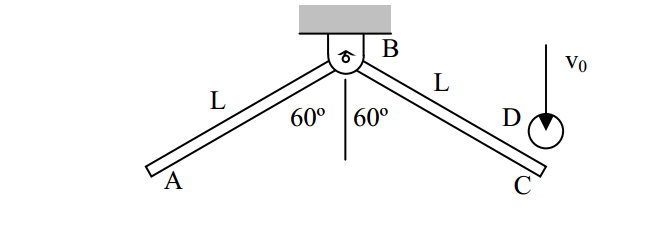 B L Vo
A eee
A C
This is AI generated Response.
Asked by: manish kumar
Created at: 2025-08-18 07:59:14
Asked by: manish kumar
Created at: 2025-08-18 07:59:14
Final Answer:
Rendered
Raw Text
Did you like this answer?
Let’s break this problem into clear steps:
---
## **Part (a): Required Equations**
### **Step 1: Conservation of Angular Momentum (about B, just before and after impact)**
Since the system is pinned at B and the impact is instantaneous, **external impulses about B are zero**. Use conservation of angular momentum about point B:
\[
\sum H_B^{\text{before}} = \sum H_B^{\text{after}}
\]
#### **Angular Momentum Before Impact**
- Bar assembly is at rest, so its angular momentum = 0.
- Only the putty (D) has angular momentum about B:
- Distance BC = L
- Perpendicular distance from B to line of v₀ at C = L (since C is vertically below B).
- \( H_B^{\text{before}} = m_D \cdot v_0 \cdot L \)
#### **Angular Momentum After Impact**
- Now the putty and the assembly rotate together at angular velocity ω:
- Total moment of inertia about B:
- For each bar (slender rod, mass m, length L, **about one end**): \( I_{\text{bar, B}} = \frac{1}{3}mL^2 \)
- 2 bars: \( 2 \times \frac{1}{3}mL^2 = \frac{2}{3}mL^2 \)
- Putty (point mass at distance L): \( I_{\text{putty}} = m_D L^2 \)
- **Total:** \( I_{\text{total}} = \frac{2}{3}mL^2 + m_D L^2 \)
- Total angular momentum after: \( H_B^{\text{after}} = I_{\text{total}} \cdot \omega \)
#### **Set up the equation:**
\[
m_D v_0 L = \left( \frac{2}{3} m L^2 + m_D L^2 \right) \omega
\]
\[
\boxed{
\omega = \frac{m_D v_0}{\frac{2}{3}mL + m_D L}
}
\]
---
### **Step 2: Reactions at B Immediately After Impact**
Immediately after impact, the **impulsive reaction at B** can be found by considering the change in linear momentum of the system:
- The system's center of mass will have some velocity right after the impact.
- The total impulsive force at B (\( \vec{J}_B \)) must account for the change in linear momentum of the bars+putty.
#### **Linear Impulse-Momentum (in x and y)**
\[
\sum \vec{J}_B + \sum \vec{J}_{\text{ext}} = \Delta \vec{P}_{\text{system}}
\]
But only B applies an impulse, and only the putty has initial momentum.
- Initial linear momentum: Only putty, downward: \( m_D v_0 \) (y-direction)
- Final linear momentum: System (bars+putty) moves with velocity of center of mass (\( \vec{V}_{\text{cm}} \))
\[
\vec{J}_B = m_{\text{total}} \vec{V}_{\text{cm}} - m_D v_0 \, \hat{j}
\]
Where \( m_{\text{total}} = 2m + m_D \).
#### **Velocity of Center of Mass (\( \vec{V}_{\text{cm}} \))**
- After impact, the system rotates with angular velocity ω about B.
- Find the center of mass location and its velocity (\( \vec{V}_{\text{cm}} = \vec{\omega} \times \vec{r}_{\text{cm}} \)).
##### **Location of Center of Mass (relative to B):**
Let’s take the coordinate system with B at (0,0), y downward, x right.
- Bar BA: at 60° left of vertical (i.e., angle θ = +60° from vertical, or 120° from x-axis).
- Bar BC: at 60° right of vertical (θ = -60° from vertical).
- Center of each bar is at distance L/2 from B.
Bar BA center:
\[
x_1 = -\frac{L}{2} \sin(60^\circ) = -\frac{L}{2} \cdot \frac{\sqrt{3}}{2} = -\frac{\sqrt{3}}{4}L
\]
\[
y_1 = \frac{L}{2} \cos(60^\circ) = \frac{L}{2} \cdot \frac{1}{2} = \frac{L}{4}
\]
Bar BC center:
\[
x_2 = +\frac{L}{2} \sin(60^\circ) = +\frac{\sqrt{3}}{4}L
\]
\[
y_2 = \frac{L}{4}
\]
Putty at C:
\[
x_3 = L \sin(60^\circ) = \frac{\sqrt{3}}{2}L
\]
\[
y_3 = L \cos(60^\circ) = \frac{1}{2}L
\]
Total mass: \( M = 2m + m_D \)
So,
\[
x_{\text{cm}} = \frac{m x_1 + m x_2 + m_D x_3}{2m + m_D}
\]
\[
y_{\text{cm}} = \frac{m y_1 + m y_2 + m_D y_3}{2m + m_D}
\]
Plug in values:
\[
x_{\text{cm}} = \frac{m(-\frac{\sqrt{3}}{4}L) + m(\frac{\sqrt{3}}{4}L) + m_D(\frac{\sqrt{3}}{2}L)}{2m + m_D} = \frac{0 + m_D \frac{\sqrt{3}}{2}L}{2m + m_D} = \frac{m_D \frac{\sqrt{3}}{2}L}{2m + m_D}
\]
\[
y_{\text{cm}} = \frac{m(\frac{L}{4}) + m(\frac{L}{4}) + m_D(\frac{L}{2})}{2m + m_D} = \frac{2m \frac{L}{4} + m_D \frac{L}{2}}{2m + m_D} = \frac{\frac{mL}{2} + \frac{m_D L}{2}}{2m + m_D} = \frac{(m + m_D)\frac{L}{2}}{2m + m_D}
\]
##### **Velocity of Center of Mass:**
Right after impact, only rotation about B:
\[
\vec{V}_{\text{cm}} = \omega \hat{k} \times \vec{r}_{\text{cm}}
\]
So,
\[
V_{\text{cm}, x} = -\omega y_{\text{cm}}
\]
\[
V_{\text{cm}, y} = \omega x_{\text{cm}}
\]
---
## **Part (b): Numerical Solutions**
Given:
\[
v_0 = 1.5\, \text{m/s}, \quad m = 0.7\, \text{kg}, \quad L = 0.4\, \text{m}, \quad m_D = 0.5\, \text{kg}
\]
### **Step 1: Angular Velocity**
\[
\omega = \frac{m_D v_0}{\frac{2}{3}mL + m_D L}
\]
First, calculate denominator:
\[
\frac{2}{3} m L = \frac{2}{3} \cdot 0.7 \cdot 0.4 = \frac{2 \cdot 0.7 \cdot 0.4}{3} = \frac{0.56}{3} = 0.1867
\]
\[
m_D L = 0.5 \cdot 0.4 = 0.2
\]
\[
\frac{2}{3} m L + m_D L = 0.1867 + 0.2 = 0.3867
\]
So,
\[
\omega = \frac{0.5 \cdot 1.5}{0.3867} = \frac{0.75}{0.3867} \approx 1.94\, \text{rad/s}
\]
---
### **Step 2: Center of Mass Position**
\[
x_{\text{cm}} = \frac{m_D \cdot \frac{\sqrt{3}}{2}L}{2m + m_D} = \frac{0.5 \cdot 0.866 \cdot 0.4}{2 \cdot 0.7 + 0.5} = \frac{0.5 \cdot 0.3464}{1.9} = \frac{0.1732}{1.9} \approx 0.0912\, \text{m}
\]
\[
y_{\text{cm}} = \frac{(m + m_D)\frac{L}{2}}{2m + m_D} = \frac{(0.7 + 0.5)\cdot 0.2}{1.9} = \frac{1.2 \cdot 0.2}{1.9} = \frac{0.24}{1.9} \approx 0.1263\, \text{m}
\]
---
### **Step 3: Center of Mass Velocity**
\[
V_{\text{cm}, x} = -\omega y_{\text{cm}} = -1.94 \cdot 0.1263 \approx -0.245\, \text{m/s}
\]
\[
V_{\text{cm}, y} = \omega x_{\text{cm}} = 1.94 \cdot 0.0912 \approx 0.177\, \text{m/s}
\]
---
### **Step 4: Impulsive Reaction at B**
\[
\vec{J}_B = M \vec{V}_{\text{cm}} - m_D v_0 \hat{j}
\]
where \( M = 2m + m_D = 1.9\, \text{kg} \)
\[
J_{Bx} = M V_{\text{cm}, x} = 1.9 \cdot (-0.245) = -0.465\, \text{kg m/s}
\]
\[
J_{By} = M V_{\text{cm}, y} - m_D v_0 = 1.9 \cdot 0.177 - 0.5 \cdot 1.5 = 0.336 - 0.75 = -0.414\, \text{kg m/s}
\]
---
## **Final Answers**
### **(a) Equations:**
- **Angular velocity:**
\[
\boxed{
\omega = \frac{m_D v_0}{\frac{2}{3}mL + m_D L}
}
\]
- **Reactions at B (impulsive):**
\[
\boxed{
\begin{aligned}
J_{Bx} &= (2m + m_D) V_{\text{cm},x} \\
J_{By} &= (2m + m_D) V_{\text{cm},y} - m_D v_0
\end{aligned}
}
\]
where
\[
\begin{aligned}
x_{\text{cm}} &= \frac{m_D \frac{\sqrt{3}}{2}L}{2m + m_D} \\
y_{\text{cm}} &= \frac{(m+m_D)\frac{L}{2}}{2m + m_D} \\
V_{\text{cm}, x} &= -\omega y_{\text{cm}} \\
V_{\text{cm}, y} &= \omega x_{\text{cm}}
\end{aligned}
\]
### **(b) Numerical Answers:**
- **Angular velocity right after impact:**
\[
\boxed{
\omega \approx 1.94\ \text{rad/s}
}
\]
- **Impulsive reactions at B:**
\[
\boxed{
\begin{aligned}
J_{Bx} &\approx -0.465\ \text{kg}\cdot\text{m/s}\\
J_{By} &\approx -0.414\ \text{kg}\cdot\text{m/s}
\end{aligned}
}
\]
---
If you need further clarification or step-by-step calculations for the center of mass or the moment of inertia, let me know!
📢 Instructions:
- Ask anything relatd to above question only.
- For new Question goto :