 VIPSolutions
Give step-by-step solution with explanation and final answer:1 ‘Amovie monopolist sels to college students and ther auf. The demand function fo students s Qf = 1,700 — 1007, 5 pos and the mand funcron for omer dus 5 Q4 = 2,000 100P. L] se Com = ©(@) = 1Q + 0.005Q™ por ticket, where @= Qs- Qa. 3) sume: Instructions: Round your ansiers to 2 decimal places a Winat price wi he monopolst st when she can dcrmingte? Puce S[ perce Pour=S[Jpertciet Po-S] b.Wnatif demand for acl ncresses to 4 = 2200 10087 Puce S[ perce Pour=S[Jpertciet eroft=S——] When act demand ncrescs, the acl price: © does not change. O creases © decreases. When adult demand increases, the student price © decreases. © goss nox change. O ncreases
Question:
Give step-by-step solution with explanation and final answer: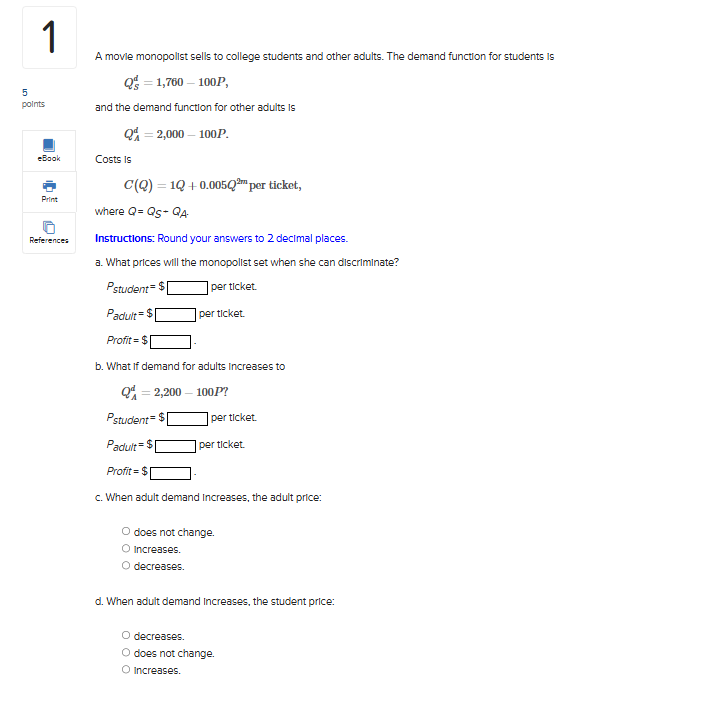 1 ‘Amovie monopolist sels to college students and ther auf. The demand function fo students s
Qf = 1,700 — 1007,
5
pos and the mand funcron for omer dus 5
Q4 = 2,000 100P.
L]
se Com
= ©(@) = 1Q + 0.005Q™ por ticket,
where @= Qs- Qa.
3)
sume: Instructions: Round your ansiers to 2 decimal places
a Winat price wi he monopolst st when she can dcrmingte?
Puce S[ perce
Pour=S[Jpertciet
Po-S]
b.Wnatif demand for acl ncresses to
4 = 2200 10087
Puce S[ perce
Pour=S[Jpertciet
eroft=S——]
When act demand ncrescs, the acl price:
© does not change.
O creases
© decreases.
When adult demand increases, the student price
© decreases.
© goss nox change.
O ncreases
This is AI generated Response.
Asked by: ravi
Created at: 2025-08-18 05:55:15
Asked by: ravi
Created at: 2025-08-18 05:55:15
Final Answer:
Rendered
Raw Text
Did you like this answer?
Let's solve the problem step by step.
---
### **Given:**
**Student demand:**
\[ Q^S = 1,760 - 100P \]
**Adult demand:**
\[ Q^A = 2,000 - 100P \]
**Cost:**
\[ C(Q) = 1Q + 0.005Q^2 \]
where \( Q = Q^S + Q^A \)
---
## **a. Prices and Profit with Price Discrimination**
### **Step 1: Find MR for Each Group**
#### **For Students:**
Inverse demand:
\[ Q^S = 1,760 - 100P \implies P = 17.6 - 0.01Q^S \]
Revenue:
\[ R^S = P \cdot Q^S = (17.6 - 0.01Q^S)Q^S = 17.6Q^S - 0.01(Q^S)^2 \]
Marginal Revenue:
\[ MR^S = \frac{dR^S}{dQ^S} = 17.6 - 0.02Q^S \]
#### **For Adults:**
Inverse demand:
\[ Q^A = 2,000 - 100P \implies P = 20 - 0.01Q^A \]
Revenue:
\[ R^A = (20 - 0.01Q^A)Q^A = 20Q^A - 0.01(Q^A)^2 \]
Marginal Revenue:
\[ MR^A = 20 - 0.02Q^A \]
---
### **Step 2: Marginal Cost**
Total Output: \( Q = Q^S + Q^A \)
Cost: \( C(Q) = 1Q + 0.005Q^2 \)
Marginal Cost:
\[ MC = \frac{dC}{dQ} = 1 + 0.01Q \]
---
### **Step 3: Equate MR to MC for Each Group**
#### **Students:**
\[
MR^S = MC \implies 17.6 - 0.02Q^S = 1 + 0.01(Q^S + Q^A)
\]
#### **Adults:**
\[
MR^A = MC \implies 20 - 0.02Q^A = 1 + 0.01(Q^S + Q^A)
\]
---
### **Step 4: Solve the System**
Let \( x = Q^S \), \( y = Q^A \), \( Q = x + y \):
**Students:**
\[
17.6 - 0.02x = 1 + 0.01(x + y) \implies 17.6 - 1 = 0.02x + 0.01x + 0.01y \implies 16.6 = 0.03x + 0.01y
\]
**Adults:**
\[
20 - 0.02y = 1 + 0.01(x + y) \implies 19 = 0.01x + 0.03y
\]
Now solve:
\[
\begin{cases}
16.6 = 0.03x + 0.01y \\
19 = 0.01x + 0.03y \\
\end{cases}
\]
Multiply first by 3: \( 49.8 = 0.09x + 0.03y \)
Subtract the second:
\[
49.8 - 19 = 0.09x + 0.03y - (0.01x + 0.03y) \implies 30.8 = 0.08x \implies x = \frac{30.8}{0.08} = 385
\]
Plug \( x = 385 \) into the second:
\[
19 = 0.01(385) + 0.03y \implies 19 = 3.85 + 0.03y \implies 15.15 = 0.03y \implies y = \frac{15.15}{0.03} = 505
\]
---
### **Step 5: Find Prices**
- **Student Price:**
\( Q^S = 385 \)
\( P^S = 17.6 - 0.01(385) = 17.6 - 3.85 = \boxed{13.75} \)
- **Adult Price:**
\( Q^A = 505 \)
\( P^A = 20 - 0.01(505) = 20 - 5.05 = \boxed{14.95} \)
---
### **Step 6: Profit**
Total output \( Q = 385 + 505 = 890 \)
- **Total Revenue:**
\( TR = P^S \times Q^S + P^A \times Q^A \)
\( = 13.75 \times 385 + 14.95 \times 505 \)
\( = 5293.75 + 7549.75 = 12843.50 \)
- **Total Cost:**
\( C(Q) = 1Q + 0.005Q^2 = 1 \times 890 + 0.005 \times 890^2 \)
\( = 890 + 0.005 \times 792100 \)
\( = 890 + 3960.5 = 4850.50 \)
- **Profit:**
\( \text{Profit} = 12843.50 - 4850.50 = \boxed{7993.00} \)
---
## **b. If Adult demand increases to \( Q^A = 2,200 - 100P \):**
Repeat Steps 1–6 with new adult demand.
**Inverse demand:**
\( Q^A = 2,200 - 100P \implies P = 22 - 0.01Q^A \)
\( R^A = 22Q^A - 0.01(Q^A)^2 \)
\( MR^A = 22 - 0.02Q^A \)
Set up the new system:
- For students: \( 17.6 - 0.02x = 1 + 0.01(x + y) \implies 16.6 = 0.03x + 0.01y \)
- For adults: \( 22 - 0.02y = 1 + 0.01(x + y) \implies 21 = 0.01x + 0.03y \)
Multiply first by 3: \( 49.8 = 0.09x + 0.03y \)
Subtract the second:
\[
49.8 - 21 = (0.09x + 0.03y) - (0.01x + 0.03y)
\]
\[
28.8 = 0.08x \implies x = \frac{28.8}{0.08} = 360
\]
Plug \( x = 360 \) into second:
\[
21 = 0.01(360) + 0.03y \implies 21 = 3.6 + 0.03y \implies 17.4 = 0.03y \implies y = \frac{17.4}{0.03} = 580
\]
Now, calculate prices:
- Student: \( P^S = 17.6 - 0.01(360) = 17.6 - 3.60 = \boxed{14.00} \)
- Adult: \( P^A = 22 - 0.01(580) = 22 - 5.80 = \boxed{16.20} \)
Calculate profit:
- \( Q = 360 + 580 = 940 \)
- \( TR = 14.00 \times 360 + 16.20 \times 580 = 5040 + 9396 = 14436 \)
- \( TC = 1 \times 940 + 0.005 \times 940^2 = 940 + 0.005 \times 883600 = 940 + 4418 = 5358 \)
- \( \text{Profit} = 14436 - 5358 = \boxed{9078} \)
---
## **c. When adult demand increases, the adult price:**
**Increases** (from $14.95 to $16.20).
---
## **d. When adult demand increases, the student price:**
**Increases** (from $13.75 to $14.00).
---
## **Final Answers (rounded to 2 decimal places):**
### a.
- \( P_{student} = \$13.75 \)
- \( P_{adult} = \$14.95 \)
- Profit = \$7,993.00
### b.
- \( P_{student} = \$14.00 \)
- \( P_{adult} = \$16.20 \)
- Profit = \$9,078.00
### c.
- **Adult price** increases.
### d.
- **Student price** increases.
---
**Let me know if you need the boxed values filled in or further explanation!**
📢 Instructions:
- Ask anything relatd to above question only.
- For new Question goto :