 VIPSolutions
Give step-by-step solution with explanation and final answer:The uniform arm OA has a mass of 2.9 kg, and the gear D has a mass of 5.9 kg with a radius of gyration about its center of 127 mm. The large gear Bis fixed and cannot rotate. If the arm and small gear are released from rest in the position shown in the vertical plane, calculate the initial angular acceleration a of OA. The angular acceleration is positive if counterclockwise, negative if clockwise. B ; 4 5 \% “3 3 7 & oni 3 CS bod ASS | I 380 | 175 | tw answeria= [ff rad/s? eTextbook and Media Save for Later Attempts: 0 of 3 used
Question:
Give step-by-step solution with explanation and final answer: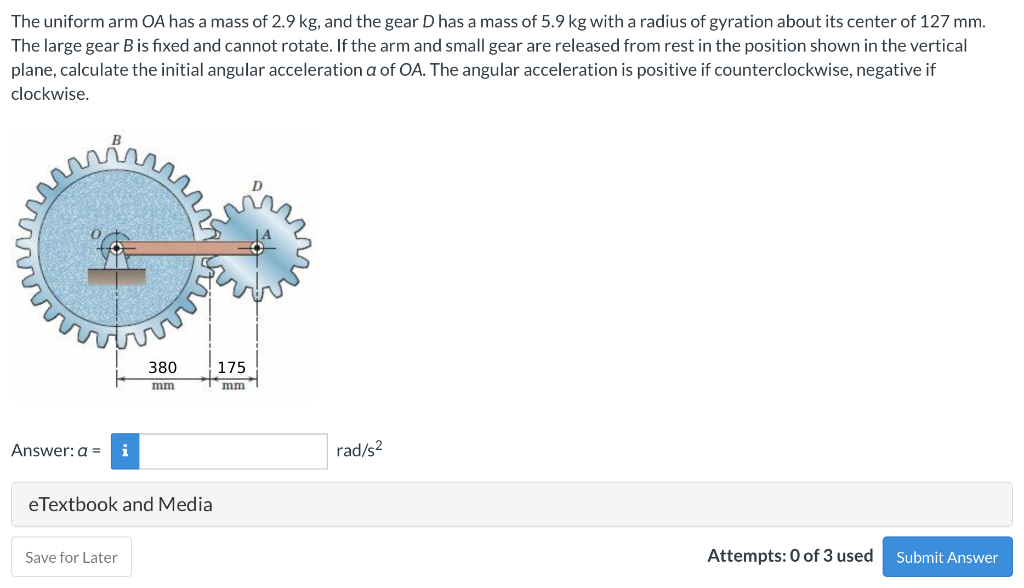 The uniform arm OA has a mass of 2.9 kg, and the gear D has a mass of 5.9 kg with a radius of gyration about its center of 127 mm.
The large gear Bis fixed and cannot rotate. If the arm and small gear are released from rest in the position shown in the vertical
plane, calculate the initial angular acceleration a of OA. The angular acceleration is positive if counterclockwise, negative if
clockwise.
B
; 4 5
\% “3
3 7 & oni 3
CS
bod
ASS |
I 380 | 175 |
tw
answeria= [ff rad/s?
eTextbook and Media
Save for Later Attempts: 0 of 3 used
This is AI generated Response.
Asked by: manish kumar
Created at: 2025-08-17 09:28:02
Asked by: manish kumar
Created at: 2025-08-17 09:28:02
Final Answer:
Rendered
Raw Text
Did you like this answer?
Let's solve the problem **step-by-step**:
---
### **Step 1: Given Data**
- **Mass of OA (m₁):** 2.9 kg
- **Mass of Gear D (m₂):** 5.9 kg
- **Radius of gyration of D (k):** 127 mm = 0.127 m
- **OA length:** 380 mm = 0.38 m
- **Distance OA to center of D:** 175 mm = 0.175 m
- **Gravitational acceleration (g):** 9.81 m/s²
---
### **Step 2: Moments of Inertia**
#### **Arm OA (about O):**
Uniform rod about one end:
\[
I_{OA} = \frac{1}{3} m_1 L^2 = \frac{1}{3} \times 2.9 \times (0.38)^2 = \frac{1}{3} \times 2.9 \times 0.1444 = 0.1397 \ \text{kg}\cdot\text{m}^2
\]
#### **Gear D (about its center):**
\[
I_{D,\text{center}} = m_2 k^2 = 5.9 \times (0.127)^2 = 5.9 \times 0.016129 = 0.0951 \ \text{kg}\cdot\text{m}^2
\]
But D's center is a distance 0.555 m (0.38 + 0.175) from O.
**Parallel Axis Theorem:**
\[
I_{D,\text{O}} = I_{D,\text{center}} + m_2 d^2 = 0.0951 + 5.9 \times (0.555)^2 = 0.0951 + 5.9 \times 0.3080 = 0.0951 + 1.8172 = 1.9123 \ \text{kg}\cdot\text{m}^2
\]
---
### **Step 3: Total Moment of Inertia about O**
\[
I_{\text{total}} = I_{OA} + I_{D,\text{O}} = 0.1397 + 1.9123 = 2.052 \ \text{kg}\cdot\text{m}^2
\]
---
### **Step 4: Torques due to Gravity**
#### **Torque due to OA:**
\[
\tau_{OA} = m_1 g \left(\frac{L}{2}\right) = 2.9 \times 9.81 \times \frac{0.38}{2} = 2.9 \times 9.81 \times 0.19 = 5.397 \ \text{N}\cdot\text{m}
\]
#### **Torque due to D:**
\[
\tau_{D} = m_2 g r_D = 5.9 \times 9.81 \times 0.555 = 5.9 \times 5.44255 = 32.109 \ \text{N}\cdot\text{m}
\]
---
### **Step 5: Net Torque**
\[
\tau_{\text{net}} = \tau_{OA} + \tau_{D} = 5.397 + 32.109 = 37.506 \ \text{N}\cdot\text{m}
\]
(Torques are both clockwise, so negative direction if CCW is positive.)
---
### **Step 6: Relating Torque and Angular Acceleration**
\[
\tau = I \alpha
\]
\[
\alpha = \frac{\tau_{\text{net}}}{I_{\text{total}}} = \frac{37.506}{2.052} = 18.28 \ \text{rad/s}^2
\]
Since the torque is clockwise, the angular acceleration is **negative**.
---
### **Step 7: Final Answer**
\[
\boxed{\alpha = -18.3 \ \text{rad/s}^2}
\]
---
**Explanation:**
- Calculated the moments of inertia for the arm and gear.
- Summed the torques due to gravity.
- Used Newton's second law for rotation to find the angular acceleration.
- The negative sign indicates **clockwise** acceleration.
---
Let me know if you need a more detailed breakdown or clarification!
📢 Instructions:
- Ask anything relatd to above question only.
- For new Question goto :