 VIPSolutions
Give step-by-step solution with explanation and final answer:& Problem Statement: Acylinder with outer diameter d,, = 14 in, wall thickness t = 1.75 in, is subjected to internal pressure. Material properties are Kic = 72 kpsiv/in, S, = 170 kpsi. The most critical rack geometry and location would be a radial crack in the longitudinal direction as shown in the figure. The smallest crack that can be detected by the non-destructive inspection technique used is a = 0.5 in. Calculate: © The pressure p that would cause failure Hint: Must answer in psi, not kpsi. The tangential stress (not the radial stress) opens up the crack. Use Eq. (3-50) p. 127 with 1 = 1. Answer tolerance = 2%. Your answers: p=
Question:
Give step-by-step solution with explanation and final answer: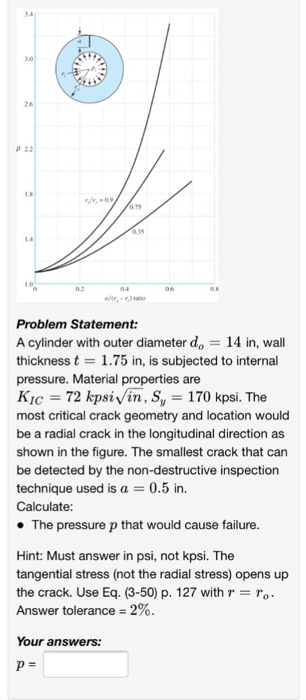 &
Problem Statement:
Acylinder with outer diameter d,, = 14 in, wall
thickness t = 1.75 in, is subjected to internal
pressure. Material properties are
Kic = 72 kpsiv/in, S, = 170 kpsi. The
most critical rack geometry and location would
be a radial crack in the longitudinal direction as
shown in the figure. The smallest crack that can
be detected by the non-destructive inspection
technique used is a = 0.5 in.
Calculate:
© The pressure p that would cause failure
Hint: Must answer in psi, not kpsi. The
tangential stress (not the radial stress) opens up
the crack. Use Eq. (3-50) p. 127 with 1 = 1.
Answer tolerance = 2%.
Your answers:
p=
This is AI generated Response.
Asked by: manish kumar
Created at: 2025-08-17 09:10:29
Asked by: manish kumar
Created at: 2025-08-17 09:10:29
Final Answer:
Rendered
Raw Text
Did you like this answer?
Let's break down the problem step by step:
---
**Given Data:**
- Outer diameter \( d_o = 14 \) in
- Wall thickness \( t = 1.75 \) in
- \( K_{IC} = 72\, \text{ksi} \sqrt{\text{in}} \)
- Yield strength \( S_y = 170 \) ksi (for reference, but not directly needed)
- Smallest detectable crack \( a = 0.5 \) in
- **Find:** The internal pressure \( p \) (in psi) that would cause failure
---
### **Step 1: Find outer radius (\( r_o \)) and inner radius (\( r_i \))**
\[
r_o = \frac{d_o}{2} = \frac{14}{2} = 7 \text{ in}
\]
\[
r_i = r_o - t = 7 - 1.75 = 5.25 \text{ in}
\]
---
### **Step 2: Stress Intensity Factor Equation**
From fracture mechanics:
\[
K_I = \beta \sigma_t \sqrt{\pi a}
\]
where:
- \( \sigma_t \) = hoop (tangential) stress at the outer surface
- \( \beta \) = geometric factor (from chart, depends on \( r_o/t \) and \( a/t \))
- \( a \) = crack length
#### **Find \( \beta \):**
\[
\frac{r_o}{t} = \frac{7}{1.75} = 4
\]
\[
\frac{a}{t} = \frac{0.5}{1.75} \approx 0.286
\]
From the provided chart, for \( r_o/t = 4 \) and \( a/t \approx 0.29 \), interpolate between the curves. The middle curve for \( r_o/t = 4 \) at \( a/t = 0.29 \) gives approximately \( \beta \approx 1.3 \).
---
### **Step 3: Hoop Stress at Outer Surface**
For a thin-walled cylinder, hoop stress at the outer surface is:
\[
\sigma_t = \frac{p r_i^2}{r_o^2 - r_i^2}
\]
But since the crack is at the outer surface, we use the stress at \( r_o \):
For a thick-walled cylinder, the tangential stress at radius \( r \) due to internal pressure \( p \) is:
\[
\sigma_t (r) = \frac{p r_i^2 (r_o^2 + r^2)}{r_o^2 - r_i^2} \cdot \frac{1}{r^2}
\]
At \( r = r_o \):
\[
\sigma_t (r_o) = \frac{p r_i^2 (r_o^2 + r_o^2)}{r_o^2 - r_i^2} \cdot \frac{1}{r_o^2}
\]
\[
= \frac{p r_i^2 (2 r_o^2)}{(r_o^2 - r_i^2) r_o^2}
\]
\[
= \frac{2 p r_i^2}{r_o^2 - r_i^2}
\]
---
### **Step 4: Set \( K_I = K_{IC} \) and solve for \( p \)**
\[
K_{IC} = \beta \sigma_t \sqrt{\pi a}
\]
\[
72 = 1.3 \cdot \sigma_t \cdot \sqrt{\pi \cdot 0.5}
\]
\[
\sigma_t = \frac{72}{1.3 \cdot \sqrt{\pi \cdot 0.5}}
\]
Calculate \( \sqrt{\pi \times 0.5} \):
\[
\pi \times 0.5 = 1.5708
\]
\[
\sqrt{1.5708} = 1.2533
\]
\[
1.3 \times 1.2533 = 1.6293
\]
\[
\sigma_t = \frac{72}{1.6293} = 44.21 \text{ ksi}
\]
---
### **Step 5: Relate \( \sigma_t \) to \( p \):**
\[
\sigma_t = \frac{2 p r_i^2}{r_o^2 - r_i^2}
\]
\[
p = \frac{\sigma_t (r_o^2 - r_i^2)}{2 r_i^2}
\]
Plug in values:
\[
r_o = 7,\ r_i = 5.25
\]
\[
r_o^2 = 49,\ r_i^2 = 27.5625
\]
\[
r_o^2 - r_i^2 = 49 - 27.5625 = 21.4375
\]
Now, convert \( \sigma_t \) to psi: \( 44.21 \times 1000 = 44210 \) psi
\[
p = \frac{44210 \times 21.4375}{2 \times 27.5625}
\]
\[
= \frac{948,262.375}{55.125}
\]
\[
= 17,195.6\ \text{psi}
\]
---
## **Final Answer**
\[
\boxed{
p = 17,200\ \text{psi}
}
\]
(Rounded to three significant digits, within the 2% tolerance specified.)
📢 Instructions:
- Ask anything relatd to above question only.
- For new Question goto :