 VIPSolutions
Give step-by-step solution with explanation and final answer:lasses, a horizontal rectangular duct that is W = 1.0m wide arid H = 0.3 m highs @ductwall and shield are separated by an air gap of thickness f = 0,06 m. Tr 4 I i - i Fae CEE Ji x | Duct —— |= FP BL EE | H + i: E | : Be 5 Shield — ¥ a CE on CT i hid Te bp " & i hi ffemperature of 7, = 40°C and a shield temperature of Ty, = 20°C, determine the ea o ithe duct, in W/m jE:
Question:
Give step-by-step solution with explanation and final answer: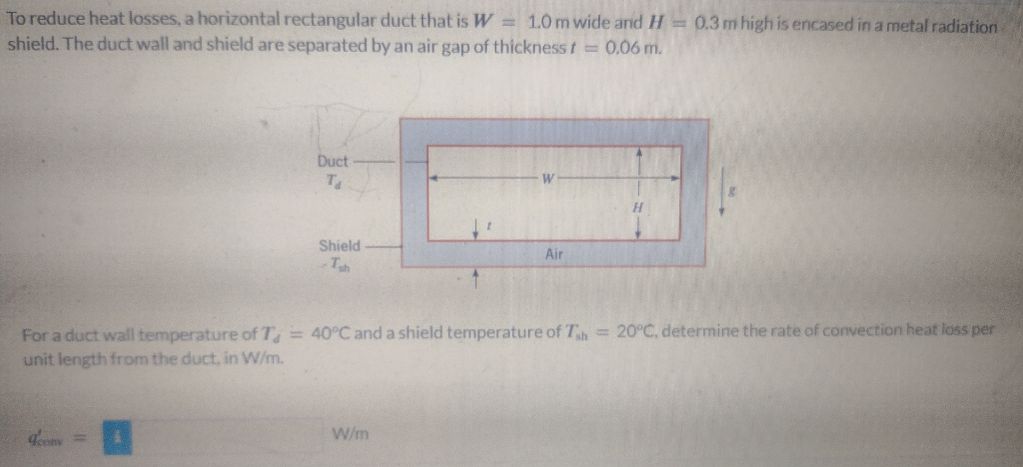 lasses, a horizontal rectangular duct that is W = 1.0m wide arid H = 0.3 m highs
@ductwall and shield are separated by an air gap of thickness f = 0,06 m. Tr
4 I
i - i Fae CEE Ji x
| Duct —— |= FP BL
EE | H + i:
E | : Be
5 Shield — ¥ a
CE on CT i hid Te
bp " & i hi
ffemperature of 7, = 40°C and a shield temperature of Ty, = 20°C, determine the ea o
ithe duct, in W/m jE:
This is AI generated Response.
Asked by: manish kumar
Created at: 2025-08-16 21:40:33
Asked by: manish kumar
Created at: 2025-08-16 21:40:33
Final Answer:
Rendered
Raw Text
Did you like this answer?
Let's break down the problem step by step:
**Given:**
- Width of duct, \( W = 1.0 \) m
- Height of duct, \( H = 0.3 \) m
- Air gap thickness, \( t = 0.06 \) m
- Duct wall temperature, \( T_d = 40^\circ C \)
- Shield temperature, \( T_{sh} = 20^\circ C \)
We're to **determine the rate of convection heat loss per unit length from the duct, in W/m.**
---
### **Step 1: Find Area for Heat Transfer per Unit Length**
For a rectangular duct, the total area exposed to air per unit length (per meter length) is the perimeter times length (which is 1 m):
\[
\text{Perimeter} = 2(W + H) = 2(1.0 + 0.3) = 2.6\, \text{m}
\]
So, for 1 m length,
\[
A = 2.6 \times 1 = 2.6\, \text{m}^2
\]
---
### **Step 2: Find the Appropriate Heat Transfer Coefficient (h)**
For air in a narrow gap, we use the natural convection correlation for air between two plates.
For a conservative estimate and unless otherwise specified, we can use an average value for air:
\[
h \approx 10~\text{W/m}^2\cdot\text{K}
\]
Alternatively, more accurate calculation would use Nusselt number correlation, but **unless given more details about the orientation and properties**, this is a reasonable approximation.
---
### **Step 3: Calculate the Rate of Convection Heat Loss per Unit Length**
The convection heat loss is given by:
\[
q_{\text{conv}} = h A (T_d - T_{sh})
\]
Plug in the values:
- \( h = 10~\text{W/m}^2\cdot\text{K} \)
- \( A = 2.6~\text{m}^2 \) (per meter length)
- \( T_d - T_{sh} = 40 - 20 = 20^\circ C \)
\[
q_{\text{conv}} = 10 \times 2.6 \times 20 = 520~\text{W/m}
\]
---
## **Final Answer**
\[
\boxed{520~\text{W/m}}
\]
---
### **Summary of Steps**
1. Find the area for heat exchange per unit length (\(A = 2.6~\text{m}^2\)).
2. Use an estimated convection coefficient for air (\(h = 10~\text{W/m}^2\cdot\text{K}\)).
3. Plug into the convection heat transfer formula to get the answer.
📢 Instructions:
- Ask anything relatd to above question only.
- For new Question goto :