 VIPSolutions
Give step-by-step solution with explanation and final answer: Also find the acceleration of point p in vector formQuestions. 7and8 Atyre is rolling on a rough surface with an angular velocity of w = 8 rad/s clockwise and an angular acceleration of a= rad/s? counter-clockwise as illustrated in Figure 2. The radius of the tyre is 250mm. Please answer questions 7 ands. Question 7: When the linear velocity of the centre of the tyre is v, = 10.23 m/s, determine the velocity vector at point p. : 3 bE k z ® # if Y Ls NV 2 2 a a, od - & Yo p x ~ No «\J . i AC Figure 2b: 2D kinematic model Figure 2a: 3D kinematic model. KE gelect one: EK
Question:
Give step-by-step solution with explanation and final answer:
Also find the acceleration of point p in vector form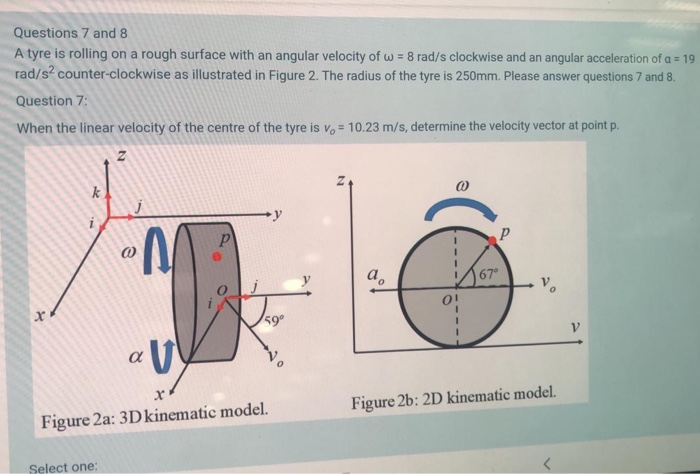 Questions. 7and8
Atyre is rolling on a rough surface with an angular velocity of w = 8 rad/s clockwise and an angular acceleration of a=
rad/s? counter-clockwise as illustrated in Figure 2. The radius of the tyre is 250mm. Please answer questions 7 ands.
Question 7:
When the linear velocity of the centre of the tyre is v, = 10.23 m/s, determine the velocity vector at point p. :
3 bE
k z ® #
if Y Ls NV
2
2 a
a, od
- & Yo p
x ~ No
«\J . i
AC Figure 2b: 2D kinematic model
Figure 2a: 3D kinematic model. KE
gelect one: EK
This is AI generated Response.
Asked by: manish kumar
Created at: 2025-08-16 08:41:12
Asked by: manish kumar
Created at: 2025-08-16 08:41:12
Final Answer:
Rendered
Raw Text
Did you like this answer?
Let's break the problem into logical steps:
---
### **Given Data:**
- Angular velocity, \( \omega = 8 \) rad/s (**clockwise**)
- Angular acceleration, \( \alpha = 19 \) rad/s² (**counterclockwise**)
- Radius of tyre, \( r = 0.25 \) m
- Linear velocity of the center, \( v_o = 10.23 \) m/s
The direction of axes:
- \( +x \) to the right
- \( +y \) into the plane
- \( +z \) upward
Point \( p \) is at an angle \( 67^\circ \) from the center in the 2D view.
---
## **Step 1: Find the Velocity Vector at Point \( p \)**
The velocity at point \( p \) on the rim is
\[
\vec{v}_p = \vec{v}_o + \vec{\omega} \times \vec{r}_{p/o}
\]
### **a. Find \(\vec{v}_o\):**
\[
\vec{v}_o = v_o \hat{i} = 10.23 \hat{i} \text{ m/s}
\]
### **b. Find \(\vec{\omega}\):**
- Clockwise about the \( z \)-axis, which is \( -\hat{k} \):
\[
\vec{\omega} = -8 \hat{k} \text{ rad/s}
\]
### **c. Find the position vector \(\vec{r}_{p/o}\):**
Point \( p \) is at radius \( r \) and angle \( 67^\circ \) from the center, so
\[
\vec{r}_{p/o} = r(\cos 67^\circ \hat{i} + \sin 67^\circ \hat{j}) = 0.25 (\cos 67^\circ \hat{i} + \sin 67^\circ \hat{j})
\]
\[
\cos 67^\circ \approx 0.3907,\quad \sin 67^\circ \approx 0.9205
\]
\[
\vec{r}_{p/o} = 0.25 (0.3907 \hat{i} + 0.9205 \hat{j}) = (0.0977\hat{i} + 0.2301\hat{j}) \text{ m}
\]
### **d. Compute \( \vec{\omega} \times \vec{r}_{p/o} \):**
\[
\vec{\omega} \times \vec{r}_{p/o} = |-8\hat{k}| \times (0.0977\hat{i} + 0.2301\hat{j})
\]
- \( \hat{k} \times \hat{i} = \hat{j} \)
- \( \hat{k} \times \hat{j} = -\hat{i} \)
So,
\[
(-8\hat{k}) \times (0.0977\hat{i} + 0.2301\hat{j}) = -8\left(0.0977 \hat{k} \times \hat{i} + 0.2301 \hat{k} \times \hat{j}\right)
\]
\[
= -8(0.0977\hat{j} - 0.2301\hat{i})
\]
\[
= (-8 \times 0.0977) \hat{j} + (8 \times 0.2301) \hat{i}
\]
\[
= -0.7816 \hat{j} + 1.8408 \hat{i}
\]
### **e. Add to \( \vec{v}_o \):**
\[
\vec{v}_p = 10.23 \hat{i} + 1.8408 \hat{i} - 0.7816 \hat{j}
\]
\[
= (12.0708 \hat{i} - 0.7816 \hat{j}) \text{ m/s}
\]
---
### **Final Answer for Velocity at Point \( p \):**
\[
\boxed{
\vec{v}_p = 12.07\,\hat{i} - 0.78\,\hat{j} \ \text{m/s}
}
\]
---
## **Step 2: Find the Acceleration of Point \( p \) in Vector Form**
The acceleration at \( p \) is:
\[
\vec{a}_p = \vec{a}_o + \vec{\alpha} \times \vec{r}_{p/o} + \vec{\omega} \times (\vec{\omega} \times \vec{r}_{p/o})
\]
### **a. Center acceleration, \( \vec{a}_o \):**
Since the center is moving at constant velocity, \( \vec{a}_o = 0 \).
### **b. Angular acceleration vector, \( \vec{\alpha} \):**
- Counterclockwise about \( z \)-axis → \( +\hat{k} \):
\[
\vec{\alpha} = 19 \hat{k} \text{ rad/s}^2
\]
### **c. Compute \( \vec{\alpha} \times \vec{r}_{p/o} \):**
\[
\vec{\alpha} \times \vec{r}_{p/o} = 19 \hat{k} \times (0.0977\hat{i} + 0.2301\hat{j}) = 19 (0.0977\hat{j} - 0.2301\hat{i})
\]
\[
= (19 \times 0.0977) \hat{j} - (19 \times 0.2301) \hat{i}
\]
\[
= 1.8563\hat{j} - 4.372\hat{i}
\]
### **d. Compute \( \vec{\omega} \times (\vec{\omega} \times \vec{r}_{p/o}) \):**
First, find \( \vec{\omega} \times \vec{r}_{p/o} \) (already computed above):
\[
\vec{\omega} \times \vec{r}_{p/o} = 1.8408 \hat{i} - 0.7816 \hat{j}
\]
Now, take cross product with \( \vec{\omega} \):
\[
\vec{\omega} \times (\vec{\omega} \times \vec{r}_{p/o}) = (-8\hat{k}) \times (1.8408 \hat{i} - 0.7816 \hat{j})
\]
\[
= -8\hat{k} \times 1.8408\hat{i} + 8\hat{k} \times 0.7816\hat{j}
\]
\[
= -8(1.8408\hat{k} \times \hat{i}) + 8(0.7816\hat{k} \times \hat{j})
\]
\[
= -8(1.8408\hat{j}) + 8(-0.7816\hat{i})
\]
\[
= -14.7264 \hat{j} - 6.2528 \hat{i}
\]
### **e. Add all terms:**
\[
\vec{a}_p = (1.8563\hat{j} - 4.372\hat{i}) + (-14.7264 \hat{j} - 6.2528 \hat{i})
\]
\[
= (1.8563 - 14.7264)\hat{j} + (-4.372 - 6.2528)\hat{i}
\]
\[
= -12.8701 \hat{j} - 10.6248 \hat{i}
\]
---
### **Final Answer for Acceleration at Point \( p \):**
\[
\boxed{
\vec{a}_p = -10.62\,\hat{i} - 12.87\,\hat{j} \ \text{m/s}^2
}
\]
---
## **Summary of Answers:**
### **Velocity at Point \( p \):**
\[
\boxed{
\vec{v}_p = 12.07\,\hat{i} - 0.78\,\hat{j} \ \text{(m/s)}
}
\]
### **Acceleration at Point \( p \):**
\[
\boxed{
\vec{a}_p = -10.62\,\hat{i} - 12.87\,\hat{j} \ \text{(m/s}^2\text{)}
}
\]
📢 Instructions:
- Ask anything relatd to above question only.
- For new Question goto :