 VIPSolutions
Give step-by-step solution with explanation and final answer:Problem 6 (5 pts): A three-phase 400KY, SOHz transmission ie is 200 km long. 1 is found that under no- load condition and with 400KV sending end line voltage, th receiving end line voltage is: 40 KV and the sending end per-phase current is 246.690 A. Determine the foal shunt admittance of the line?
Question:
Give step-by-step solution with explanation and final answer: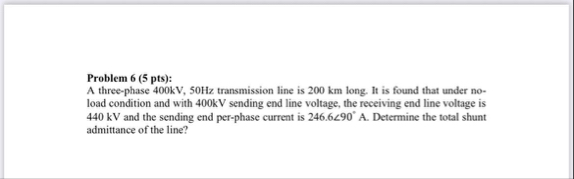 Problem 6 (5 pts):
A three-phase 400KY, SOHz transmission ie is 200 km long. 1 is found that under no-
load condition and with 400KV sending end line voltage, th receiving end line voltage is:
40 KV and the sending end per-phase current is 246.690 A. Determine the foal shunt
admittance of the line?
This is AI generated Response.
Asked by: admin3
Created at: 2025-08-12 15:07:28
Asked by: admin3
Created at: 2025-08-12 15:07:28
Final Answer:
Rendered
Raw Text
Did you like this answer?
Let's break down the problem step by step:
### Given Data
- **Line-to-line sending end voltage, \( V_{S,LL} \) = 400 kV**
- **Line-to-line receiving end voltage, \( V_{R,LL} \) = 440 kV**
- **Sending end per-phase current, \( I_S = 246.6 \angle 90^\circ \) A**
- **Line length = 200 km**
- **Frequency, \( f = 50 \) Hz**
- **Three-phase transmission line**
- **No load at receiving end (open-circuit load)**
---
### Step 1: Convert Line-to-Line Voltages to Phase Voltages
\[
V_{S,ph} = \frac{V_{S,LL}}{\sqrt{3}} = \frac{400,000}{\sqrt{3}} = 230,940\, \text{V}
\]
\[
V_{R,ph} = \frac{V_{R,LL}}{\sqrt{3}} = \frac{440,000}{\sqrt{3}} = 254,034\, \text{V}
\]
---
### Step 2: No Load Condition
- At no load, the receiving end current is **zero**.
- The **sending end current** is due to the **charging current** (shunt admittance).
---
### Step 3: Shunt Admittance Per Phase
The shunt current per phase, at no load, is given by:
\[
I_{S,ph} = j B V_{S,ph}
\]
where
- \( I_{S,ph} \) is the sending end current per phase,
- \( B \) is the total shunt admittance per phase,
- \( V_{S,ph} \) is the sending end phase voltage.
Given \( I_{S,ph} = 246.6 \angle 90^\circ \) A (which is purely reactive, as expected for a charging current).
---
### Step 4: Find Total Shunt Admittance Per Phase
\[
I_{S,ph} = j B V_{S,ph}
\]
\[
B = \frac{I_{S,ph}}{j V_{S,ph}}
\]
Since \( I_{S,ph} \) is already at \( 90^\circ \), it is positive imaginary (i.e., \( j 246.6 \) A).
\[
B = \frac{j 246.6}{j \cdot 230,940}
\]
\( j/j = 1 \)
\[
B = \frac{246.6}{230,940}
\]
\[
B = 0.001068 \text{ S}
\]
or
\[
B = 1.068 \times 10^{-3} \text{ S (per phase)}
\]
---
### Step 5: Total Shunt Admittance for Three Phases
For all three phases:
\[
B_{\text{total}} = 3 \times B = 3 \times 1.068 \times 10^{-3} = 3.204 \times 10^{-3} \text{ S}
\]
---
## **Final Answer**
### **The total shunt admittance of the line is:**
\[
\boxed{3.20 \times 10^{-3}\ \text{S}}
\] (rounded to three significant digits)
---
**Summary Table:**
| Quantity | Value |
|-----------------------|------------------|
| Per-phase shunt adm. | \(1.07\times10^{-3}\) S |
| Total (3-phase) adm. | \(3.20\times10^{-3}\) S |
Let me know if you need further clarification!
📢 Instructions:
- Ask anything relatd to above question only.
- For new Question goto :