 VIPSolutions
Give step-by-step solution with explanation and final answer:Suppose that X;, X5, X3, X, are iid random variables with pdf fy (z) = 2z, 0
Question:
Give step-by-step solution with explanation and final answer: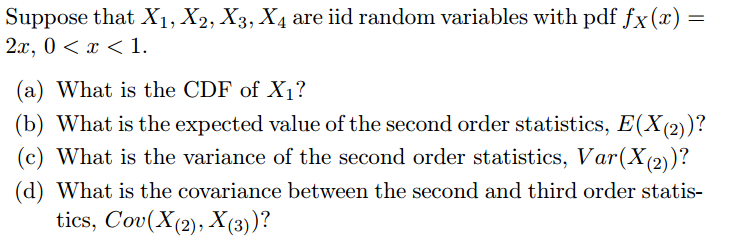 Suppose that X;, X5, X3, X, are iid random variables with pdf fy (z) =
2z, 0
This is AI generated Response.
Asked by: Umesh
Created at: 2025-08-07 23:08:50
Asked by: Umesh
Created at: 2025-08-07 23:08:50
Final Answer:
Rendered
Raw Text
Did you like this answer?
Let's solve the problem step by step.
---
## (a) **CDF of \( X_1 \)**
Given PDF:
\[ f_X(x) = 2x, \quad 0 < x < 1 \]
CDF is:
\[
F_X(x) = P(X_1 \leq x) = \int_0^x 2t\,dt = [t^2]_0^x = x^2, \quad 0 < x < 1
\]
---
## (b) **Expected Value of the Second Order Statistic, \( E(X_{(2)}) \)**
For \( n = 4 \), the PDF of the \( k \)-th order statistic is:
\[
f_{X_{(k)}}(x) = \frac{n!}{(k-1)!(n-k)!} [F_X(x)]^{k-1} [1 - F_X(x)]^{n-k} f_X(x)
\]
For \( k = 2, n = 4 \):
\[
f_{X_{(2)}}(x) = \frac{4!}{1!2!} [F_X(x)]^{1} [1 - F_X(x)]^{2} f_X(x) = 12 \, F_X(x) [1 - F_X(x)]^2 f_X(x)
\]
Recall \( F_X(x) = x^2 \), \( f_X(x) = 2x \):
\[
f_{X_{(2)}}(x) = 12x^2 (1 - x^2)^2 \cdot 2x = 24x^3 (1 - x^2)^2, \quad 0 < x < 1
\]
Now, compute the expected value:
\[
E[X_{(2)}] = \int_0^1 x f_{X_{(2)}}(x) dx = \int_0^1 x \cdot 24x^3 (1 - x^2)^2 dx = 24 \int_0^1 x^4 (1 - x^2)^2 dx
\]
Expand \( (1 - x^2)^2 = 1 - 2x^2 + x^4 \):
\[
x^4 (1 - x^2)^2 = x^4 - 2x^6 + x^8
\]
So:
\[
E[X_{(2)}] = 24 \int_0^1 (x^4 - 2x^6 + x^8) dx = 24 \left[ \frac{x^5}{5} - 2\frac{x^7}{7} + \frac{x^9}{9} \right]_0^1
\]
\[
= 24 \left( \frac{1}{5} - \frac{2}{7} + \frac{1}{9} \right)
\]
Compute the sum:
\[
\frac{1}{5} - \frac{2}{7} + \frac{1}{9} = \frac{63 - 90 + 35}{315} = \frac{8}{315}
\]
Therefore,
\[
E[X_{(2)}] = 24 \times \frac{8}{315} = \frac{192}{315} = \frac{64}{105}
\]
---
## (c) **Variance of the Second Order Statistic, \( Var(X_{(2)}) \)**
\[
Var(X_{(2)}) = E[X_{(2)}^2] - (E[X_{(2)}])^2
\]
Calculate \( E[X_{(2)}^2] \):
\[
E[X_{(2)}^2] = \int_0^1 x^2 f_{X_{(2)}}(x) dx = 24 \int_0^1 x^5 (1 - x^2)^2 dx
\]
Expand:
\[
x^5 (1 - x^2)^2 = x^5 - 2x^7 + x^9
\]
\[
E[X_{(2)}^2] = 24 \left[ \frac{x^6}{6} - 2\frac{x^8}{8} + \frac{x^{10}}{10} \right]_0^1 = 24 \left( \frac{1}{6} - \frac{1}{4} + \frac{1}{10} \right)
\]
\[
= 24 \left( \frac{10 - 15 + 6}{60} \right) = 24 \left( \frac{1}{60} \right) = \frac{24}{60} = \frac{2}{5}
\]
Now, recall \( E[X_{(2)}] = \frac{64}{105} \):
\[
Var(X_{(2)}) = \frac{2}{5} - \left(\frac{64}{105}\right)^2 = \frac{2}{5} - \frac{4096}{11025}
\]
Convert \(\frac{2}{5}\) to denominator 11025:
\[
\frac{2}{5} = \frac{2 \times 2205}{5 \times 2205} = \frac{4410}{11025}
\]
So,
\[
Var(X_{(2)}) = \frac{4410-4096}{11025} = \frac{314}{11025}
\]
---
## (d) **Covariance \( Cov(X_{(2)}, X_{(3)}) \)**
\[
Cov(X_{(2)}, X_{(3)}) = E[X_{(2)} X_{(3)}] - E[X_{(2)}]E[X_{(3)}]
\]
The joint PDF for the 2nd and 3rd order statistics for \( n = 4 \) is:
\[
f_{X_{(2)}, X_{(3)}}(x, y) = \frac{4!}{1!1!1!1!} [F_X(x)]^1 [F_X(y) - F_X(x)]^1 [1-F_X(y)]^1 f_X(x) f_X(y)
\]
where \( 0 < x < y < 1 \).
\[
= 24 \cdot x^2 \cdot (y^2 - x^2) \cdot (1 - y^2) \cdot 2x \cdot 2y
\]
\[
= 96 x^3 y (y^2 - x^2)(1 - y^2)
\]
So,
\[
E[X_{(2)} X_{(3)}] = \int_{0}^{1} \int_{x}^{1} x y \cdot 96 x^3 y (y^2 - x^2)(1 - y^2) dy dx
\]
\[
= 96 \int_{0}^{1} \int_{x}^{1} x^4 y^2 (y^2 - x^2)(1 - y^2) dy dx
\]
Let's expand \( (y^2 - x^2)(1 - y^2) = y^2 - x^2 - y^4 + x^2 y^2 \):
\[
x^4 y^2 (y^2 - x^2 - y^4 + x^2 y^2) = x^4 y^4 - x^6 y^2 - x^4 y^6 + x^6 y^4
\]
So,
\[
E[X_{(2)} X_{(3)}] = 96 \int_0^1 \int_x^1 (x^4 y^4 - x^6 y^2 - x^4 y^6 + x^6 y^4) \, dy dx
\]
Let's compute each term:
### \( \int_x^1 x^4 y^4 dy = x^4 \left[ \frac{y^5}{5} \right]_x^1 = x^4 \left( \frac{1}{5} - \frac{x^5}{5} \right) \)
### \( \int_x^1 x^6 y^2 dy = x^6 \left[ \frac{y^3}{3} \right]_x^1 = x^6 \left( \frac{1}{3} - \frac{x^3}{3} \right) \)
### \( \int_x^1 x^4 y^6 dy = x^4 \left[ \frac{y^7}{7} \right]_x^1 = x^4 \left( \frac{1}{7} - \frac{x^7}{7} \right) \)
### \( \int_x^1 x^6 y^4 dy = x^6 \left[ \frac{y^5}{5} \right]_x^1 = x^6 \left( \frac{1}{5} - \frac{x^5}{5} \right) \)
Putting together:
\[
E[X_{(2)} X_{(3)}] = 96 \int_0^1 \Bigg[
x^4 \left( \frac{1}{5} - \frac{x^5}{5} \right)
- x^6 \left( \frac{1}{3} - \frac{x^3}{3} \right)
- x^4 \left( \frac{1}{7} - \frac{x^7}{7} \right)
+ x^6 \left( \frac{1}{5} - \frac{x^5}{5} \right)
\Bigg] dx
\]
Group terms:
\[
= 96 \int_0^1 \Bigg[
\frac{x^4}{5} - \frac{x^9}{5}
- \frac{x^6}{3} + \frac{x^9}{3}
- \frac{x^4}{7} + \frac{x^{11}}{7}
+ \frac{x^6}{5} - \frac{x^{11}}{5}
\Bigg] dx
\]
Now, combine like terms:
- \( x^4 \): \( \frac{1}{5} - \frac{1}{7} = \frac{2}{35} \)
- \( x^6 \): \( -\frac{1}{3} + \frac{1}{5} = -\frac{2}{15} \)
- \( x^9 \): \( -\frac{1}{5} + \frac{1}{3} = \frac{2}{15} \)
- \( x^{11} \): \( \frac{1}{7} - \frac{1}{5} = -\frac{2}{35} \)
So,
\[
E[X_{(2)} X_{(3)}] = 96 \int_0^1 \left( \frac{2}{35}x^4 - \frac{2}{15}x^6 + \frac{2}{15}x^9 - \frac{2}{35}x^{11} \right) dx
\]
\[
= 96 \cdot \frac{2}{35} \int_0^1 x^4 dx
- 96 \cdot \frac{2}{15} \int_0^1 x^6 dx
+ 96 \cdot \frac{2}{15} \int_0^1 x^9 dx
- 96 \cdot \frac{2}{35} \int_0^1 x^{11} dx
\]
Integrate each term:
- \( \int_0^1 x^4 dx = \frac{1}{5} \)
- \( \int_0^1 x^6 dx = \frac{1}{7} \)
- \( \int_0^1 x^9 dx = \frac{1}{10} \)
- \( \int_0^1 x^{11} dx = \frac{1}{12} \)
Substitute:
\[
= 96 \left[ \frac{2}{35} \cdot \frac{1}{5} - \frac{2}{15} \cdot \frac{1}{7} + \frac{2}{15} \cdot \frac{1}{10} - \frac{2}{35} \cdot \frac{1}{12} \right]
\]
\[
= 96 \left( \frac{2}{175} - \frac{2}{105} + \frac{1}{75} - \frac{1}{210} \right )
\]
Find a common denominator (LCM of 175, 105, 75, 210 is 3150):
- \( \frac{2}{175} = \frac{36}{3150} \)
- \( \frac{2}{105} = \frac{60}{3150} \)
- \( \frac{1}{75} = \frac{42}{3150} \)
- \( \frac{1}{210} = \frac{15}{3150} \)
So sum:
\[
\frac{36 - 60 + 42 - 15}{3150} = \frac{3}{3150} = \frac{1}{1050}
\]
Multiply by 96:
\[
E[X_{(2)} X_{(3)}] = 96 \times \frac{1}{1050} = \frac{96}{1050} = \frac{32}{350} = \frac{16}{175}
\]
Now recall \( E[X_{(2)}] = \frac{64}{105} \) and \( E[X_{(3)}] \). For \( X_{(3)} \):
📢 Instructions:
- Ask anything relatd to above question only.
- For new Question goto :