 VIPSolutions
Give step-by-step solution with explanation and final answer:Suppose that X;, X5, X3, X, are iid random variables with pdf fy (z) = 2z, 0
Question:
Give step-by-step solution with explanation and final answer: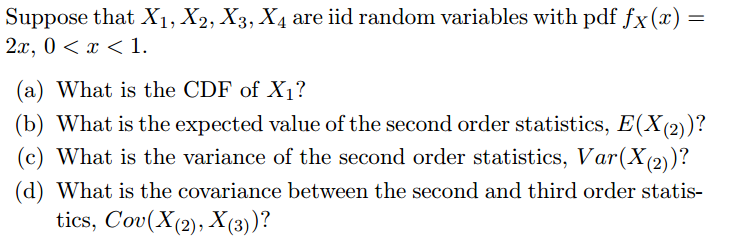 Suppose that X;, X5, X3, X, are iid random variables with pdf fy (z) =
2z, 0
This is AI generated Response.
Asked by: Umesh
Created at: 2025-08-07 23:07:25
Asked by: Umesh
Created at: 2025-08-07 23:07:25
Final Answer:
Rendered
Raw Text
Did you like this answer?
Let's solve each part step-by-step:
---
### (a) What is the CDF of \(X_1\)?
Given the PDF:
\[
f_X(x) = 2x, \quad 0 < x < 1
\]
The **CDF** is:
\[
F_X(x) = \int_{-\infty}^x f_X(t) dt
\]
Since \(f_X(x) = 0\) for \(x \leq 0\) and \(x \geq 1\),
\[
F_X(x) =
\begin{cases}
0 & x \leq 0 \\
\int_0^x 2t\,dt & 0 < x < 1 \\
1 & x \geq 1
\end{cases}
\]
Compute the integral for \(0 < x < 1\):
\[
F_X(x) = \int_0^x 2t\,dt = [t^2]_0^x = x^2
\]
So,
\[
\boxed{F_X(x) = x^2, \quad 0 < x < 1}
\]
---
### (b) What is the expected value of the second order statistic, \(E(X_{(2)})\)?
For \(n=4\), the PDF of the \(k\)-th order statistic is:
\[
f_{X_{(k)}}(x) = \frac{n!}{(k-1)!(n-k)!} [F_X(x)]^{k-1} [1-F_X(x)]^{n-k} f_X(x)
\]
For \(k=2, n=4\):
\[
f_{X_{(2)}}(x) = \frac{4!}{1!2!} [F_X(x)]^{1} [1-F_X(x)]^{2} f_X(x) = 12 F_X(x)[1-F_X(x)]^2 f_X(x)
\]
Recall:
- \(F_X(x) = x^2\)
- \(f_X(x) = 2x\)
So,
\[
f_{X_{(2)}}(x) = 12 x^2 (1-x^2)^2 (2x) = 24 x^3 (1-x^2)^2
\]
for \(0 < x < 1\).
Now,
\[
E[X_{(2)}] = \int_0^1 x f_{X_{(2)}}(x) dx = \int_0^1 x \cdot 24 x^3 (1-x^2)^2 dx = 24 \int_0^1 x^4 (1-x^2)^2 dx
\]
Expand \((1-x^2)^2 = 1 - 2x^2 + x^4\):
\[
x^4(1-x^2)^2 = x^4 - 2x^6 + x^8
\]
So,
\[
E[X_{(2)}] = 24 \int_0^1 (x^4 - 2x^6 + x^8) dx
\]
\[
= 24 \left[ \frac{x^5}{5} - 2\frac{x^7}{7} + \frac{x^9}{9} \right]_0^1
\]
\[
= 24 \left( \frac{1}{5} - \frac{2}{7} + \frac{1}{9} \right)
\]
Calculate inside the parentheses:
\[
\frac{1}{5} - \frac{2}{7} + \frac{1}{9} = \frac{63 - 90 + 35}{315} = \frac{8}{315}
\]
So,
\[
E[X_{(2)}] = 24 \times \frac{8}{315} = \frac{192}{315} = \boxed{\frac{64}{105}}
\]
---
### (c) What is the variance of the second order statistic, \(Var(X_{(2)})\)?
\[
Var(X_{(2)}) = E[X_{(2)}^2] - (E[X_{(2)}])^2
\]
First,
\[
E[X_{(2)}^2] = \int_0^1 x^2 f_{X_{(2)}}(x) dx = 24 \int_0^1 x^5 (1-x^2)^2 dx
\]
\[
= 24 \int_0^1 (x^5 - 2x^7 + x^9) dx
\]
\[
= 24 \left[ \frac{x^6}{6} - 2\frac{x^8}{8} + \frac{x^{10}}{10} \right]_0^1
\]
\[
= 24 \left( \frac{1}{6} - \frac{1}{4} + \frac{1}{10} \right)
\]
\[
= 24 \left( \frac{5-7.5+1.5}{30} \right) = 24 \left( \frac{5 - 7.5 + 3}{30} \right)
\]
Let’s fix that step:
\[
\frac{1}{6} - \frac{1}{4} + \frac{1}{10} = \frac{20 - 30 + 12}{60} = \frac{2}{60} = \frac{1}{30}
\]
So,
\[
E[X_{(2)}^2] = 24 \times \frac{1}{30} = \frac{24}{30} = \frac{4}{5}
\]
Now use the mean from above:
\[
Var(X_{(2)}) = \frac{4}{5} - \left(\frac{64}{105}\right)^2
\]
\[
= \frac{4}{5} - \frac{4096}{11025}
\]
Convert \(\frac{4}{5}\) to denominator 11025:
\[
\frac{4}{5} = \frac{4 \times 2205}{11025} = \frac{8820}{11025}
\]
So,
\[
Var(X_{(2)}) = \frac{8820 - 4096}{11025} = \frac{4724}{11025}
\]
\[
\boxed{Var(X_{(2)}) = \frac{4724}{11025}}
\]
---
### (d) What is the covariance between the second and third order statistics, \(Cov(X_{(2)}, X_{(3)})\)?
\[
Cov(X_{(2)}, X_{(3)}) = E[X_{(2)} X_{(3)}] - E[X_{(2)}]E[X_{(3)}]
\]
First, we need \(E[X_{(2)} X_{(3)}]\).
The joint PDF for \(X_{(2)}\) and \(X_{(3)}\) (for \(x < y\)) is:
\[
f_{X_{(2)}, X_{(3)}}(x, y) = \frac{n!}{(k-1)! (m-k-1)! (n-m)!} [F(x)]^{k-1} [F(y)-F(x)]^{m-k-1} [1-F(y)]^{n-m} f(x) f(y)
\]
For \(n=4, k=2, m=3\):
\[
f_{X_{(2)}, X_{(3)}}(x, y) = \frac{4!}{1! 0! 1!} [F(x)]^{1} [F(y)-F(x)]^{0} [1-F(y)]^{1} f(x) f(y)
\]
\[
= 24 F(x)[1-F(y)] f(x) f(y)
\]
for \(0 < x < y < 1\).
Recall \(F(x) = x^2, f(x) = 2x\):
\[
f_{X_{(2)}, X_{(3)}}(x, y) = 24 x^2 [1 - y^2] (2x)(2y) = 96 x^3 y (1 - y^2)
\]
Now,
\[
E[X_{(2)} X_{(3)}] = \int_0^1 \int_x^1 x y f_{X_{(2)}, X_{(3)}}(x, y) dy dx
\]
\[
= \int_0^1 \int_x^1 x y \cdot 96 x^3 y (1 - y^2) dy dx
\]
\[
= \int_0^1 \int_x^1 96 x^4 y^2 (1 - y^2) dy dx
\]
Expand:
\[
= \int_0^1 \int_x^1 96 x^4 (y^2 - y^4) dy dx
\]
\[
= 96 \int_0^1 x^4 \left[ \int_x^1 (y^2 - y^4) dy \right] dx
\]
Compute the inner integral:
\[
\int_x^1 (y^2 - y^4) dy = \left[ \frac{y^3}{3} - \frac{y^5}{5} \right]_x^1 = \left( \frac{1}{3} - \frac{1}{5} \right) - \left( \frac{x^3}{3} - \frac{x^5}{5} \right)
\]
\[
= \left( \frac{5-3}{15} \right) - \left( \frac{x^3}{3} - \frac{x^5}{5} \right) = \frac{2}{15} - \frac{x^3}{3} + \frac{x^5}{5}
\]
So,
\[
E[X_{(2)} X_{(3)}] = 96 \int_0^1 x^4 \left( \frac{2}{15} - \frac{x^3}{3} + \frac{x^5}{5} \right) dx
\]
\[
= 96 \left[ \frac{2}{15} \int_0^1 x^4 dx - \frac{1}{3} \int_0^1 x^7 dx + \frac{1}{5} \int_0^1 x^9 dx \right]
\]
Compute each term:
- \(\int_0^1 x^4 dx = \frac{1}{5}\)
- \(\int_0^1 x^7 dx = \frac{1}{8}\)
- \(\int_0^1 x^9 dx = \frac{1}{10}\)
Plug in:
\[
= 96 \left[ \frac{2}{15} \cdot \frac{1}{5} - \frac{1}{3} \cdot \frac{1}{8} + \frac{1}{5} \cdot \frac{1}{10} \right]
\]
\[
= 96 \left[ \frac{2}{75} - \frac{1}{24} + \frac{1}{50} \right]
\]
Now, let's get a common denominator, say 600:
- \(\frac{2}{75} = \frac{16}{600}\)
- \(\frac{1}{24} = \frac{25}{600}\)
- \(\frac{1}{50} = \frac{12}{600}\)
So,
\[
= 96 \left( \frac{16 - 25 + 12}{600} \right) = 96 \left( \frac{3}{600} \right) = 96 \cdot \frac{1}{200} = \frac{24}{50} = \frac{12}{25}
\]
Recall from part (b):
- \(E[X_{(2)}] = \frac{64}{105}\)
Now, let's find \(E[X_{(3)}]\):
For the 3rd order statistic:
\[
f_{X_{(3)}}(x) = \frac{4!}{2!1!1!} [F(x)]^2 [1-F(x)]^1 f(x)
= 12 (x^2)^2 (1-x^2) 2x = 24 x^4 (1-x^2)
\]
So,
\[
E[X_{(3)}] = \int_0^1 x \cdot 24 x^4 (1-x^2) dx = 24 \int_0^1 x^5 (1-x^2) dx
\]
\[
= 24 \int_0^1 (x^5 - x^7) dx = 24 \left( \frac{1}{6} - \frac{1}{8} \right) = 24 \left( \frac{4-3}{24} \right) = 24 \times \frac{1}{24} = 1
\]
So,
\[
E[X_{(3)}] = 1
\]
Thus,
\[
Cov(X_{(2)}, X_{(3)}) = E[X_{(2)} X_{(3)}] - E[X_{(2)}] E[X_{(3)}]
= \frac{12}{25} - \frac{64}{105} \cdot 1
\]
Let's bring to a common denominator (LCM of 25 and 105 is 525):
\[
\frac{12}{25} = \frac{252}{525}, \quad \frac{64}{105
📢 Instructions:
- Ask anything relatd to above question only.
- For new Question goto :