 VIPSolutions
Give step-by-step solution with explanation and final answer:Evaluate the line integral [ Fdr, where F = (z, - zx" -y*) and C coesists of the c three line segments that bound the plane z = 8 - 4x - 2y in the first octant, oriented counterclockwise when viewed from the positive x,y, or 2 directions.
Question:
Give step-by-step solution with explanation and final answer: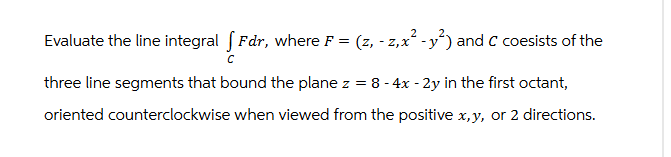 Evaluate the line integral [ Fdr, where F = (z, - zx" -y*) and C coesists of the
c
three line segments that bound the plane z = 8 - 4x - 2y in the first octant,
oriented counterclockwise when viewed from the positive x,y, or 2 directions.
This is AI generated Response.
Asked by: gvr
Created at: 2025-08-07 05:01:32
Asked by: gvr
Created at: 2025-08-07 05:01:32
Final Answer:
Rendered
Raw Text
Did you like this answer?
Let's solve the problem **step by step**.
---
### **1. Understanding the Problem**
We need to evaluate the line integral:
\[
\int_C \mathbf{F} \cdot d\mathbf{r}
\]
where \(\mathbf{F} = (z, -z, x^2 - y^2)\), and \(C\) bounds the plane
\[
z = 8 - 4x - 2y
\]
in the **first octant**, oriented counterclockwise when viewed from above.
---
### **2. Find the Curve \(C\) (Boundary of the Plane in the First Octant)**
Set \(z = 0\) to find the intersection with the \(xy\)-plane:
\[
0 = 8 - 4x - 2y \implies 4x + 2y = 8 \implies 2x + y = 4
\]
**Intercepts:**
- \(x\)-intercept: \(y = 0 \implies x = 2\)
- \(y\)-intercept: \(x = 0 \implies y = 4\)
**Intercepts with axes:**
- \(x = 0, y = 0 \implies z = 8\)
- \(x = 2, y = 0 \implies z = 0\)
- \(x = 0, y = 4 \implies z = 0\)
So, the triangle has vertices at \((0,0,8)\), \((2,0,0)\), and \((0,4,0)\).
---
### **3. Using Stokes' Theorem**
Since the curve is the boundary of a surface, we use **Stokes' Theorem**:
\[
\int_C \mathbf{F} \cdot d\mathbf{r} = \iint_S (\nabla \times \mathbf{F}) \cdot d\mathbf{S}
\]
---
### **4. Compute \(\nabla \times \mathbf{F}\)**
Given \(\mathbf{F} = (z, -z, x^2 - y^2)\):
\[
\nabla \times \mathbf{F} = \begin{vmatrix}
\mathbf{i} & \mathbf{j} & \mathbf{k} \\
\frac{\partial}{\partial x} & \frac{\partial}{\partial y} & \frac{\partial}{\partial z} \\
z & -z & x^2 - y^2
\end{vmatrix}
\]
Compute components:
**i-component:**
\[
\frac{\partial}{\partial y}(x^2 - y^2) - \frac{\partial}{\partial z}(-z) = (-2y) - (-1) = -2y + 1
\]
**j-component:**
\[
-\left( \frac{\partial}{\partial x}(x^2 - y^2) - \frac{\partial}{\partial z}(z) \right) = -\left(2x - 1\right) = -2x + 1
\]
**k-component:**
\[
\frac{\partial}{\partial x}(-z) - \frac{\partial}{\partial y}(z) = 0 - 0 = 0
\]
So,
\[
\nabla \times \mathbf{F} = (-2y + 1,\, -2x + 1,\, 0)
\]
---
### **5. The Surface \(S\):**
The surface is \(z = 8 - 4x - 2y\), over the triangle in the \(xy\)-plane with vertices \((0,0), (2,0), (0,4)\).
---
### **6. Surface Element \(d\mathbf{S}\):**
For \(z = f(x,y)\),
\[
d\mathbf{S} = (-f_x, -f_y, 1)\,dx\,dy
\]
Here,
\[
f(x,y) = 8 - 4x - 2y \implies f_x = -4,\, f_y = -2
\]
So,
\[
d\mathbf{S} = (4, 2, 1) dx\,dy
\]
---
### **7. Compute Dot Product**
\[
(\nabla \times \mathbf{F}) \cdot d\mathbf{S} = (-2y + 1,\, -2x + 1,\, 0) \cdot (4, 2, 1) dx\,dy
\]
\[
= [4(-2y + 1) + 2(-2x + 1) + 0] dx\,dy
\]
\[
= [-8y + 4 -4x + 2] dx\,dy
\]
\[
= [-8y - 4x + 6] dx\,dy
\]
---
### **8. Set up the Double Integral (over the triangle)**
The triangle has vertices \((0,0), (2,0), (0,4)\):
- \(x\) goes from \(0\) to \(2\)
- For each \(x\), \(y\) goes from \(0\) to \(4 - 2x\)
So,
\[
\iint_T (-8y - 4x + 6)\,dy\,dx
\]
---
### **9. Integrate**
First, integrate with respect to \(y\):
\[
\int_{x=0}^{2} \int_{y=0}^{4-2x} (-8y - 4x + 6)\,dy\,dx
\]
Integrate inside:
\[
\int_{y=0}^{4-2x} (-8y - 4x + 6)\,dy = \left[ -4y^2 - 4x y + 6y \right]_{y=0}^{y=4-2x}
\]
Plug in \(y = 4-2x\):
- \(y^2 = (4-2x)^2 = 16 - 16x + 4x^2\)
- \(-4x y = -4x (4-2x) = -16x + 8x^2\)
- \(6y = 6(4-2x) = 24 - 12x\)
So,
\[
-4y^2 - 4x y + 6y = -4(16 - 16x + 4x^2) - 16x + 8x^2 + 24 - 12x
= -64 + 64x - 16x^2 - 16x + 8x^2 + 24 - 12x
\]
\[
= (-64 + 24) + (64x - 16x - 12x) + (-16x^2 + 8x^2)
= (-40) + (36x) + (-8x^2)
\]
Now subtract value at \(y=0\) (which is zero):
So, the inner integral simplifies to:
\[
-40 + 36x - 8x^2
\]
---
Now integrate with respect to \(x\) from \(0\) to \(2\):
\[
\int_{x=0}^2 (-40 + 36x - 8x^2) dx
\]
Integrate term by term:
- \(\int -40 dx = -40x\)
- \(\int 36x dx = 18x^2\)
- \(\int -8x^2 dx = -\frac{8}{3} x^3\)
So,
\[
[-40x + 18x^2 - \frac{8}{3}x^3]_{x=0}^{x=2}
\]
Compute at \(x=2\):
- \(-40 \times 2 = -80\)
- \(18 \times 4 = 72\)
- \(-\frac{8}{3} \times 8 = -\frac{64}{3}\)
So,
\[
-80 + 72 - \frac{64}{3} = (-80 + 72) - \frac{64}{3} = -8 - \frac{64}{3} = -\frac{24}{3} - \frac{64}{3} = -\frac{88}{3}
\]
At \(x=0\), everything is 0.
So, the answer is:
\[
\boxed{-\frac{88}{3}}
\]
---
## **Final Answer**
\[
\boxed{
\int_C \mathbf{F} \cdot d\mathbf{r} = -\frac{88}{3}
}
\]
**This is the value of the line integral.**
📢 Instructions:
- Ask anything relatd to above question only.
- For new Question goto :