 VIPSolutions
Give step-by-step solution with explanation and final answer:Evaluate [J SF*ndS, where Floy2) =xyit OF +69) + sin(x)ke and Sis the surface of the solid region D bounded by the parabolic cylinder x=1-x"andthe planes z= 0,y =0, and y +z = 2.
Question:
Give step-by-step solution with explanation and final answer: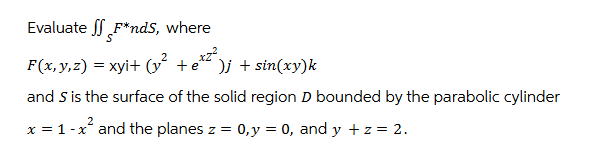 Evaluate [J SF*ndS, where
Floy2) =xyit OF +69) + sin(x)ke
and Sis the surface of the solid region D bounded by the parabolic cylinder
x=1-x"andthe planes z= 0,y =0, and y +z = 2.
This is AI generated Response.
Asked by: gvr
Created at: 2025-08-07 04:54:46
Asked by: gvr
Created at: 2025-08-07 04:54:46
Final Answer:
Rendered
Raw Text
Did you like this answer?
Let's solve the given flux integral step-by-step using the **Divergence Theorem**.
---
### **Step 1: Write the Vector Field and the Region**
Given:
\[
\vec{F}(x, y, z) = xy\,\vec{i} + (y^2 + e^{xz^2})\,\vec{j} + \sin(xy)\,\vec{k}
\]
The region \( D \) is bounded by:
- \( x = 1 - x^2 \) (which means \( x \) goes from \(-1\) to \(1\))
- \( y = 0 \)
- \( z = 0 \)
- \( y + z = 2 \)
So, the boundaries in terms of variables:
- \( x \) from \(-1\) to \(1\)
- \( y \) from \(0\) to \(1 - x^2\) (from the parabolic cylinder)
- \( z \) from \(0\) to \(2-y\) (from the planes \( z=0 \) and \( y+z=2 \))
---
### **Step 2: State the Divergence Theorem**
The Divergence Theorem states:
\[
\iint_{S} \vec{F} \cdot \vec{n} \, dS = \iiint_{D} (\nabla \cdot \vec{F}) \, dV
\]
---
### **Step 3: Compute the Divergence**
\[
\nabla \cdot \vec{F} = \frac{\partial}{\partial x}(xy) + \frac{\partial}{\partial y}(y^2 + e^{xz^2}) + \frac{\partial}{\partial z}(\sin(xy))
\]
Calculate each term:
- \(\frac{\partial}{\partial x}(xy) = y\)
- \(\frac{\partial}{\partial y}(y^2 + e^{xz^2}) = 2y\)
- \(\frac{\partial}{\partial z}(\sin(xy)) = 0\) (since \(\sin(xy)\) does not depend on \(z\))
So,
\[
\nabla \cdot \vec{F} = y + 2y = 3y
\]
---
### **Step 4: Set Up the Triple Integral**
\[
\iiint_{D} 3y \, dV
\]
Bounds (as described above):
\[
\int_{x=-1}^{1} \int_{y=0}^{1-x^2} \int_{z=0}^{2-y} 3y \, dz\,dy\,dx
\]
Integrate with respect to \(z\) first:
\[
\int_{z=0}^{2-y} dz = (2-y) - 0 = (2-y)
\]
So the integral becomes:
\[
\int_{x=-1}^{1} \int_{y=0}^{1-x^2} 3y(2-y)\, dy\, dx
\]
\[
= \int_{x=-1}^{1} \int_{y=0}^{1-x^2} (6y - 3y^2)\, dy\, dx
\]
---
### **Step 5: Integrate with Respect to \(y\)**
Integrate \(6y - 3y^2\) with respect to \(y\):
\[
\int (6y - 3y^2)\, dy = 3y^2 - y^3
\]
Evaluate from \(y=0\) to \(y=1-x^2\):
\[
= 3(1 - x^2)^2 - (1 - x^2)^3
\]
---
### **Step 6: Integrate with Respect to \(x\)**
Now set up the last integral:
\[
\int_{x=-1}^{1} \left[ 3(1 - x^2)^2 - (1 - x^2)^3 \right] dx
\]
Let's expand:
- \((1 - x^2)^2 = 1 - 2x^2 + x^4\)
- \((1 - x^2)^3 = 1 - 3x^2 + 3x^4 - x^6\)
So,
\[
3(1 - x^2)^2 - (1 - x^2)^3 = 3(1 - 2x^2 + x^4) - [1 - 3x^2 + 3x^4 - x^6]
\]
\[
= (3 - 6x^2 + 3x^4) - (1 - 3x^2 + 3x^4 - x^6)
\]
\[
= 3 - 6x^2 + 3x^4 - 1 + 3x^2 - 3x^4 + x^6
\]
\[
= (3 - 1) + (-6x^2 + 3x^2) + (3x^4 - 3x^4) + x^6
\]
\[
= 2 - 3x^2 + x^6
\]
So, our integral is:
\[
\int_{x=-1}^{1} (2 - 3x^2 + x^6) dx
\]
---
### **Step 7: Evaluate the Final Integral**
Each term is even, so double the integral from 0 to 1:
\[
= 2 \int_{0}^{1} (2 - 3x^2 + x^6) dx
\]
\[
= 2 \left[ 2x - x^3 + \frac{1}{7}x^7 \right]_{0}^{1}
\]
\[
= 2 \left[ 2(1) - (1)^3 + \frac{1}{7}(1)^7 - (0 - 0 + 0) \right]
\]
\[
= 2 \left[ 2 - 1 + \frac{1}{7} \right]
\]
\[
= 2 \left[ 1 + \frac{1}{7} \right]
\]
\[
= 2 \cdot \frac{8}{7} = \frac{16}{7}
\]
---
### **Final Answer**
\[
\boxed{\frac{16}{7}}
\]
That is the value of the surface integral \(\iint_S \vec{F} \cdot \vec{n} \, dS\) over the given region.
📢 Instructions:
- Ask anything relatd to above question only.
- For new Question goto :