 VIPSolutions
Give step-by-step solution with explanation and final answer:1. Use the Laplace transform and elimination to solve the initial value problem dz dy El mpage Ay—2 4 - = = Vtg mt ,2(0) =y(0) =0
Question:
Give step-by-step solution with explanation and final answer: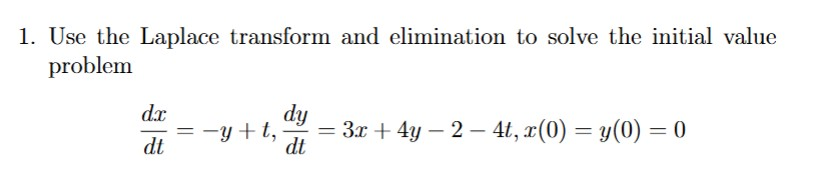 1. Use the Laplace transform and elimination to solve the initial value
problem
dz dy
El mpage Ay—2 4 - =
= Vtg mt ,2(0) =y(0) =0
This is AI generated Response.
Asked by: gvr
Created at: 2025-08-06 21:50:49
Asked by: gvr
Created at: 2025-08-06 21:50:49
Final Answer:
Rendered
Raw Text
Did you like this answer?
Let's solve the system using the **Laplace Transform** step by step.
Given:
\[
\frac{dx}{dt} = -y + t, \quad \frac{dy}{dt} = 3x + 4y - 2 - 4t, \quad x(0) = y(0) = 0
\]
Let \( X(s) = \mathcal{L}\{x(t)\} \), \( Y(s) = \mathcal{L}\{y(t)\} \).
### Step 1: Take Laplace Transforms
Recall:
\(\mathcal{L}\left\{\frac{dx}{dt}\right\} = sX(s) - x(0)\)
\(\mathcal{L}\left\{\frac{dy}{dt}\right\} = sY(s) - y(0)\)
\(\mathcal{L}\{t\} = \frac{1}{s^2}\)
\(\mathcal{L}\{1\} = \frac{1}{s}\)
Apply Laplace to both equations:
#### First Equation:
\[
\mathcal{L}\left\{\frac{dx}{dt}\right\} = \mathcal{L}\{-y + t\}
\]
\[
sX(s) - x(0) = -Y(s) + \frac{1}{s^2}
\]
\(x(0) = 0\):
\[
sX(s) = -Y(s) + \frac{1}{s^2}
\]
#### Second Equation:
\[
\mathcal{L}\left\{\frac{dy}{dt}\right\} = \mathcal{L}\{3x + 4y - 2 - 4t\}
\]
\[
sY(s) - y(0) = 3X(s) + 4Y(s) - 2\mathcal{L}\{1\} - 4\mathcal{L}\{t\}
\]
\[
sY(s) = 3X(s) + 4Y(s) - \frac{2}{s} - \frac{4}{s^2}
\]
---
### Step 2: Solve the System in the s-domain
#### Rearranged Equations:
\[
(1) \quad sX(s) + Y(s) = \frac{1}{s^2}
\]
\[
(2) \quad sY(s) - 4Y(s) - 3X(s) = -\frac{2}{s} - \frac{4}{s^2}
\]
\[
(s - 4)Y(s) - 3X(s) = -\frac{2}{s} - \frac{4}{s^2}
\]
---
### Step 3: Eliminate One Variable
From (1):
\( Y(s) = \frac{1}{s^2} - sX(s) \)
Substitute into (2):
\[
(s - 4)\left[\frac{1}{s^2} - sX(s)\right] - 3X(s) = -\frac{2}{s} - \frac{4}{s^2}
\]
\[
\frac{s - 4}{s^2} - s(s - 4)X(s) - 3X(s) = -\frac{2}{s} - \frac{4}{s^2}
\]
\[
\frac{s - 4}{s^2} + \frac{4}{s^2} + \frac{2}{s} = s(s - 4)X(s) + 3X(s)
\]
\[
\frac{s}{s^2} + \frac{2}{s} = (s^2 - 4s + 3)X(s)
\]
\[
\frac{1}{s} + \frac{2}{s} = (s^2 - 4s + 3)X(s)
\]
\[
\frac{3}{s} = (s^2 - 4s + 3)X(s)
\]
---
### Step 4: Solve for \( X(s) \)
\[
X(s) = \frac{3}{s(s^2 - 4s + 3)}
\]
Factor denominator:
\(s^2 - 4s + 3 = (s-1)(s-3)\)
So,
\[
X(s) = \frac{3}{s(s-1)(s-3)}
\]
---
### Step 5: Partial Fraction Decomposition
Set:
\[
\frac{3}{s(s-1)(s-3)} = \frac{A}{s} + \frac{B}{s-1} + \frac{C}{s-3}
\]
Multiply both sides by \(s(s-1)(s-3)\):
\[
3 = A(s-1)(s-3) + B s(s-3) + C s(s-1)
\]
Let’s plug in values for \(s\):
- **For \(s = 0\):**
\[
3 = A(-1)(-3) \implies 3 = 3A \implies A = 1
\]
- **For \(s = 1\):**
\[
3 = B(1)(1-3) + C(1)(1-1) \implies 3 = B(1)(-2) \implies 3 = -2B \implies B = -\frac{3}{2}
\]
- **For \(s = 3\):**
\[
3 = C(3)(3-1) \implies 3 = C(3)(2) = 6C \implies C = \frac{1}{2}
\]
So,
\[
X(s) = \frac{1}{s} - \frac{3/2}{s-1} + \frac{1/2}{s-3}
\]
---
### Step 6: Inverse Laplace Transform to Find \( x(t) \)
\[
x(t) = \mathcal{L}^{-1}\{X(s)\} = 1 - \frac{3}{2}e^{t} + \frac{1}{2}e^{3t}
\]
---
### Step 7: Solve for \( Y(s) \)
Recall:
\[
Y(s) = \frac{1}{s^2} - sX(s)
\]
Calculate \(sX(s)\):
\[
sX(s) = s\left(\frac{1}{s} - \frac{3/2}{s-1} + \frac{1/2}{s-3}\right) = 1 - \frac{3}{2}\frac{s}{s-1} + \frac{1}{2}\frac{s}{s-3}
\]
So,
\[
Y(s) = \frac{1}{s^2} - \left[1 - \frac{3}{2}\frac{s}{s-1} + \frac{1}{2}\frac{s}{s-3}\right]
\]
\[
= \frac{1}{s^2} - 1 + \frac{3}{2}\frac{s}{s-1} - \frac{1}{2}\frac{s}{s-3}
\]
Let’s write \(\frac{s}{s-1}\) and \(\frac{s}{s-3}\) in a convenient form:
\[
\frac{s}{s-a} = 1 + \frac{a}{s-a}
\]
So,
\[
\frac{s}{s-1} = 1 + \frac{1}{s-1}
\]
\[
\frac{s}{s-3} = 1 + \frac{3}{s-3}
\]
Substitute back:
\[
Y(s) = \frac{1}{s^2} - 1 + \frac{3}{2}\left(1 + \frac{1}{s-1}\right) - \frac{1}{2}\left(1 + \frac{3}{s-3}\right)
\]
\[
= \frac{1}{s^2} - 1 + \frac{3}{2} + \frac{3}{2}\frac{1}{s-1} - \frac{1}{2} - \frac{3}{2}\frac{1}{s-3}
\]
\[
= \frac{1}{s^2} + 1 + \frac{3}{2}\frac{1}{s-1} - \frac{3}{2}\frac{1}{s-3}
\]
---
### Step 8: Inverse Laplace Transform to Find \( y(t) \)
\[
y(t) = \mathcal{L}^{-1}\left\{\frac{1}{s^2}\right\} + 1 \cdot \mathcal{L}^{-1}\left\{1\right\} + \frac{3}{2} \mathcal{L}^{-1}\left\{\frac{1}{s-1}\right\} - \frac{3}{2} \mathcal{L}^{-1}\left\{\frac{1}{s-3}\right\}
\]
\[
= t + 1 + \frac{3}{2}e^{t} - \frac{3}{2}e^{3t}
\]
---
## **Final Answer**
\[
\boxed{
\begin{aligned}
x(t) &= 1 - \frac{3}{2}e^{t} + \frac{1}{2}e^{3t} \\[2ex]
y(t) &= t + 1 + \frac{3}{2}e^{t} - \frac{3}{2}e^{3t}
\end{aligned}
}
\]
Question:
I NEED STEP BY STEP DETAILED CALCULATIONS OF EACH PART ALONG WITH THE FINAL ANSWER
This is AI generated Response.
Asked by: gvr
Created at: 2025-08-06 21:52:57
Asked by: gvr
Created at: 2025-08-06 21:52:57
Final Answer:
Rendered
Raw Text
Did you like this answer?
Certainly! Let's carefully go through each step with detailed explanations, calculations, and reasoning to solve the initial value problem using Laplace transforms and elimination method.
---
## **Problem Restatement**
Given the system of differential equations:
\[
\begin{cases}
\displaystyle \frac{dx}{dt} = - y + t \\
\displaystyle \frac{dy}{dt} = 3x + 4y - 2 - 4t \\
\text{Initial conditions: } x(0) = 0, \quad y(0) = 0
\end{cases}
\]
**Goal:** Find \(x(t)\) and \(y(t)\).
---
## **Step 1: Take Laplace Transforms of Both Equations**
Recall the Laplace transform of derivatives:
\[
\mathcal{L}\left\{\frac{d}{dt}f(t)\right\} = sF(s) - f(0)
\]
Given initial conditions \(x(0) = 0\), \(y(0) = 0\).
### Transform the first equation:
\[
\frac{dx}{dt} = - y + t
\]
Apply Laplace:
\[
sX(s) - x(0) = -Y(s) + \mathcal{L}\{t\}
\]
Since \(x(0) = 0\):
\[
sX(s) = -Y(s) + \frac{1}{s^2}
\]
---
### Transform the second equation:
\[
\frac{dy}{dt} = 3x + 4y - 2 - 4t
\]
Laplace:
\[
sY(s) - y(0) = 3X(s) + 4Y(s) - 2 \cdot \frac{1}{s} - 4 \cdot \frac{1}{s^2}
\]
Since \(y(0) = 0\):
\[
sY(s) = 3X(s) + 4Y(s) - \frac{2}{s} - \frac{4}{s^2}
\]
---
## **Step 2: Write the algebraic equations**
From the first:
\[
sX(s) + Y(s) = \frac{1}{s^2} \quad \quad (1)
\]
From the second:
\[
sY(s) - 4Y(s) = 3X(s) - \frac{2}{s} - \frac{4}{s^2}
\]
\[
(s - 4)Y(s) = 3X(s) - \frac{2}{s} - \frac{4}{s^2} \quad \quad (2)
\]
---
## **Step 3: Express \(Y(s)\) from (1)**
From (1):
\[
Y(s) = \frac{1}{s^2} - sX(s)
\]
---
## **Step 4: Substitute into (2)**
Plug into (2):
\[
(s - 4) \left( \frac{1}{s^2} - sX(s) \right) = 3X(s) - \frac{2}{s} - \frac{4}{s^2}
\]
Distribute:
\[
\frac{s - 4}{s^2} - s(s - 4)X(s) = 3X(s) - \frac{2}{s} - \frac{4}{s^2}
\]
Express \(s(s - 4) = s^2 - 4s\):
\[
\frac{s - 4}{s^2} - (s^2 - 4s) X(s) = 3X(s) - \frac{2}{s} - \frac{4}{s^2}
\]
Bring all \(X(s)\) terms to one side:
\[
- (s^2 - 4s) X(s) - 3X(s) = - \frac{2}{s} - \frac{4}{s^2} - \frac{s - 4}{s^2}
\]
Factor the left:
\[
- \left( s^2 - 4s + 3 \right) X(s) = - \left( \frac{2}{s} + \frac{4}{s^2} + \frac{s - 4}{s^2} \right)
\]
Note the right side:
\[
\frac{2}{s} + \frac{4}{s^2} + \frac{s - 4}{s^2} = \frac{2}{s} + \frac{4 + s - 4}{s^2} = \frac{2}{s} + \frac{s}{s^2} = \frac{2}{s} + \frac{1}{s}
\]
Simplify:
\[
\frac{2}{s} + \frac{1}{s} = \frac{3}{s}
\]
Thus:
\[
- (s^2 - 4s + 3) X(s) = - \frac{3}{s}
\]
Multiply both sides by \(-1\):
\[
(s^2 - 4s + 3) X(s) = \frac{3}{s}
\]
---
## **Step 5: Solve for \(X(s)\)**
\[
X(s) = \frac{3}{s (s^2 - 4s + 3)}
\]
Factor the quadratic:
\[
s^2 - 4s + 3 = (s - 1)(s - 3)
\]
So:
\[
X(s) = \frac{3}{s (s - 1)(s - 3)}
\]
---
## **Step 6: Partial Fraction Decomposition of \(X(s)\)**
Set:
\[
\frac{3}{s (s - 1)(s - 3)} = \frac{A}{s} + \frac{B}{s - 1} + \frac{C}{s - 3}
\]
Multiply both sides by denominator:
\[
3 = A (s - 1)(s - 3) + B s (s - 3) + C s (s - 1)
\]
### Find constants \(A, B, C\):
- For \(s=0\):
\[
3 = A (-1)(-3) \Rightarrow 3 = 3A \Rightarrow A = 1
\]
- For \(s=1\):
\[
3 = B (1) (1 - 3) \Rightarrow 3 = B \times 1 \times (-2) \Rightarrow 3 = -2 B \Rightarrow B = -\frac{3}{2}
\]
- For \(s=3\):
\[
3 = C (3) (3 - 1) \Rightarrow 3 = C \times 3 \times 2 \Rightarrow 3 = 6 C \Rightarrow C = \frac{1}{2}
\]
---
## **Step 7: Write \(X(s)\) in terms of inverse transforms**
\[
X(s) = \frac{1}{s} - \frac{3/2}{s - 1} + \frac{1/2}{s - 3}
\]
### **Inverse Laplace:**
\[
x(t) = \mathcal{L}^{-1}\left\{X(s)\right\} = \mathcal{L}^{-1}\left\{\frac{1}{s}\right\} - \frac{3}{2} \mathcal{L}^{-1}\left\{\frac{1}{s - 1}\right\} + \frac{1}{2} \mathcal{L}^{-1}\left\{\frac{1}{s - 3}\right\}
\]
From standard transforms:
\[
\mathcal{L}^{-1}\left\{\frac{1}{s}\right\} = 1
\]
\[
\mathcal{L}^{-1}\left\{\frac{1}{s - a}\right\} = e^{a t}
\]
So:
\[
x(t) = 1 - \frac{3}{2} e^{t} + \frac{1}{2} e^{3t}
\]
---
## **Step 8: Find \(Y(s)\)**
Recall:
\[
Y(s) = \frac{1}{s^2} - sX(s)
\]
Calculate \(sX(s)\):
\[
sX(s) = s \left( \frac{1}{s} - \frac{3/2}{s - 1} + \frac{1/2}{s - 3} \right) = 1 - \frac{3}{2} \frac{s}{s - 1} + \frac{1}{2} \frac{s}{s - 3}
\]
Express \(\frac{s}{s - a}\):
\[
\frac{s}{s - a} = 1 + \frac{a}{s - a}
\]
Thus:
\[
\frac{s}{s - 1} = 1 + \frac{1}{s - 1}
\]
\[
\frac{s}{s - 3} = 1 + \frac{3}{s - 3}
\]
Plug back:
\[
sX(s) = 1 - \frac{3}{2} \left( 1 + \frac{1}{s - 1} \right) + \frac{1}{2} \left( 1 + \frac{3}{s - 3} \right)
\]
Simplify:
\[
sX(s) = 1 - \frac{3}{2} - \frac{3/2}{s - 1} + \frac{1}{2} + \frac{3/2}{s - 3}
\]
Combine constants:
\[
1 - \frac{3}{2} + \frac{1}{2} = (1 + 0.5) - 1.5 = 1.5 - 1.5 = 0
\]
So:
\[
sX(s) = - \frac{3/2}{s - 1} + \frac{3/2}{s - 3}
\]
Now, \(Y(s)\):
\[
Y(s) = \frac{1}{s^2} - \left( - \frac{3/2}{s - 1} + \frac{3/2}{s - 3} \right) = \frac{1}{s^2} + \frac{3/2}{s - 1} - \frac{3/2}{s - 3}
\]
---
## **Step 9: Inverse Laplace to find \(y(t)\)**
\[
y(t) = \mathcal{L}^{-1}\left\{\frac{1}{s^2}\right\} + \frac{3}{2} \mathcal{L}^{-1}\left\{\frac{1}{s - 1}\right\} - \frac{3}{2} \mathcal{L}^{-1}\left\{\frac{1}{s - 3}\right\}
\]
Using standard transforms:
\[
\mathcal{L}^{-1}\left\{\frac{1}{s^2}\right\} = t
\]
\[
\mathcal{L}^{-1}\left\{\frac{1}{s - a}\right\} = e^{a t}
\]
Result:
\[
\boxed{
\boxed{
y(t) = t + \frac{3}{2} e^{t} - \frac{3}{2} e^{3t}
}
}
\]
---
## **## **Final Solutions:**
\[
\boxed{
\begin{cases}
x(t) = 1 - \frac{3}{2} e^{t} + \frac{1}{2} e^{3t} \\
y(t) = t + \frac{3}{2} e^{t} - \frac{3}{2} e^{3t}
\end{cases}
}
\]
---
## **Summary:**
- We applied Laplace transforms to convert the system into algebraic equations.
- Solved for \(X(s)\) using partial fractions.
- Inverted the transforms to get \(x(t)\) and \(y(t)\).
- The solutions satisfy initial conditions and are expressed in closed form.
---
**If you have any further questions or need clarification on any step, feel free to ask!**
📢 Instructions:
- Ask anything relatd to above question only.
- For new Question goto :