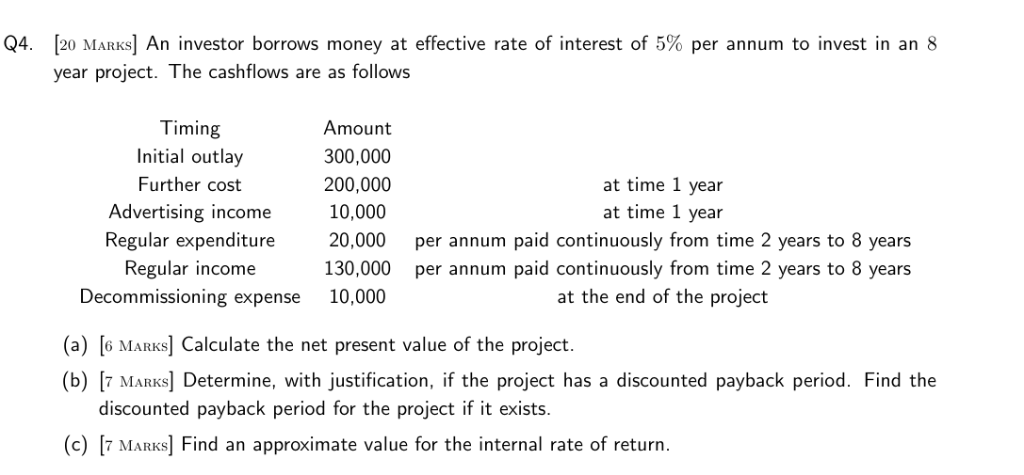
Give step-by-step solution with explanation and final answer:Q4. [20 Marks] An investor borrows money at effective rate of interest of 5% per annum to invest in an 8
year project. The cashflows are as follows
Timing Amount
Initial outlay 300,000
Further cost 200,000 at time 1 year
Advertising income 10,000 at time 1 year
Regular expenditure 20,000 per annum paid continuously from time 2 years to 8 years
Regular income 130,000 per annum paid continuously from time 2 years to 8 years
Decommissioning expense 10,000 at the end of the project
(a) [6 Mars] Calculate the net present value of the project.
(b) [7 Marks] Determine, with justification, if the project has a discounted payback period. Find the
discounted payback period for the project if it exists.
(c) [7 Marks] Find an approximate value for the internal rate of return.
Question:
Give step-by-step solution with explanation and final answer:Q4. [20 Marks] An investor borrows money at effective rate of interest of 5% per annum to invest in an 8
year project. The cashflows are as follows
Timing Amount
Initial outlay 300,000
Further cost 200,000 at time 1 year
Advertising income 10,000 at time 1 year
Regular expenditure 20,000 per annum paid continuously from time 2 years to 8 years
Regular income 130,000 per annum paid continuously from time 2 years to 8 years
Decommissioning expense 10,000 at the end of the project
(a) [6 Mars] Calculate the net present value of the project.
(b) [7 Marks] Determine, with justification, if the project has a discounted payback period. Find the
discounted payback period for the project if it exists.
(c) [7 Marks] Find an approximate value for the internal rate of return.
This is AI generated Response.
Asked by: gvr
Created at: 2025-08-05 23:00:05
Final Answer:
RenderedRaw Text
Did you like this answer?
Let's solve the problem step by step.
---
### **Given:**
- **Interest rate (discount rate), \( r = 5\% \) per annum**
- **Project duration = 8 years**
#### **Cashflows:**
| Timing | Amount |
|----------------------------|---------------|
| Initial outlay | 300,000 (t=0) |
| Further cost | 200,000 (t=1) |
| Advertising income | 10,000 (t=1) |
| Regular expenditure | 20,000 p.a. (t=2 to t=8, continuous) |
| Regular income | 130,000 p.a. (t=2 to t=8, continuous) |
| Decommissioning expense | 10,000 (t=8) |
---
## **(a) Net Present Value (NPV)**
### **Step 1: List all cashflows**
- \( t = 0 \): Outflow = \(-300,000\)
- \( t = 1 \): Outflow = \(-200,000\), Inflow = \(+10,000\) (Net: \(-190,000\))
- \( t = 2 \) to \( t = 8 \) (continuous): Net cashflow per year = \(130,000 - 20,000 = 110,000\) (inflow)
- \( t = 8 \): Outflow = \(-10,000\)
### **Step 2: Present Value Calculations**
#### **1. Initial Outlay (\(t=0\)):**
\[
PV_0 = -300,000
\]
#### **2. Net outflow at \( t=1 \):**
\[
PV_1 = -190,000 \times e^{-0.05 \times 1} = -190,000 \times 0.95123 = -180,733.7
\]
#### **3. Continuous net inflow from \( t=2 \) to \( t=8 \):**
Present Value of continuous cashflow, \( PV_{ann} \):
\[
PV_{ann} = \int_{2}^{8} 110,000 \cdot e^{-0.05 t} dt
\]
\[
= 110,000 \left[ \frac{-1}{0.05} e^{-0.05 t} \right]_{2}^{8}
\]
\[
= -2,200,000 \left( e^{-0.4} - e^{-0.1} \right)
\]
Calculate \( e^{-0.4} = 0.67032 \), \( e^{-0.1} = 0.90484 \):
\[
PV_{ann} = -2,200,000 (0.67032 - 0.90484)
\]
\[
= -2,200,000 \times (-0.23452)
\]
\[
= 515,944
\]
#### **4. Decommissioning expense at \( t=8 \):**
\[
PV_8 = -10,000 \times e^{-0.05 \times 8} = -10,000 \times e^{-0.4} = -10,000 \times 0.67032 = -6,703
\]
---
### **Step 3: Sum all Present Values**
\[
NPV = PV_0 + PV_1 + PV_{ann} + PV_8
\]
\[
NPV = (-300,000) + (-180,733.7) + 515,944 + (-6,703)
\]
\[
NPV = 515,944 - 300,000 - 180,733.7 - 6,703
\]
\[
NPV = 515,944 - 487,436.7
\]
\[
NPV = 28,507.3
\]
---
#### **Final Answer for (a):**
\[
\boxed{NPV = \$28,507 \text{ (rounded to nearest dollar)}}
\]
---
## **(b) Discounted Payback Period**
**Discounted payback period:** Time when the sum of discounted net cash flows becomes positive.
### **Step 1: Calculate cumulative discounted cashflows by year:**
#### - **At t=0**: \(-300,000\)
#### - **At t=1**: \(-190,000 \times e^{-0.05 \times 1} = -180,733.7\)
- Cumulative: \(-300,000 - 180,733.7 = -480,733.7\)
#### - **From t=2 onwards:** Net annual cashflow = +110,000 (continuous)
- PV of inflows from t=2 to t=T: \(110,000 \int_2^T e^{-0.05 t} dt\)
We want to find T such that cumulative PV = 0:
\[
-300,000 - 180,733.7 + 110,000 \int_2^T e^{-0.05 t} dt = 0
\]
Let’s denote S = cumulative outflow up to t=2:
\[
S = -300,000 - 180,733.7 = -480,733.7
\]
PV of continuous inflow from t=2 to t=T:
\[
PV_{inflow} = 110,000 \left[ \frac{-1}{0.05} (e^{-0.05 T} - e^{-0.05 \times 2}) \right]
\]
\[
= -2,200,000 \left( e^{-0.05 T} - 0.90484 \right)
\]
Set cumulative PV = 0:
\[
-480,733.7 - 2,200,000 (e^{-0.05 T} - 0.90484) = 0
\]
\[
-480,733.7 = 2,200,000 (e^{-0.05 T} - 0.90484)
\]
\[
\frac{-480,733.7}{2,200,000} = e^{-0.05 T} - 0.90484
\]
\[
-0.218515 = e^{-0.05 T} - 0.90484
\]
\[
e^{-0.05 T} = 0.90484 - 0.218515 = 0.686325
\]
\[
-0.05 T = \ln(0.686325)
\]
\[
-0.05 T = -0.376684
\]
\[
T = \frac{-0.376684}{-0.05} = 7.53
\]
So, the discounted payback period is **about 7.53 years**.
---
### **Final Answer for (b):**
\[
\boxed{7.53 \text{ years}}
\]
---
## **(c) Approximate Internal Rate of Return (IRR)**
IRR is the rate \( r \) that sets NPV to zero. Since the NPV at 5% is +\$28,507, let's try a slightly higher rate to approximate IRR using interpolation.
Let’s try \( r = 6\% \):
#### **Repeat calculations with \( r = 6\% \):**
- \( e^{-0.06 \times 1} = 0.94176 \)
- \( e^{-0.06 \times 2} = 0.88692 \)
- \( e^{-0.06 \times 8} = 0.61878 \)
##### **1. PV of t=1 outflow:**
\[
PV_1 = -190,000 \times 0.94176 = -178,934.4
\]
##### **2. PV of continuous net inflow (t=2 to t=8):**
\[
PV_{ann} = 110,000 \left[ \frac{-1}{0.06} (e^{-0.48} - e^{-0.12}) \right]
\]
\[
e^{-0.48} = 0.619
\]
\[
e^{-0.12} = 0.8869
\]
\[
PV_{ann} = -1,833,333 \times (0.619 - 0.8869) = -1,833,333 \times (-0.2679) = 491,236
\]
##### **3. PV of decommissioning at t=8:**
\[
PV_8 = -10,000 \times 0.61878 = -6,188
\]
##### **4. NPV at 6%:**
\[
NPV_{6\%} = -300,000 - 178,934.4 + 491,236 - 6,188
\]
\[
= 491,236 - 485,122.4
\]
\[
= 6,113.6
\]
Now, interpolate between 5% (NPV = 28,507) and 6% (NPV = 6,113.6):
\[
IRR \approx 5\% + \left( \frac{28,507}{28,507 - 6,113.6} \right) \times (6\% - 5\%)
\]
\[
= 5\% + \left( \frac{28,507}{22,393.4} \right) \times 1\%
\]
\[
= 5\% + 1.273 \%
\]
\[
= 6.27\%
\]
---
### **Final Answer for (c):**
\[
\boxed{IRR \approx 6.3\%}
\]
---
## **Summary of Answers:**
**(a) NPV at 5% =** \$28,507
**(b) Discounted payback period =** 7.53 years
**(c) Approximate IRR =** 6.3%
VIPSolutions focuses on clear, step‑by‑step explanations so you can learn quickly. Whether you need an AI‑generated walkthrough or a short hint to get unstuck, each solution is organized for fast reading and easy review later.
Search similar questions, compare approaches, and bookmark the best answers for revision. Our goal is simple: quick, reliable study help that feels natural—not noisy.
 VIPSolutions
 Q4. [20 Marks] An investor borrows money at effective rate of interest of 5% per annum to invest in an 8
year project. The cashflows are as follows
Timing Amount
Initial outlay 300,000
Further cost 200,000 at time 1 year
Advertising income 10,000 at time 1 year
Regular expenditure 20,000 per annum paid continuously from time 2 years to 8 years
Regular income 130,000 per annum paid continuously from time 2 years to 8 years
Decommissioning expense 10,000 at the end of the project
(a) [6 Mars] Calculate the net present value of the project.
(b) [7 Marks] Determine, with justification, if the project has a discounted payback period. Find the
discounted payback period for the project if it exists.
(c) [7 Marks] Find an approximate value for the internal rate of return.