 VIPSolutions
Give step-by-step solution with explanation and final answer:EG QUESTION 1 (20 MARKS) bi: a. Determine whether the given differential equation is ‘exac en ~iauie equation, accordingly. he La tir (2xe?) dx + (x?¢” + cosy) dy =0 E (CO1:PO1~8 marks 4 i EE b. Find the value of k so that the given differential equation is exact Sle i O° + kxy* — 2x) dx + (3xy? + 20x23) dy = 0 Re Ea ii. (6xy* + cos y) dx + (2kx2y? — x siny) dy =0 4p Ye ye gh, HHI SE fe. (€o1:RO1 marke) c. Solve the given initial value problem. fies Blois Br as dy xy? —cosxsinx An ax Ian (0) = 2 TIE) an iv : is 7 SE (COT:PO1 ~8 marks)
Question:
Give step-by-step solution with explanation and final answer: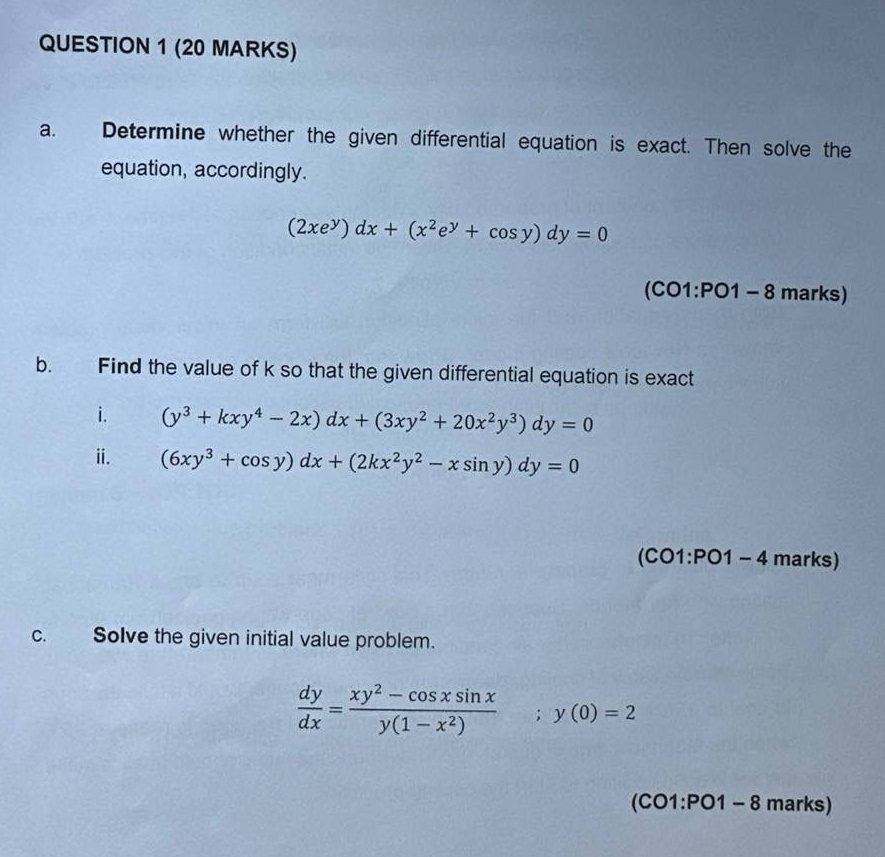 EG
QUESTION 1 (20 MARKS) bi:
a. Determine whether the given differential equation is ‘exac en
~iauie
equation, accordingly. he
La
tir
(2xe?) dx + (x?¢” + cosy) dy =0 E
(CO1:PO1~8 marks
4 i
EE
b. Find the value of k so that the given differential equation is exact
Sle
i O° + kxy* — 2x) dx + (3xy? + 20x23) dy = 0 Re
Ea
ii. (6xy* + cos y) dx + (2kx2y? — x siny) dy =0 4p Ye ye
gh,
HHI SE fe.
(€o1:RO1 marke)
c. Solve the given initial value problem. fies Blois Br as
dy xy? —cosxsinx An
ax Ian (0) = 2
TIE) an iv
: is 7 SE
(COT:PO1 ~8 marks)
This is AI generated Response.
Asked by: gvr
Created at: 2025-08-05 20:52:03
Asked by: gvr
Created at: 2025-08-05 20:52:03
Final Answer:
Rendered
Raw Text
Did you like this answer?
Let's solve each part step-by-step:
---
## (a) **Exactness and Solution**
Given:
\[
(2x e^y) dx + (x^2 e^y + \cos y) dy = 0
\]
Let \( M(x, y) = 2x e^y \) and \( N(x, y) = x^2 e^y + \cos y \).
### **Step 1: Check for Exactness**
A differential equation \( M(x, y) dx + N(x, y) dy = 0 \) is **exact** if:
\[
\frac{\partial M}{\partial y} = \frac{\partial N}{\partial x}
\]
Calculate:
- \( \frac{\partial M}{\partial y} = \frac{\partial}{\partial y}(2x e^y) = 2x e^y \)
- \( \frac{\partial N}{\partial x} = \frac{\partial}{\partial x}(x^2 e^y + \cos y) = 2x e^y \)
Since \( \frac{\partial M}{\partial y} = \frac{\partial N}{\partial x} \), **the equation is exact.**
---
### **Step 2: Find the Solution**
There exists a function \( F(x, y) \) such that:
\[
\frac{\partial F}{\partial x} = M(x, y) \quad \text{and} \quad \frac{\partial F}{\partial y} = N(x, y)
\]
Integrate \( M(x, y) \) with respect to \( x \):
\[
F(x, y) = \int 2x e^y dx = x^2 e^y + h(y)
\]
Now, differentiate with respect to \( y \):
\[
\frac{\partial F}{\partial y} = x^2 e^y + h'(y)
\]
Set equal to \( N(x, y) \):
\[
x^2 e^y + h'(y) = x^2 e^y + \cos y \implies h'(y) = \cos y \implies h(y) = \sin y
\]
So,
\[
F(x, y) = x^2 e^y + \sin y
\]
**General solution:**
\[
\boxed{x^2 e^y + \sin y = C}
\]
---
## (b) **Find \( k \) for Exactness**
### **(i)**
Given:
\[
M = y^3 + k x y^4 - 2x, \quad N = 3x y^2 + 20x^2 y^3
\]
Calculate:
- \( \frac{\partial M}{\partial y} = 3y^2 + 4k x y^3 \)
- \( \frac{\partial N}{\partial x} = 3y^2 + 40x y^3 \)
Set equal for exactness:
\[
3y^2 + 4k x y^3 = 3y^2 + 40x y^3 \implies 4k x y^3 = 40x y^3 \implies 4k = 40 \implies k = 10
\]
**Final answer:** \(\boxed{k = 10}\)
---
### **(ii)**
Given:
\[
M = 6x y^3 + \cos y, \quad N = 2k x^2 y^2 - x \sin y
\]
Calculate:
- \( \frac{\partial M}{\partial y} = 18x y^2 - \sin y \)
- \( \frac{\partial N}{\partial x} = 4k x y^2 - \sin y \)
Set equal for exactness:
\[
18x y^2 - \sin y = 4k x y^2 - \sin y \implies 18x y^2 = 4k x y^2 \implies 18 = 4k \implies k = \frac{9}{2}
\]
**Final answer:** \(\boxed{k = \dfrac{9}{2}}\)
---
## (c) **Initial Value Problem**
\[
\frac{dy}{dx} = \frac{xy^2 - \cos x \sin x}{y(1-x^2)}, \qquad y(0) = 2
\]
### **Step 1: Rearrangement**
\[
\frac{dy}{dx} = \frac{xy^2}{y(1-x^2)} - \frac{\cos x \sin x}{y(1-x^2)}
= \frac{x y}{1-x^2} - \frac{\cos x \sin x}{y(1-x^2)}
\]
Bring \( y \) terms to one side:
\[
y \, \frac{dy}{dx} = \frac{x y^2}{1-x^2} - \frac{\cos x \sin x}{1-x^2}
\]
Write as:
\[
y \frac{dy}{dx} - \frac{x y^2}{1-x^2} = -\frac{\cos x \sin x}{1-x^2}
\]
Alternatively, bring all terms involving \( y \) to one side:
\[
\frac{dy}{dx} - \frac{x}{1-x^2} y = -\frac{\cos x \sin x}{y(1-x^2)}
\]
Multiply both sides by \( y \):
\[
y \frac{dy}{dx} - \frac{x}{1-x^2} y^2 = -\frac{\cos x \sin x}{1-x^2}
\]
Let’s separate variables if possible:
\[
y \frac{dy}{dx} = \frac{x y^2 - \cos x \sin x}{1-x^2}
\]
Now, write as:
\[
y \frac{dy}{dx} = \frac{x y^2}{1-x^2} - \frac{\cos x \sin x}{1-x^2}
\]
Let’s try to separate variables:
\[
y \frac{dy}{dx} - \frac{x y^2}{1-x^2} = - \frac{\cos x \sin x}{1-x^2}
\]
Now, \( y \frac{dy}{dx} - \frac{x}{1-x^2} y^2 \) is a linear ODE in \( y^2 \). Let’s use substitution:
Let \( u = y^2 \implies \frac{du}{dx} = 2y \frac{dy}{dx} \implies y \frac{dy}{dx} = \frac{1}{2} \frac{du}{dx} \)
Substitute:
\[
\frac{1}{2} \frac{du}{dx} - \frac{x}{1-x^2} u = -\frac{\cos x \sin x}{1-x^2}
\]
Multiply both sides by 2:
\[
\frac{du}{dx} - \frac{2x}{1-x^2} u = -\frac{2 \cos x \sin x}{1-x^2}
\]
This is a linear ODE in \( u \):
\[
\frac{du}{dx} + P(x) u = Q(x)
\]
where \( P(x) = -\frac{2x}{1-x^2} \), \( Q(x) = -\frac{2 \cos x \sin x}{1-x^2} \)
### **Step 2: Find Integrating Factor**
\[
\text{IF} = \exp\left(\int -\frac{2x}{1-x^2} dx \right)
\]
Let \( 1-x^2 = t \implies dt = -2x dx \implies -\frac{1}{2} dt = x dx \)
So,
\[
\int -\frac{2x}{1-x^2} dx = \int \frac{2x}{x^2-1} dx
\]
But let's be careful with the sign:
\[
-\frac{2x}{1-x^2} = \frac{2x}{x^2-1}
\]
So,
\[
\int \frac{2x}{x^2-1} dx
\]
Let \( s = x^2-1 \implies ds = 2x dx \implies \frac{ds}{s} = dx \)
Therefore,
\[
\int \frac{2x}{x^2-1} dx = \int \frac{ds}{s} = \ln|x^2-1|
\]
So,
\[
\text{Integrating factor} = e^{\ln|x^2-1|} = |x^2-1|
\]
Assume \( x^2<1 \) for initial value \( x=0 \), so \( x^2-1 < 0 \), but integrating factor can be \( x^2-1 \).
### **Step 3: Multiply Through by Integrating Factor**
Multiply both sides by \( x^2-1 \):
\[
(x^2-1) \frac{du}{dx} - 2x u = -2 \cos x \sin x
\]
But recall, integrating factor method: Multiply both sides by \( x^2-1 \):
\[
\frac{d}{dx}[(x^2-1) u] = -2 \cos x \sin x
\]
### **Step 4: Integrate Both Sides**
\[
\frac{d}{dx} [(x^2-1) u] = -2 \cos x \sin x
\]
\[
(x^2-1) u = \int -2 \cos x \sin x dx + C
\]
Recall:
\[
-2 \cos x \sin x = -\sin 2x
\]
So,
\[
\int -2 \cos x \sin x dx = \int -\sin 2x dx = \frac{\cos 2x}{2}
\]
Thus,
\[
(x^2-1) u = \frac{\cos 2x}{2} + C
\]
Recall \( u = y^2 \):
\[
(x^2-1) y^2 = \frac{\cos 2x}{2} + C
\]
### **Step 5: Apply Initial Condition \( y(0) = 2 \)**
At \( x = 0 \), \( y = 2 \):
\[
(0^2-1)(2^2) = \frac{\cos 0}{2} + C
\]
\[
(-1)(4) = \frac{1}{2} + C
\]
\[
-4 = \frac{1}{2} + C
\]
\[
C = -4 - \frac{1}{2} = -\frac{9}{2}
\]
### **Step 6: Write Final Solution**
\[
(x^2-1) y^2 = \frac{\cos 2x}{2} - \frac{9}{2}
\]
Or,
\[
\boxed{
(x^2-1) y^2 = \frac{\cos 2x - 9}{2}
}
\]
Or, solving for \( y \):
\[
\boxed{
y(x) = \pm \sqrt{\frac{\cos 2x - 9}{2(x^2-1)}}
}
\]
But considering initial value \( y(0) = 2 > 0 \), take the positive root.
---
## **Summary of Final Answers**
### (a)
\[
\boxed{x^2 e^y + \sin y = C}
\]
### (b)
(i) \( \boxed{k = 10} \)
(ii) \( \boxed{k = \frac{9}{2}} \)
### (c)
\[
\boxed{
y(x) = \sqrt{\frac{\cos 2x - 9}{2(x^2-1)}}
}
\]
with initial condition \( y(0) = 2 \).
📢 Instructions:
- Ask anything relatd to above question only.
- For new Question goto :