VIPSolutions logo ✨ VIPSolutions

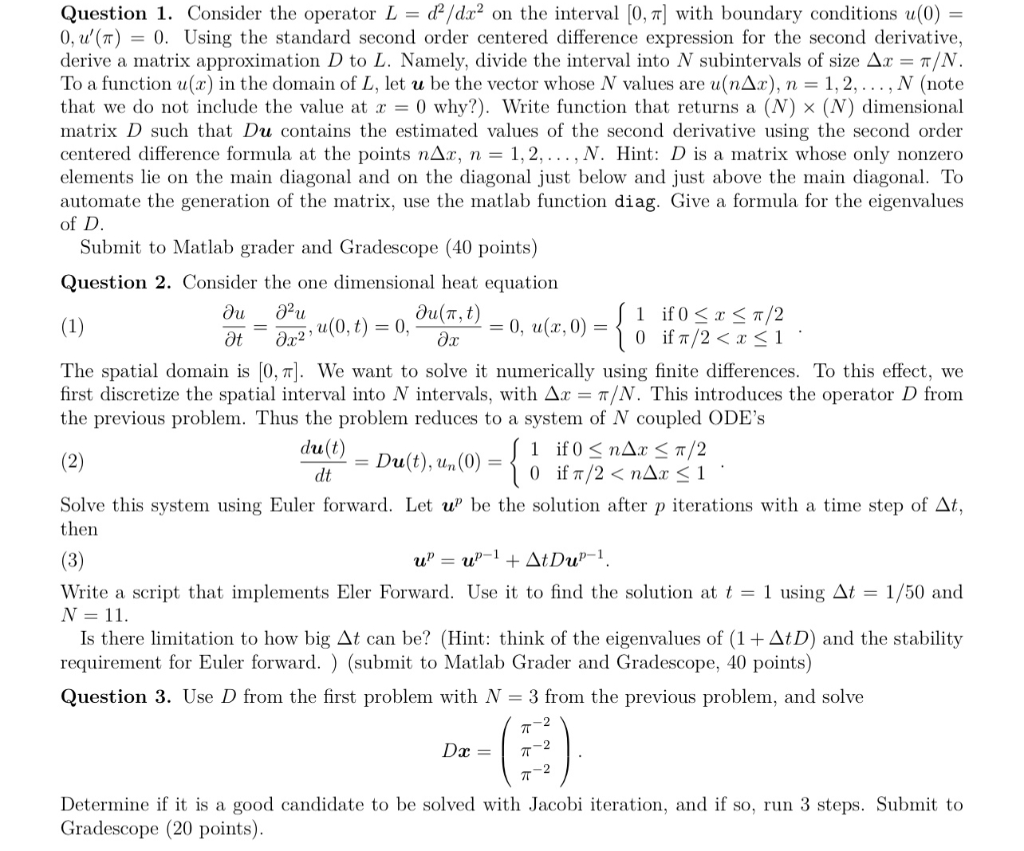
Give step-by-step solution with explanation and final answer:Question 1. Consider the operator L = d?/dz? on the interval [0,7] with boundary conditions u(0) = 0,/(r) = 0. Using the standard second order centered difference expression for the second derivative, derive a matrix approximation D to L. Namely, divide the interval into N subintervals of size Az = m/N. To a function u(x) in the domain of L, let u be the vector whose N values are u(nAz), n = 1,2,..., N (note that we do not include the value at z = 0 why?). Waite function that returns a (N) x (N) dimensional matrix D such that Du contains the estimated values of the second derivative using the second order centered difference formula at the points nAz, n = 1,2,..., N. Hint: D is a matrix whose only nonzero elements lie on the main diagonal and on the diagonal just below and just above the main diagonal. To automate the generation of the matrix, use the matlab function diag. Give a formula for the eigenvalues of D. Submit to Matlab grader and Gradescope (40 points) Question 2. Consider the one dimensional heat equation ou tu du(r, 1) 1 if0

Question:

Give step-by-step solution with explanation and final answer:Uploaded ImageQuestion 1. Consider the operator L = d?/dz? on the interval [0,7] with boundary conditions u(0) = 0,/(r) = 0. Using the standard second order centered difference expression for the second derivative, derive a matrix approximation D to L. Namely, divide the interval into N subintervals of size Az = m/N. To a function u(x) in the domain of L, let u be the vector whose N values are u(nAz), n = 1,2,..., N (note that we do not include the value at z = 0 why?). Waite function that returns a (N) x (N) dimensional matrix D such that Du contains the estimated values of the second derivative using the second order centered difference formula at the points nAz, n = 1,2,..., N. Hint: D is a matrix whose only nonzero elements lie on the main diagonal and on the diagonal just below and just above the main diagonal. To automate the generation of the matrix, use the matlab function diag. Give a formula for the eigenvalues of D. Submit to Matlab grader and Gradescope (40 points) Question 2. Consider the one dimensional heat equation ou tu du(r, 1) 1 if0
This is AI generated Response.
Asked by: gvr
Created at: 2025-08-05 14:13:48

Final Answer:

Rendered Raw Text
Did you like this answer?
Let's break down **Question 1** step by step: --- ### **Question 1:** Finite Difference Matrix for \( L = \frac{d^2}{dx^2} \) #### **Step 1: Discretize the Interval** - Interval: \( [0, \pi] \) - Divide into \( N \) subintervals of size \( \Delta x = \pi / N \). - Points: \( x_n = n\Delta x \), \( n = 1, 2, ..., N \) (do **not** include \( x=0 \) or \( x=\pi \); these are boundary points). #### **Step 2: Centered Second Difference Approximation** For \( u''(x_n) \): \[ u''(x_n) \approx \frac{u(x_{n-1}) - 2u(x_n) + u(x_{n+1})}{\Delta x^2} \] #### **Step 3: Construct the Matrix \( D \)** - \( D \) is an \( N \times N \) tridiagonal matrix. - Main diagonal: \( -2/\Delta x^2 \) - Super- and sub-diagonal: \( 1/\Delta x^2 \) So, \[ D = \frac{1}{\Delta x^2} \begin{bmatrix} -2 & 1 & 0 & \cdots & 0 \\ 1 & -2 & 1 & \ddots & \vdots \\ 0 & 1 & -2 & \ddots & 0 \\ \vdots & \ddots & \ddots & \ddots & 1 \\ 0 & \cdots & 0 & 1 & -2 \end{bmatrix} \] In **Matlab**: ```matlab N = ...; % number of interior points dx = pi/N; D = diag(-2*ones(N,1)) + diag(ones(N-1,1),1) + diag(ones(N-1,1),-1); D = D/(dx^2); ``` #### **Step 4: Formula for Eigenvalues of \( D \)** The eigenvalues of this matrix are: \[ \lambda_j = -\frac{4}{\Delta x^2} \sin^2\left(\frac{j\pi}{2(N+1)}\right) \quad \text{for } j = 1, 2, ..., N \] #### **Summary Table** | Step | Expression/Formula | |-------------------------|---------------------------------------------------------------------------------------------------| | Discretization | \( x_n = n\Delta x, \quad n=1,\ldots,N \) | | Centered difference | \( u''(x_n) \approx \frac{u(x_{n-1}) - 2u(x_n) + u(x_{n+1})}{\Delta x^2} \) | | Matrix \( D \) | Tridiagonal: main = \(-2/\Delta x^2\), off-diagonals = \(1/\Delta x^2\) | | Matlab code | See above | | Eigenvalues of \( D \) | \( \lambda_j = -\frac{4}{\Delta x^2} \sin^2\left(\frac{j\pi}{2(N+1)}\right),\; j=1,\ldots,N \) | --- ### **Final Answers** #### **a) Matrix \( D \) formula**: \[ D = \frac{1}{\Delta x^2} \begin{bmatrix} -2 & 1 & 0 & \cdots & 0 \\ 1 & -2 & 1 & \ddots & \vdots \\ 0 & 1 & -2 & \ddots & 0 \\ \vdots & \ddots & \ddots & \ddots & 1 \\ 0 & \cdots & 0 & 1 & -2 \end{bmatrix} \] #### **b) Eigenvalues of \( D \)**: \[ \boxed{ \lambda_j = -\frac{4}{\Delta x^2} \sin^2\left(\frac{j\pi}{2(N+1)}\right),\quad j=1,\ldots,N } \] --- If you need the Matlab function for matrix generation or more details, let me know!

📢 Instructions:

  • Ask anything relatd to above question only.
  • For new Question goto :

Study Help, Fast Answers

VIPSolutions focuses on clear, step‑by‑step explanations so you can learn quickly. Whether you need an AI‑generated walkthrough or a short hint to get unstuck, each solution is organized for fast reading and easy review later.

Search similar questions, compare approaches, and bookmark the best answers for revision. Our goal is simple: quick, reliable study help that feels natural—not noisy.