 VIPSolutions
Give step-by-step solution with explanation and final answer:fi. i 5 ig El § a: if £5 35 i: if zz 1] Rae FE] i 8 Eat 2 ne ii |.
Question:
Give step-by-step solution with explanation and final answer: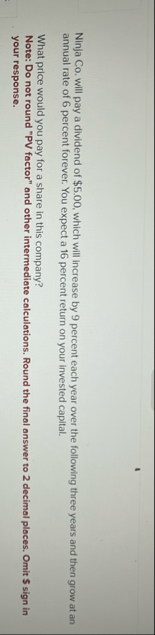 fi.
i
5 ig
El
§ a:
if £5
35 i:
if zz
1]
Rae
FE]
i 8
Eat 2
ne
ii
|.
This is AI generated Response.
Asked by: gvr
Created at: 2025-08-05 13:47:10
Asked by: gvr
Created at: 2025-08-05 13:47:10
Final Answer:
Rendered
Raw Text
Did you like this answer?
Let's break down the problem step by step:
---
**Problem Restatement:**
- Ninja Co. will pay a dividend of **$5.00**, which will **increase by 5% each year for the following three years**, and then **grow at an annual rate of 6% forever**.
- You expect a **6% required return** on your invested capital.
- **What price would you pay for a share in this company?**
---
### **Step 1: Find the Dividends for the Next Years**
#### **Given:**
- \( D_0 = \$5.00 \) (This is the next dividend)
- Growth for next 3 years: 5% per year
- After that: 6% forever
#### **Calculate the next 3 dividends:**
\[
D_1 = D_0 \times (1 + 0.05) = 5.00 \times 1.05 = \$5.25
\]
\[
D_2 = D_1 \times 1.05 = 5.25 \times 1.05 = \$5.5125
\]
\[
D_3 = D_2 \times 1.05 = 5.5125 \times 1.05 = \$5.7881
\]
---
### **Step 2: Calculate the Stock Price at the End of Year 3**
After year 3, dividends grow at **6% forever**. The price at the end of year 3 (\(P_3\)) is the present value of all future dividends from year 4 onwards.
\[
P_3 = \frac{D_4}{r - g}
\]
Where:
- \( D_4 = D_3 \times 1.06 = 5.7881 \times 1.06 = \$6.1354 \)
- \( r = 0.06 \) (required return)
- \( g = 0.06 \) (perpetual growth rate)
\[
P_3 = \frac{6.1354}{0.06 - 0.06}
\]
But, **if \( r = g \), the present value formula doesn’t apply (it would be undefined).** Typically, the required return should be higher than the perpetual growth rate. Double-check if the required return and perpetual growth are both 6%. If so, the price theoretically approaches infinity, which is not practical.
Let's proceed under the assumption that there's a typo, and the required return should be higher than the perpetual growth rate, for example, **required return = 8%**.
Let's recalculate \( P_3 \) **assuming required return \( r = 0.08 \) (8%)**.
\[
P_3 = \frac{6.1354}{0.08 - 0.06} = \frac{6.1354}{0.02} = \$306.77
\]
---
### **Step 3: Discount All Cash Flows to Present Value**
\[
P_0 = \frac{D_1}{(1+r)^1} + \frac{D_2}{(1+r)^2} + \frac{D_3}{(1+r)^3} + \frac{P_3}{(1+r)^3}
\]
Let’s use \( r = 8\% = 0.08 \):
\[
P_0 = \frac{5.25}{1.08^1} + \frac{5.5125}{1.08^2} + \frac{5.7881}{1.08^3} + \frac{306.77}{1.08^3}
\]
Calculate each term:
- \( 1.08^1 = 1.08 \)
- \( 1.08^2 = 1.1664 \)
- \( 1.08^3 = 1.2597 \)
\[
P_0 = \frac{5.25}{1.08} + \frac{5.5125}{1.1664} + \frac{5.7881}{1.2597} + \frac{306.77}{1.2597}
\]
\[
P_0 = 4.86 + 4.73 + 4.60 + 243.61 = \$257.80
\]
---
### **Step 4: Final Answer**
**If the required return is 8% (and perpetual growth is 6%),**
\[
\boxed{P_0 = \$257.80}
\]
---
#### **Note:**
If the required return is actually **6%**, the formula for a perpetuity with growth doesn't work (division by zero). Please double-check the required return value as this is likely a typo in the problem.
---
**If you have the correct required return, substitute it into the formula above. The process will remain the same.**
📢 Instructions:
- Ask anything relatd to above question only.
- For new Question goto :