 VIPSolutions
Give step-by-step solution with explanation and final answer:
Question:
Give step-by-step solution with explanation and final answer: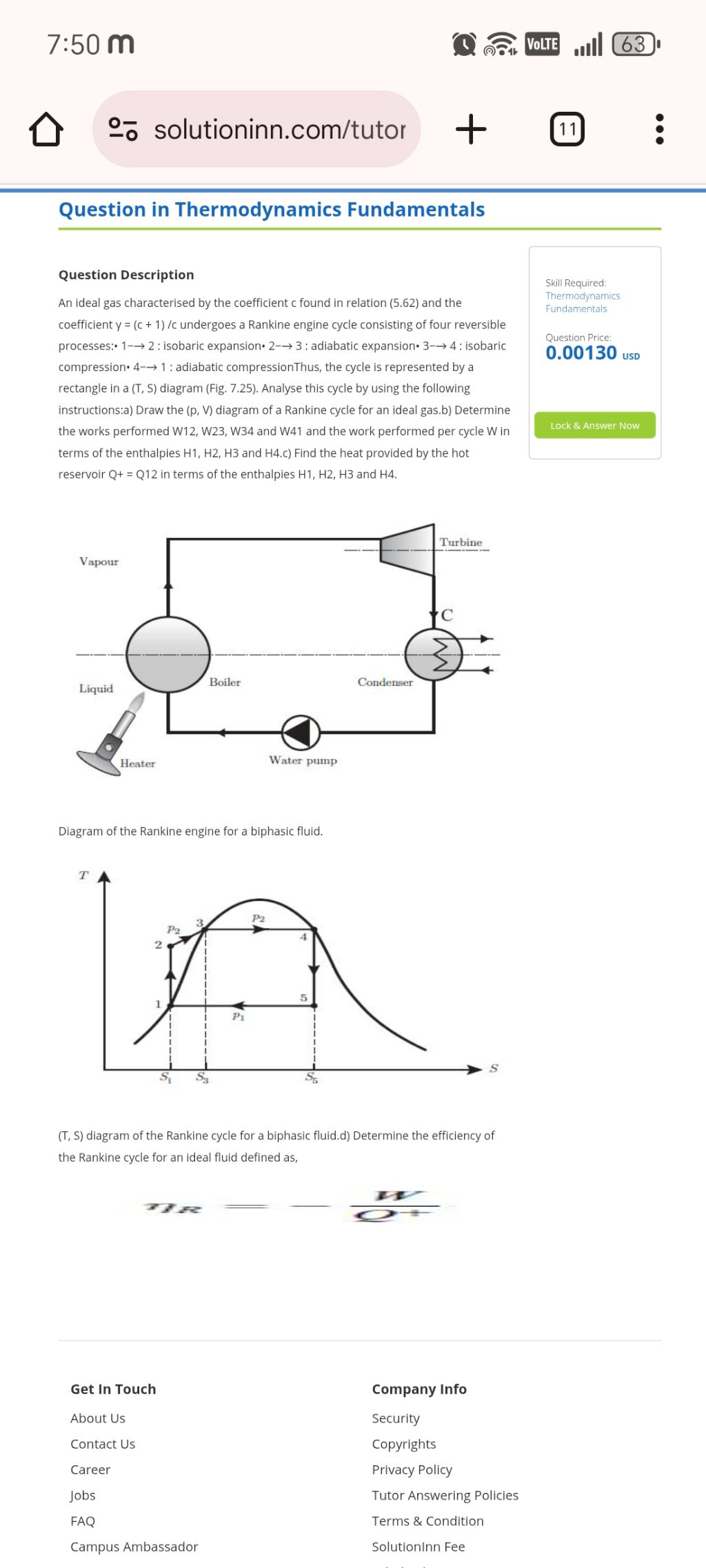
This is AI generated Response.
Asked by: Kota Swarupa Rani
Created at: 2025-08-04 19:52:54
Asked by: Kota Swarupa Rani
Created at: 2025-08-04 19:52:54
Final Answer:
Rendered
Raw Text
Did you like this answer?
Let's solve the Rankine cycle problem step by step:
---
### **Given:**
- Rankine cycle for an **ideal gas** (not steam!)
- Four **reversible processes**:
1. **1→2:** Isobaric expansion (constant pressure)
2. **2→3:** Adiabatic expansion (isentropic)
3. **3→4:** Isobaric compression (constant pressure)
4. **4→1:** Adiabatic compression (isentropic)
- Need to analyze the cycle:
---
## **a) Draw the (p, V) diagram for the Rankine cycle for an ideal gas**
### **Steps:**
1. **Isobaric expansion (1→2):**
- Pressure constant, volume increases.
2. **Adiabatic expansion (2→3):**
- Pressure and volume both decrease, but entropy stays constant.
3. **Isobaric compression (3→4):**
- Pressure constant (lower than 1→2), volume decreases.
4. **Adiabatic compression (4→1):**
- Pressure and volume both increase, entropy stays constant.
#### **Diagram**
- The (p, V) diagram forms a closed loop:
- **1→2:** horizontal line (constant p, V↑)
- **2→3:** curve down left (adiabatic, V↑, p↓)
- **3→4:** horizontal line (constant p, V↓)
- **4→1:** curve up right (adiabatic, V↓, p↑)
---
## **b) Work performed in each process and per cycle**
### **Work for each process:**
#### **1→2 (Isobaric expansion):**
\[
W_{12} = P_1 (V_2 - V_1)
\]
#### **2→3 (Adiabatic expansion):**
\[
W_{23} = \int_{V_2}^{V_3} P \, dV
\]
For ideal gas and adiabatic process:
\[
PV^\gamma = \text{constant}
\]
\[
W_{23} = \frac{P_2 V_2 - P_3 V_3}{\gamma - 1}
\]
#### **3→4 (Isobaric compression):**
\[
W_{34} = P_3 (V_4 - V_3)
\]
#### **4→1 (Adiabatic compression):**
\[
W_{41} = \int_{V_4}^{V_1} P \, dV = \frac{P_4 V_4 - P_1 V_1}{\gamma - 1}
\]
### **Net work per cycle:**
\[
W_{cycle} = W_{12} + W_{23} + W_{34} + W_{41}
\]
#### **In terms of enthalpies:**
- For an ideal gas, work (and heat) can be related to enthalpy changes for isobaric and adiabatic processes:
- Isobaric: \( Q = H_2 - H_1 \)
- Adiabatic: \( Q = 0 \), \( \Delta H = C_p(T_{end} - T_{start}) \)
---
## **c) Heat provided by the hot reservoir (Q⁺)**
Heat input is during **isobaric expansion (1→2):**
\[
Q_{in} = Q_{12} = H_2 - H_1
\]
Heat rejected (3→4):
\[
Q_{out} = Q_{34} = H_4 - H_3
\]
So,
\[
Q^+ = Q_{12} = H_2 - H_1
\]
---
## **d) Efficiency of the Rankine cycle**
\[
\eta_{R} = \frac{W_{cycle}}{Q^+}
\]
But,
\[
W_{cycle} = (H_2 - H_1) + (H_3 - H_2) + (H_4 - H_3) + (H_1 - H_4)
\]
\[
W_{cycle} = (H_2 - H_1) + (H_4 - H_3) + (H_3 - H_2) + (H_1 - H_4)
\]
But since adiabatic steps have \( Q = 0 \), only net enthalpy difference over the isobaric legs matter.
So,
\[
\eta_{R} = \frac{(H_2 - H_1) + (H_4 - H_3)}{H_2 - H_1}
\]
But since \( H_4 < H_3 \), \( H_4 - H_3 \) is negative (work done out), so:
\[
\eta_{R} = 1 - \frac{Q_{out}}{Q_{in}} = 1 - \frac{H_4 - H_3}{H_2 - H_1}
\]
---
### **Final Answers Summarized**
#### **a) (p, V) diagram:**
Draw a rectangle with two isobaric and two adiabatic curves as sides.
#### **b) Work per process:**
- \( W_{12} = P_1(V_2 - V_1) \)
- \( W_{23} = \frac{P_2V_2 - P_3V_3}{\gamma-1} \)
- \( W_{34} = P_3(V_4 - V_3) \)
- \( W_{41} = \frac{P_4V_4 - P_1V_1}{\gamma-1} \)
#### **c) Heat input:**
- \( Q^+ = Q_{12} = H_2 - H_1 \)
#### **d) Efficiency:**
\[
\boxed{
\eta_{R} = 1 - \frac{H_4 - H_3}{H_2 - H_1}
}
\]
Where \( H_1, H_2, H_3, H_4 \) are the enthalpies at states 1, 2, 3, 4 respectively.
---
**If you need further numerical examples or step-wise calculation with values, let me know!**
📢 Instructions:
- Ask anything relatd to above question only.
- For new Question goto :