Give step-by-step solution with explanation and final answer:"ng cost map th fon em sing es meth vey he cc
Cl CR
=
Heh
Question:
Give step-by-step solution with explanation and final answer:"ng cost map th fon em sing es meth vey he cc
Cl CR
=
Heh
This is AI generated Response.
Asked by: mohit
Created at: 2025-08-04 00:05:08
Final Answer:
RenderedRaw Text
Did you like this answer?
Let's solve the problem step by step:
## Step 1: Label the System
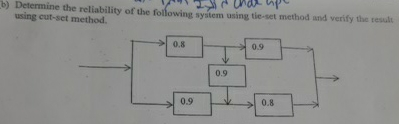
Let’s label the blocks for clarity:
```
A (0.8) ──┬── B (0.9) ──┬
│ │
├─ C (0.9) ───┤
│ │
D (0.9) ──┴── E (0.8) ──┘
```
- A = 0.8
- B = 0.9
- C = 0.9
- D = 0.9
- E = 0.8
There are two parallel paths:
- Upper path: A → B
- Middle path: C
- Lower path: D → E
## Step 2: Find All Tie-Sets (Minimal Path Sets)
A tie-set (path set) is a set of components whose *functioning* ensures system success.
**Path 1:** A → B
**Path 2:** C
**Path 3:** D → E
## Step 3: Write Reliability for Each Path
- Path 1: Reliability = P(A) × P(B) = 0.8 × 0.9 = **0.72**
- Path 2: Reliability = P(C) = **0.9**
- Path 3: Reliability = P(D) × P(E) = 0.9 × 0.8 = **0.72**
## Step 4: System Reliability Using Tie-Set (Path Set) Method
System works if **at least one path works**.
Let \( R_1, R_2, R_3 \) be the reliabilities of each path.
System Reliability, \( R_{sys} \):
\[
R_{sys} = P(\text{at least one works}) = 1 - P(\text{all fail})
\]
Probability all fail:
- Path 1 fails: \( 1 - 0.72 = 0.28 \)
- Path 2 fails: \( 1 - 0.9 = 0.1 \)
- Path 3 fails: \( 1 - 0.72 = 0.28 \)
All paths fail: \( 0.28 \times 0.1 \times 0.28 = 0.00784 \)
So,
\[
R_{sys} = 1 - 0.00784 = \boxed{0.9922}
\]
---
### Step 5: Verify Using Cut-Set Method
A minimal cut-set is a set whose *failure* causes system failure.
Let's find all minimal cut-sets.
#### Cut-Set 1: (A and B) fail
#### Cut-Set 2: (C) fails
#### Cut-Set 3: (D and E) fail
System fails if **all three parallel paths fail**:
- Path 1 fails: either A or B fails (\(1 - 0.8 \times 0.9 = 1 - 0.72 = 0.28\))
- Path 2 fails: C fails (\(1 - 0.9 = 0.1\))
- Path 3 fails: either D or E fails (\(1 - 0.9 \times 0.8 = 1 - 0.72 = 0.28\))
System fails if all three fail simultaneously:
\[
P_{fail} = 0.28 \times 0.1 \times 0.28 = 0.00784
\]
Thus,
\[
R_{sys} = 1 - 0.00784 = \boxed{0.9922}
\]
---
## **Final Answer:**
\[
\boxed{R_{sys} = 0.9922}
\]
This matches for both tie-set and cut-set methods.
Question:
is the above answer is correct or below one
To solve this reliability problem using **tie-set** and **cut-set** methods, we need to analyze the **network of components** (with given reliabilities) and evaluate the **overall system reliability**.
---
## ? **Understanding the Diagram**
From the diagram:
* There are **two main paths** from input to output:
* **Upper path**: 0.8 → 0.9
* **Middle path**: 0.9
* **Lower path**: 0.9 → 0.8
So we identify **3 parallel paths** from input to output:
```
Path 1 (Top): R1 = 0.8, R2 = 0.9 → Rtop = 0.8 × 0.9 = 0.72
Path 2 (Middle): R3 = 0.9 → Rmid = 0.9
Path 3 (Bottom): R4 = 0.9, R5 = 0.8 → Rbot = 0.9 × 0.8 = 0.72
```
---
## ? **Tie-Set Method (Parallel Paths)**
In this method, we compute the **probability that at least one path works**.
Let:
* $R_{\text{top}} = 0.72$
* $R_{\text{mid}} = 0.9$
* $R_{\text{bot}} = 0.72$
System reliability:
$$
R_{\text{system}} = 1 - [(1 - R_{\text{top}}) \cdot (1 - R_{\text{mid}}) \cdot (1 - R_{\text{bot}})]
$$
$$
= 1 - [(1 - 0.72)(1 - 0.9)(1 - 0.72)] \\
= 1 - [0.28 \cdot 0.1 \cdot 0.28] \\
= 1 - [0.00784] \\
= \boxed{0.99216}
$$
---
## ✂️ **Cut-Set Method (Minimum Failure Sets)**
**Cut-set** is the set of components that, if they all fail, the system fails.
Minimal cut-sets (ways to block all paths):
1. Fail both elements in top path → $\bar{R}_1 \cdot \bar{R}_2$
2. Fail middle path → $\bar{R}_3$
3. Fail both elements in bottom path → $\bar{R}_4 \cdot \bar{R}_5$
So system fails if:
* All paths are broken:
$$
P_{\text{fail}} = (1 - 0.72)(1 - 0.9)(1 - 0.72) = 0.00784
$$
$$
R_{\text{system}} = 1 - P_{\text{fail}} = \boxed{0.99216}
$$
---
## ✅ Final Answer:
* **System Reliability**: $\boxed{0.99216}$
* **Method Used**: Tie-set (parallel success) and verified with Cut-set (parallel failure)
* **Difficulty**: **Medium** (typical question in reliability engineering for EE)
Let me know if you want a diagrammatic explanation or step-by-step tie/cut-set identification visually.
This is AI generated Response.
Asked by: mohit
Created at: 2025-08-04 00:12:09
Final Answer:
RenderedRaw Text
Did you like this answer?
Let's analyze this reliability problem step-by-step to determine the system's overall reliability.
---
### Step 1: Understand the system configuration
Based on the diagram, the system has **three parallel paths** from input to output:
- **Path 1 (Top Path):** Components with reliabilities 0.8 and 0.9 in series
- **Path 2 (Middle Path):** Single component with reliability 0.9
- **Path 3 (Bottom Path):** Components with reliabilities 0.9 and 0.8 in series
---
### Step 2: Calculate the reliability of each path
- **Path 1:**
\[
R_{1} = 0.8 \times 0.9 = 0.72
\]
- **Path 2:**
\[
R_{2} = 0.9
\]
- **Path 3:**
\[
R_{3} = 0.9 \times 0.8 = 0.72
\]
---
### Step 3: Find the probability that **at least one** path functions
Since the paths are in parallel, the system functions if **any** path functions.
The probability that **all paths fail**:
\[
P_{\text{all fail}} = (1 - R_{1}) \times (1 - R_{2}) \times (1 - R_{3}) = (1 - 0.72) \times (1 - 0.9) \times (1 - 0.72)
\]
\[
= 0.28 \times 0.1 \times 0.28 = 0.00784
\]
Thus,
\[
\boxed{
R_{\text{system}} = 1 - P_{\text{all fail}} = 1 - 0.00784 = \boxed{0.99216}
}
\]
---
### **Final answer:**
### **The system reliability is approximately \(\boxed{0.9922}\).**
---
### **Summary:**
- **Method:** Using the parallel path reliability formula.
- **Result:** System reliability ≈ 0.9922, meaning the system is highly reliable.
Let me know if you'd like further explanation on cut-set methods or diagrammatic reasoning!
VIPSolutions focuses on clear, step‑by‑step explanations so you can learn quickly. Whether you need an AI‑generated walkthrough or a short hint to get unstuck, each solution is organized for fast reading and easy review later.
Search similar questions, compare approaches, and bookmark the best answers for revision. Our goal is simple: quick, reliable study help that feels natural—not noisy.
 VIPSolutions
 "ng cost map th fon em sing es meth vey he cc
Cl CR
=
Heh