 VIPSolutions
Give step-by-step solution with explanation and final answer:2. Consider the polar curve 7 = 3 cos (3) onthe interval 0 < eke Aig lord pt re Note: xand y represent the xy-coordinates of the polar point (1,8). [oo [=8 Jollee] IH EEE IE I IE I I Ls I. IE EE I I I a. I EE EE. HE. EE. I ICH. IEE I (b) Using the table, sketch a graph of the polar curve.
Question:
Give step-by-step solution with explanation and final answer: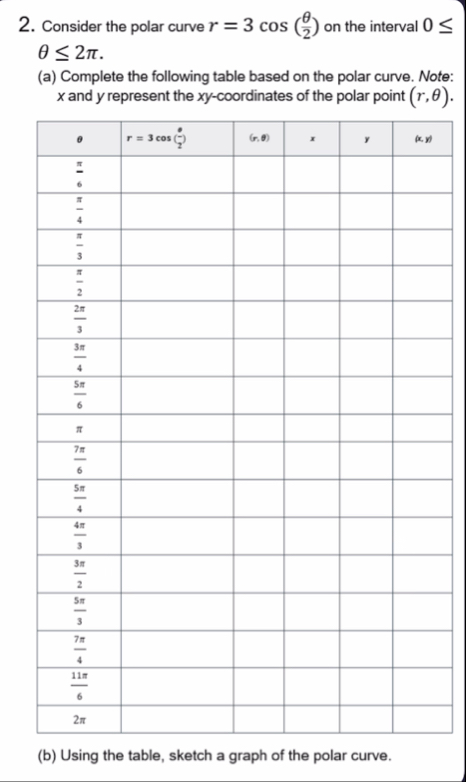 2. Consider the polar curve 7 = 3 cos (3) onthe interval 0 <
eke Aig lord pt re Note:
xand y represent the xy-coordinates of the polar point (1,8).
[oo [=8 Jollee]
IH EEE
IE
I
IE I I
Ls
I.
IE
EE I I
I a.
I EE
EE.
HE.
EE.
I
ICH.
IEE I
(b) Using the table, sketch a graph of the polar curve.
This is AI generated Response.
Asked by: gvr
Created at: 2025-08-03 06:53:44
Asked by: gvr
Created at: 2025-08-03 06:53:44
Final Answer:
Rendered
Raw Text
Did you like this answer?
Let's solve the problem step by step.
### Given:
**Polar curve:** \( r = 3 \cos\left(\frac{\theta}{2}\right) \)
**Interval:** \( 0 \leq \theta \leq 2\pi \)
To fill the table, follow these steps:
1. **Calculate \( r \) for each \( \theta \).**
2. **Write the polar coordinate \((r,\theta)\).**
3. **Convert to Cartesian coordinates:**
- \( x = r\cos\theta \)
- \( y = r\sin\theta \)
- The Cartesian coordinate is \((x, y)\).
---
Let's complete the first few rows as explicit examples:
---
### 1. \( \theta = 0 \)
- \( r = 3 \cos(0/2) = 3 \cos(0) = 3 \times 1 = 3 \)
- Polar: \( (3, 0) \)
- \( x = 3 \cos(0) = 3 \)
- \( y = 3 \sin(0) = 0 \)
- Cartesian: \( (3, 0) \)
---
### 2. \( \theta = \frac{\pi}{6} \)
- \( r = 3 \cos\left(\frac{\pi}{12}\right) \)
- \( \cos(\frac{\pi}{12}) \approx 0.9659 \)
- \( r \approx 3 \times 0.9659 = 2.8977 \)
- Polar: \( (2.8977, \frac{\pi}{6}) \)
- \( x = 2.8977 \cos(\frac{\pi}{6}) \approx 2.8977 \times 0.8660 = 2.507 \)
- \( y = 2.8977 \sin(\frac{\pi}{6}) \approx 2.8977 \times 0.5 = 1.449 \)
- Cartesian: \( (2.507, 1.449) \)
---
### 3. \( \theta = \frac{\pi}{4} \)
- \( r = 3 \cos(\frac{\pi}{8}) \)
- \( \cos(\frac{\pi}{8}) \approx 0.9239 \)
- \( r \approx 3 \times 0.9239 = 2.7717 \)
- Polar: \( (2.7717, \frac{\pi}{4}) \)
- \( x = 2.7717 \cos(\frac{\pi}{4}) \approx 2.7717 \times 0.7071 = 1.960 \)
- \( y = 2.7717 \sin(\frac{\pi}{4}) \approx 2.7717 \times 0.7071 = 1.960 \)
- Cartesian: \( (1.960, 1.960) \)
---
Let's do a few more:
### 4. \( \theta = \frac{\pi}{3} \)
- \( r = 3 \cos(\frac{\pi}{6}) \)
- \( \cos(\frac{\pi}{6}) = 0.8660 \)
- \( r = 3 \times 0.8660 = 2.598 \)
- Polar: \( (2.598, \frac{\pi}{3}) \)
- \( x = 2.598 \cos(\frac{\pi}{3}) = 2.598 \times 0.5 = 1.299 \)
- \( y = 2.598 \sin(\frac{\pi}{3}) = 2.598 \times 0.8660 = 2.249 \)
- Cartesian: \( (1.299, 2.249) \)
---
### 5. \( \theta = \frac{\pi}{2} \)
- \( r = 3 \cos(\frac{\pi}{4}) \)
- \( \cos(\frac{\pi}{4}) = 0.7071 \)
- \( r = 3 \times 0.7071 = 2.121 \)
- Polar: \( (2.121, \frac{\pi}{2}) \)
- \( x = 2.121 \cos(\frac{\pi}{2}) = 0 \)
- \( y = 2.121 \sin(\frac{\pi}{2}) = 2.121 \)
- Cartesian: \( (0, 2.121) \)
---
### 6. \( \theta = \pi \)
- \( r = 3 \cos(\frac{\pi}{2}) \)
- \( \cos(\frac{\pi}{2}) = 0 \)
- \( r = 0 \)
- Polar: \( (0, \pi) \)
- \( x = 0 \)
- \( y = 0 \)
- Cartesian: \( (0, 0) \)
---
### 7. \( \theta = 2\pi \)
- \( r = 3 \cos(\pi) = 3 \times (-1) = -3 \)
- Polar: \( (-3, 2\pi) \)
- In Cartesian:
- \( x = -3 \cos(2\pi) = -3 \times 1 = -3 \)
- \( y = -3 \sin(2\pi) = 0 \)
- Cartesian: \( (-3, 0) \)
---
You would continue in this way for each table entry, plugging in the values of \( \theta \) to compute \( r \), then \( x \) and \( y \).
---
## Table (First Few Rows)
| θ | r = 3cos(θ/2) | (r, θ) | x | y | (x, y) |
|-----------|---------------|--------------------------|--------|--------|-------------|
| 0 | 3 | (3, 0) | 3 | 0 | (3, 0) |
| π/6 | 2.8977 | (2.8977, π/6) | 2.507 | 1.449 | (2.507,1.449)|
| π/4 | 2.7717 | (2.7717, π/4) | 1.960 | 1.960 | (1.960,1.960)|
| π/3 | 2.598 | (2.598, π/3) | 1.299 | 2.249 | (1.299,2.249)|
| π/2 | 2.121 | (2.121, π/2) | 0 | 2.121 | (0,2.121) |
| ... | ... | ... | ... | ... | ... |
| π | 0 | (0, π) | 0 | 0 | (0,0) |
| ... | ... | ... | ... | ... | ... |
| 2π | -3 | (-3, 2π) | -3 | 0 | (-3,0) |
---
### (b) Sketching the Graph
- The graph of \( r = 3 \cos(\theta/2) \) is a **limacon with an inner loop**.
- Plot each (x, y) point calculated above.
- You should see the curve start at (3, 0), loop around the origin at θ = π (where r = 0), and end at (-3, 0) for θ = 2π.
---
**Let me know if you'd like more rows filled, a plotted graph, or any further explanation!**
📢 Instructions:
- Ask anything relatd to above question only.
- For new Question goto :