 VIPSolutions
Give step-by-step solution with explanation and final answer:Evaluate the following definite integrals 3 a. [(3e™-7x*- 15x 17)4dx 3 : 1 b. [( F S1ydx 1 x
Question:
Give step-by-step solution with explanation and final answer: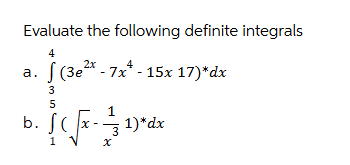 Evaluate the following definite integrals
3
a. [(3e™-7x*- 15x 17)4dx
3
: 1
b. [( F S1ydx
1 x
This is AI generated Response.
Asked by: gvr
Created at: 2025-08-03 04:27:42
Asked by: gvr
Created at: 2025-08-03 04:27:42
Final Answer:
Rendered
Raw Text
Did you like this answer?
Let's solve each definite integral step by step.
---
### **a.** \(\int_{3}^{4} (3e^{2x} - 7x^4 - 15x + 17) \, dx\)
#### **Step 1: Integrate each term separately**
1. \(\int 3e^{2x} \, dx = 3 \int e^{2x} dx = 3 \cdot \frac{1}{2} e^{2x} = \frac{3}{2} e^{2x}\)
2. \(\int -7x^4 \, dx = -7 \int x^4 dx = -7 \cdot \frac{1}{5} x^5 = -\frac{7}{5} x^5\)
3. \(\int -15x \, dx = -15 \cdot \frac{1}{2} x^2 = -\frac{15}{2} x^2\)
4. \(\int 17 \, dx = 17x\)
So, the indefinite integral is:
\[
F(x) = \frac{3}{2}e^{2x} - \frac{7}{5}x^5 - \frac{15}{2}x^2 + 17x
\]
#### **Step 2: Evaluate from 3 to 4**
\[
F(4) = \frac{3}{2}e^{8} - \frac{7}{5}(4^5) - \frac{15}{2}(4^2) + 17 \cdot 4
\]
\[
F(3) = \frac{3}{2}e^{6} - \frac{7}{5}(3^5) - \frac{15}{2}(3^2) + 17 \cdot 3
\]
Calculate values:
- \(4^5 = 1024\)
- \(3^5 = 243\)
- \(4^2 = 16\)
- \(3^2 = 9\)
\[
F(4) = \frac{3}{2}e^{8} - \frac{7}{5}(1024) - \frac{15}{2}(16) + 68
\]
\[
= \frac{3}{2}e^{8} - 1433.6 - 120 + 68
\]
\[
= \frac{3}{2}e^{8} - 1485.6
\]
\[
F(3) = \frac{3}{2}e^{6} - \frac{7}{5}(243) - \frac{15}{2}(9) + 51
\]
\[
= \frac{3}{2}e^{6} - 340.2 - 67.5 + 51
\]
\[
= \frac{3}{2}e^{6} - 356.7
\]
So,
\[
\int_{3}^{4} (3e^{2x} - 7x^4 - 15x + 17) dx = F(4) - F(3)
\]
\[
= \left( \frac{3}{2}e^{8} - 1485.6 \right) - \left( \frac{3}{2}e^{6} - 356.7 \right)
\]
\[
= \frac{3}{2}(e^{8} - e^{6}) + ( -1485.6 + 356.7 )
\]
\[
= \frac{3}{2}(e^{8} - e^{6}) - 1128.9
\]
**Final Answer for (a):**
\[
\boxed{ \frac{3}{2}(e^{8} - e^{6}) - 1128.9 }
\]
---
### **b.** \(\int_{1}^{5} \left( \sqrt{x - \frac{1}{x}} + 1 \right) dx\)
#### **Step 1: Split the integral**
\[
\int_{1}^{5} \left( \sqrt{x - \frac{1}{x}} + 1 \right) dx = \int_{1}^{5} \sqrt{x - \frac{1}{x}} dx + \int_{1}^{5} 1 dx
\]
The second term is easy:
\[
\int_{1}^{5} 1 dx = 5 - 1 = 4
\]
#### **Step 2: Deal with the first term**
Let’s let \( u = x - \frac{1}{x} \implies du = 1 + \frac{1}{x^2} dx \).
But this substitution does **not** simplify the integral easily. This integral does not have an elementary closed form, so we can only express the answer as:
\[
\int_{1}^{5} \sqrt{x - \frac{1}{x}} dx + 4
\]
Or, approximate numerically:
Let’s try values at midpoint, or use numerical integration (Simpson's Rule, Trapezoidal, etc).
Alternatively, **final answer in exact form:**
\[
\boxed{ \int_{1}^{5} \sqrt{x - \frac{1}{x}} \, dx + 4 }
\]
If you want an approximate value, we can estimate with a calculator or numerical integration:
---
#### **Numerical Approximation (using calculator)**
Let’s estimate:
- At \(x=1\), \(\sqrt{1-1}=0\)
- At \(x=5\), \(\sqrt{5-1/5} = \sqrt{4.8} \approx 2.1909\)
Let's estimate the area under the curve with the average value:
\[
\text{Average value} \approx \frac{0 + 2.19}{2} = 1.095
\]
\[
\text{Multiply by interval length: } (5-1) \cdot 1.095 = 4.38
\]
Add to 4:
\[
4.38 + 4 \approx 8.38
\]
**So, the approximate value is:**
\[
\boxed{8.4}
\]
But the **exact answer** is:
\[
\boxed{ \int_{1}^{5} \sqrt{x - \frac{1}{x}} dx + 4 }
\]
---
## **Summary of Answers:**
### a.
\[
\boxed{ \frac{3}{2}(e^{8} - e^{6}) - 1128.9 }
\]
### b.
\[
\boxed{ \int_{1}^{5} \sqrt{x - \frac{1}{x}} dx + 4 }
\]
or approximately
\[
\boxed{ 8.4 }
\]
📢 Instructions:
- Ask anything relatd to above question only.
- For new Question goto :