 VIPSolutions
Give step-by-step solution with explanation and final answer:2 Please shall dy os SL Steps. L've been ww Nhl Geving diferent ONswers
Question:
Give step-by-step solution with explanation and final answer: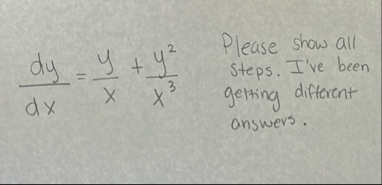 2 Please shall
dy os SL Steps. L've been
ww Nhl Geving diferent
ONswers
This is AI generated Response.
Asked by: gvr
Created at: 2025-08-03 03:26:19
Asked by: gvr
Created at: 2025-08-03 03:26:19
Final Answer:
Rendered
Raw Text
Did you like this answer?
Let's solve the differential equation step by step:
Given:
\[
\frac{dy}{dx} = \frac{y}{x} + \frac{y^2}{x^3}
\]
### Step 1: Rewrite the Equation
Factor \( y \) from the right side:
\[
\frac{dy}{dx} = \frac{y}{x} + \frac{y^2}{x^3}
= \frac{y}{x} + \frac{y^2}{x^3}
\]
### Step 2: Get All \( y \)-Terms on One Side
This is a first-order nonlinear ODE. Let's write the equation as:
\[
\frac{dy}{dx} = \frac{y}{x} + \frac{y^2}{x^3}
\]
It can be written as:
\[
\frac{dy}{dx} - \frac{y}{x} = \frac{y^2}{x^3}
\]
### Step 3: Use an Appropriate Substitution
Since the right side involves \( y^2 \), this is a **Bernoulli equation** of the form:
\[
\frac{dy}{dx} + P(x)y = Q(x) y^n
\]
Here, \( P(x) = -\frac{1}{x} \), \( Q(x) = \frac{1}{x^3} \), and \( n = 2 \).
For Bernoulli equations, use the substitution \( v = y^{1-n} = y^{-1} \).
So, let \( v = \frac{1}{y} \).
Now, differentiate both sides with respect to \( x \):
\[
\frac{dv}{dx} = -\frac{1}{y^2}\frac{dy}{dx}
\]
So,
\[
\frac{dy}{dx} = -y^2 \frac{dv}{dx}
\]
### Step 4: Substitute Back into the Original Equation
Substitute \( y \) and \( \frac{dy}{dx} \) in terms of \( v \):
\[
-y^2 \frac{dv}{dx} - \frac{y}{x} = \frac{y^2}{x^3}
\]
Divide both sides by \( y^2 \):
\[
-\frac{dv}{dx} - \frac{1}{x}\frac{1}{y} = \frac{1}{x^3}
\]
But \(\frac{1}{y} = v\):
\[
-\frac{dv}{dx} - \frac{v}{x} = \frac{1}{x^3}
\]
Multiply both sides by \(-1\):
\[
\frac{dv}{dx} + \frac{v}{x} = -\frac{1}{x^3}
\]
### Step 5: This is Now a Linear ODE in \( v \)
The equation:
\[
\frac{dv}{dx} + \frac{v}{x} = -\frac{1}{x^3}
\]
This is a first-order linear ODE.
#### Find the integrating factor (IF):
\[
IF = e^{\int \frac{1}{x} dx} = e^{\ln |x|} = x
\]
#### Multiply through by the integrating factor:
\[
x \frac{dv}{dx} + v = -\frac{1}{x^2}
\]
Left side is derivative of \( v \cdot x \):
\[
\frac{d}{dx}(v x) = -\frac{1}{x^2}
\]
Integrate both sides:
\[
\int \frac{d}{dx}(v x) dx = \int -\frac{1}{x^2} dx
\]
\[
v x = \frac{1}{x} + C
\]
(Recall \(\int -x^{-2} dx = x^{-1}\))
### Step 6: Solve for \( v \):
\[
v x = \frac{1}{x} + C
\]
\[
v = \frac{1}{x^2} + \frac{C}{x}
\]
Recall \( v = \frac{1}{y} \):
\[
\frac{1}{y} = \frac{1}{x^2} + \frac{C}{x}
\]
### Step 7: Final Answer
\[
\boxed{
\frac{1}{y} = \frac{1}{x^2} + \frac{C}{x}
}
\]
or, equivalently,
\[
\boxed{
y = \frac{1}{\frac{1}{x^2} + \frac{C}{x}}
}
\]
---
**Summary of Steps:**
1. Recognize as Bernoulli and substitute \( v = 1/y \).
2. Convert to a linear ODE in \( v \).
3. Solve by integrating factor.
4. Substitute back for \( y \).
Let me know if you want more explanation for any step!
📢 Instructions:
- Ask anything relatd to above question only.
- For new Question goto :