Did you like this answer?
👍 0
👎 0
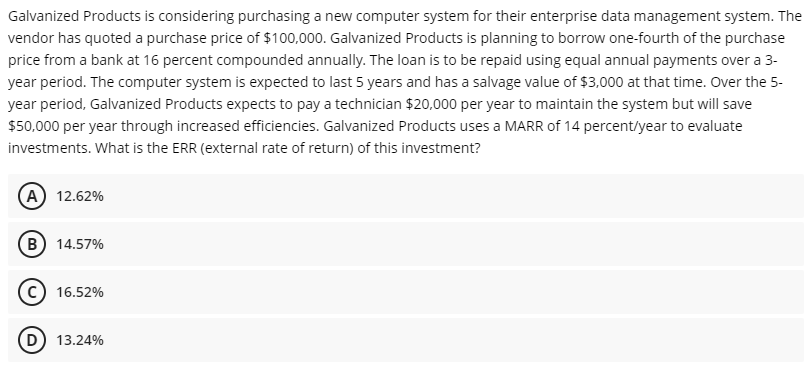
Let's break down the problem step by step.
### **Step 1: Data Extraction**
- **Purchase price:** $100,000
- **Loan amount (1/4 of purchase price):** $100,000 × 1/4 = **$25,000**
- **Own funds:** $75,000 (rest of purchase price)
- **Loan interest rate:** 16% compounded annually
- **Loan term:** 3 years, equal payments
- **System life:** 5 years
- **Salvage value at year 5:** $3,000
- **Annual technician cost:** $20,000/year (years 1-5)
- **Annual savings:** $50,000/year (years 1-5)
- **MARR for reinvestment (external rate):** 14% per year
We are to determine the **ERR (External Rate of Return)**.
---
### **Step 2: Loan Payment Calculation**
Calculate **annual loan payment** for $25,000 loan at 16% over 3 years.
The formula for annual payment \( A \) is:
\[
A = P \frac{i(1+i)^n}{(1+i)^n-1}
\]
where:
- \( P = 25,000 \)
- \( i = 0.16 \)
- \( n = 3 \)
\[
A = 25,000 \times \frac{0.16(1+0.16)^3}{(1+0.16)^3-1}
\]
First, calculate \( (1+0.16)^3 \):
\[
(1.16)^3 = 1.560896
\]
So,
\[
A = 25,000 \times \frac{0.16 \times 1.560896}{1.560896 - 1}
\]
\[
A = 25,000 \times \frac{0.24974336}{0.560896}
\]
\[
A = 25,000 \times 0.44533 = \$11,133.25
\]
---
### **Step 3: Cash Flow Diagram**
#### **Year 0**
- Outflow: -$100,000 (system purchase)
- Inflow: +$25,000 (loan)
- Net outflow: -$75,000
#### **Years 1-3**
- Loan payment: -$11,133.25 (years 1-3)
- Technician: -$20,000 (years 1-5)
- Savings: +$50,000 (years 1-5)
#### **Years 4-5**
- Technician: -$20,000
- Savings: +$50,000
#### **Year 5**
- Salvage value: +$3,000
---
### **Step 4: Net Cash Flows**
| Year | Net Cash Flow |
|------|---------------|
| 0 | -75,000 |
| 1 | 50,000 - 20,000 - 11,133.25 = **18,866.75** |
| 2 | 18,866.75 |
| 3 | 18,866.75 |
| 4 | 50,000 - 20,000 = **30,000** |
| 5 | 50,000 - 20,000 + 3,000 = **33,000** |
---
### **Step 5: Calculate ERR (External Rate of Return)**
ERR calculation:
- All **outflows** (costs, loan payment, technician) are compounded *forward* at the *MARR* (14%).
- All **inflows** (savings, salvage) are discounted *back* to present at the unknown ERR, and set equal.
#### **Future value of outflows at year 5 (compounded at 14%)**
1. **Year 0 outflow ($75,000) compounded for 5 years:**
\[
75,000 \times (1.14)^5 = 75,000 \times 1.9254 = 144,405
\]
2. **Yearly outflows (technician + loan payment):**
For years 1-3: Outflow = $31,133.25
For years 4-5: Outflow = $20,000
Let's compound each to year 5 at 14%:
- Year 1: \( 31,133.25 \times (1.14)^4 = 31,133.25 \times 1.6895 = 52,593 \)
- Year 2: \( 31,133.25 \times (1.14)^3 = 31,133.25 \times 1.4826 = 46,140 \)
- Year 3: \( 31,133.25 \times (1.14)^2 = 31,133.25 \times 1.2996 = 40,470 \)
- Year 4: \( 20,000 \times (1.14)^1 = 20,000 \times 1.14 = 22,800 \)
- Year 5: \( 20,000 \times (1.14)^0 = 20,000 \)
**Sum of compounded outflows:**
\[
144,405 + 52,593 + 46,140 + 40,470 + 22,800 + 20,000 = 326,408
\]
---
#### **Future value of inflows at year 5 (discounted at ERR)**
- Inflows: $50,000/year (years 1-5), $3,000 (year 5)
Let ERR = \( i \)
- Year 1: \( 50,000 \times (1+i)^4 \)
- Year 2: \( 50,000 \times (1+i)^3 \)
- Year 3: \( 50,000 \times (1+i)^2 \)
- Year 4: \( 50,000 \times (1+i)^1 \)
- Year 5: \( 50,000 + 3,000 = 53,000 \)
Sum all these inflows and set equal to 326,408:
\[
50,000(1+i)^4 + 50,000(1+i)^3 + 50,000(1+i)^2 + 50,000(1+i) + 53,000 = 326,408
\]
---
### **Step 6: Solve for ERR (\( i \))**
Let's try the options numerically.
#### **Option A: 12.62%**
\[
(1.1262): (1.1262)^1 = 1.1262; (1.1262)^2 = 1.2684; (1.1262)^3 = 1.429; (1.1262)^4 = 1.610
\]
\[
= 50,000 \times 1.610 + 50,000 \times 1.429 + 50,000 \times 1.2684 + 50,000 \times 1.1262 + 53,000
\]
\[
= 80,500 + 71,450 + 63,420 + 56,310 + 53,000 = 324,680
\]
This is close to the compounded outflows of **326,408**.
#### **Option B: 14.57%**
\[
(1.1457): (1.1457)^1 = 1.1457; (1.1457)^2 = 1.3126; (1.1457)^3 = 1.5047; (1.1457)^4 = 1.725
\]
\[
= 50,000 \times 1.725 + 50,000 \times 1.5047 + 50,000 \times 1.3126 + 50,000 \times 1.1457 + 53,000
\]
\[
= 86,250 + 75,235 + 65,630 + 57,285 + 53,000 = 337,400
\]
This is higher than 326,408.
#### **Option D: 13.24%**
\[
(1.1324): (1.1324)^1 = 1.1324; (1.1324)^2 = 1.2823; (1.1324)^3 = 1.4527; (1.1324)^4 = 1.6460
\]
\[
= 50,000 \times 1.6460 + 50,000 \times 1.4527 + 50,000 \times 1.2823 + 50,000 \times 1.1324 + 53,000
\]
\[
= 82,300 + 72,635 + 64,115 + 56,620 + 53,000 = 328,670
\]
#### **Option C: 16.52%**
\[
(1.1652): (1.1652)^1 = 1.1652; (1.1652)^2 = 1.3587; (1.1652)^3 = 1.5840; (1.1652)^4 = 1.8470
\]
\[
= 50,000 \times 1.8470 + 50,000 \times 1.5840 + 50,000 \times 1.3587 + 50,000 \times 1.1652 + 53,000
\]
\[
= 92,350 + 79,200 + 67,935 + 58,260 + 53,000 = 350,745
\]
---
### **Step 7: Closest Value**
The total compounded outflow is **326,408**.
- **Option A (12.62%)**: 324,680 (very close)
- **Option D (13.24%)**: 328,670 (also close)
- **Option B (14.57%)**: 337,400
- **Option C (16.52%)**: 350,745
The closest is **Option A (12.62%)**.
---
## **Final Answer**
\[
\boxed{12.62\%}
\]
**(Option A)**
---
**Summary of Steps:**
1. Calculate loan payment.
2. Set up net cash flows for each year.
3. Compound all outflows to year 5 at MARR (14%).
4. Discount all inflows to year 5 at ERR.
5. Set total inflows equal to total outflows.
6. Solve for ERR by checking answer choices.
7. Closest match is 12.62%.
 VIPSolutions
 Galvanized Products is considering purchasing a new computer system for their enterprise data management system. The
vendor has quoted a purchase price of $100,000. Galvanized Products is planning to borrow one-fourth of the purchase
price from a bank at 16 percent compounded annually. The loan is to be repaid using equal annual payments over a 3-
year period. The computer system is expected to last 5 years and has a salvage value of $3,000 at that time. Over the 5-
year period, Galvanized Products expects to pay a technician $20,000 per year to maintain the system but will save
$50,000 per year through increased efficiencies. Galvanized Products uses a MARR of 14 percent/year to evaluate
investments. What is the ERR (external rate of return) of this investment?
® 12.62%
14.57%
© 16.52%
© 13.24%