 VIPSolutions
Give step-by-step solution with explanation and final answer:A garden shop determines the demand function q = D(x) = 2 x+400/20x+7 during early summer for tomato plants where q is the number of plants sold per day when the price is x dollars per plant (a) Find the elasticity. (b) Find the elasticity when x = 3. () At S 3 per plant, will a small increase in price cause the total revenue to increase or decrease? (a) The elasticity is
Question:
Give step-by-step solution with explanation and final answer: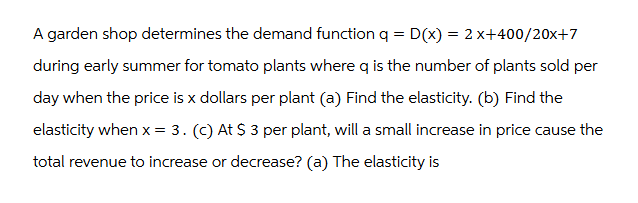 A garden shop determines the demand function q = D(x) = 2 x+400/20x+7
during early summer for tomato plants where q is the number of plants sold per
day when the price is x dollars per plant (a) Find the elasticity. (b) Find the
elasticity when x = 3. () At S 3 per plant, will a small increase in price cause the
total revenue to increase or decrease? (a) The elasticity is
This is AI generated Response.
Asked by: gvr
Created at: 2025-08-02 20:01:17
Asked by: gvr
Created at: 2025-08-02 20:01:17
Final Answer:
Rendered
Raw Text
Did you like this answer?
Let's go step by step for the given demand function:
**Demand function:**
\[ q = D(x) = 2x + \frac{400}{20x + 7} \]
---
### (a) **Find the elasticity**
**Elasticity of demand** \( E(x) \) is given by:
\[
E(x) = -\frac{x}{q} \cdot \frac{dq}{dx}
\]
Let's compute \( \frac{dq}{dx} \):
\[
q = 2x + \frac{400}{20x + 7}
\]
Let’s differentiate \( q \) with respect to \( x \):
- The derivative of \( 2x \) is \( 2 \).
- The derivative of \( \frac{400}{20x+7} \) (use the quotient or chain rule):
Let \( u = 400 \), \( v = 20x+7 \):
\[
\frac{d}{dx}\left(\frac{u}{v}\right) = \frac{u'v - uv'}{v^2}
\]
Since \( u' = 0 \) and \( v' = 20 \):
\[
\frac{d}{dx}\left(\frac{400}{20x+7}\right) = \frac{0 \cdot (20x+7) - 400 \cdot 20}{(20x+7)^2} = -\frac{8000}{(20x+7)^2}
\]
So,
\[
\frac{dq}{dx} = 2 - \frac{8000}{(20x+7)^2}
\]
Now plug into the elasticity formula:
\[
E(x) = -\frac{x}{q} \cdot \left(2 - \frac{8000}{(20x+7)^2}\right)
\]
---
### (b) **Find the elasticity when \( x = 3 \)**
First, compute \( q \) at \( x = 3 \):
\[
q = 2(3) + \frac{400}{20(3)+7}
= 6 + \frac{400}{60+7}
= 6 + \frac{400}{67}
\approx 6 + 5.97
\approx 11.97
\]
Now, compute \( (20x+7)^2 \) at \( x = 3 \):
\[
20x+7 = 67
\\
(20x+7)^2 = 67^2 = 4489
\]
Now, \( \frac{dq}{dx} \) at \( x = 3 \):
\[
\frac{dq}{dx} = 2 - \frac{8000}{4489}
\approx 2 - 1.782
= 0.218
\]
Plug these into the elasticity formula:
\[
E(3) = -\frac{3}{11.97} \cdot 0.218
\approx -0.250 \cdot 0.218
\approx -0.0545
\]
---
### (c) **At $3 per plant, will a small increase in price cause total revenue to increase or decrease?**
If \( |E(x)| < 1 \), demand is **inelastic** and an increase in price increases total revenue.
Here,
\[
|E(3)| \approx 0.0545 < 1
\]
So, **demand is inelastic** at \( x = 3 \).
**Therefore, a small increase in price will cause the total revenue to increase.**
---
## **Final Answers**
**(a) The elasticity is:**
\[
E(x) = -\frac{x}{2x + \frac{400}{20x+7}}\left(2 - \frac{8000}{(20x+7)^2}\right)
\]
**(b) The elasticity at \( x = 3 \) is:**
\[
E(3) \approx -0.0545
\]
**(c) At $3 per plant, a small increase in price will cause the total revenue to increase.**
📢 Instructions:
- Ask anything relatd to above question only.
- For new Question goto :