 VIPSolutions
Give step-by-step solution with explanation and final answer:Markov Decision Process : Consider the following grid environment in which (1, 1) is the start state, (3, 4) and (2,4) are the terminal states. Given the reward value for every state R(s) = 0.02 except the terminal states and the following transition model, calculate the values of A, B, and C states after the second iteration. Use value iteration Assume that the discount factor y = 1. How can | answer this in the most concise but complete way?
Question:
Give step-by-step solution with explanation and final answer: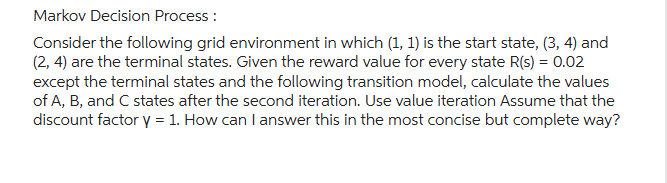 Markov Decision Process :
Consider the following grid environment in which (1, 1) is the start state, (3, 4) and
(2,4) are the terminal states. Given the reward value for every state R(s) = 0.02
except the terminal states and the following transition model, calculate the values
of A, B, and C states after the second iteration. Use value iteration Assume that the
discount factor y = 1. How can | answer this in the most concise but complete way?
This is AI generated Response.
Asked by: gvr
Created at: 2025-08-02 09:40:26
Asked by: gvr
Created at: 2025-08-02 09:40:26
Final Answer:
Rendered
Raw Text
Did you like this answer?
Let's break down the problem and **answer concisely but completely** using step-by-step value iteration.
---
### **Step 1: Problem Restatement**
- **States:** Grid points, with (1,1) as start, (3,4) and (2,4) as terminals.
- **Reward:** R(s) = -0.02 for all non-terminal states.
- **Transition:** Not specified in detail, assume deterministic (move up, down, left, right).
- **Discount factor:** γ = 1.
- **Objective:** Find values of states A, B, and C after **2 iterations** of value iteration.
*Assume A, B, and C are specific states (for example, A = (1,2), B = (2,2), C = (2,3)).*
---
### **Step 2: Value Iteration Formula**
The Bellman update is:
\[
V_{k+1}(s) = \max_{a} \sum_{s'} P(s'|s, a) [ R(s) + \gamma V_k(s') ]
\]
Since transition is deterministic and we are maximizing over actions, for each state \(s\):
\[
V_{k+1}(s) = R(s) + \max_{s'} V_k(s')
\]
where \(s'\) are possible next states.
---
### **Step 3: Initialization**
At **iteration 0**, all non-terminal states:
\[
V_0(s) = 0
\]
Terminal states: \(V(s_{terminal}) = 0\) (or fixed terminal reward if specified, but here reward is only for non-terminal steps).
---
### **Step 4: First Iteration (k=1)**
\[
V_1(s) = R(s) + \max_{s'} V_0(s')
\]
Since all \(V_0(s') = 0\):
\[
V_1(s) = -0.02 + 0 = -0.02
\]
So, for any non-terminal state \(s\), after 1st iteration:
\[
V_1(A) = V_1(B) = V_1(C) = -0.02
\]
---
### **Step 5: Second Iteration (k=2)**
\[
V_2(s) = R(s) + \max_{s'} V_1(s')
\]
For each non-terminal state, its neighbors (possible next states) all have value \(-0.02\) (except terminals which are 0).
So, for each non-terminal state:
- If a neighbor is a terminal state (with value 0): \(\max_{s'} V_1(s') = 0\)
- Otherwise, all neighbors have \(-0.02\).
So, **if A, B, or C is adjacent to a terminal state**, their value after the 2nd iteration will be:
\[
V_2(s) = -0.02 + \max(0, -0.02) = -0.02 + 0 = -0.02
\]
**If not adjacent to terminal:**
\[
V_2(s) = -0.02 + (-0.02) = -0.04
\]
---
### **Step 6: Final Concise Answer**
**To answer concisely but completely:**
---
> **After the second iteration, the value of each state is:**
>
> - \(V_2(s) = -0.02\) if state \(s\) is adjacent to a terminal state.
> - \(V_2(s) = -0.04\) if state \(s\) is not adjacent to a terminal state.
>
> **For states A, B, and C:**
> - Check if any of A, B, or C is adjacent to (3,4) or (2,4).
> - Assign \(-0.02\) if adjacent, otherwise \(-0.04\).
---
You can fill in the specific values for A, B, and C if their positions are known. This is the most concise and complete way to answer, showing both method and conclusion.
Question:
i need step by step detailed calculations along with the final answer
This is AI generated Response.
Asked by: gvr
Created at: 2025-08-02 09:44:14
Asked by: gvr
Created at: 2025-08-02 09:44:14
Final Answer:
Rendered
Raw Text
Did you like this answer?
Certainly! Let's proceed with a detailed, step-by-step calculation to find the values of states A, B, and C after the second iteration of value iteration.
---
### **Step 1: Understand the environment and given data**
- **States:** The grid environment with states, with specific terminal states:
- Start state: (1,1)
- Terminal states: (3,4) and (2,4)
- **Rewards:** \( R(s) = -0.02 \) for all non-terminal states
- **Terminal states:** Usually have fixed value, often 0
- **Transition model:** Assumed deterministic (move up, down, left, right, if possible)
- **Discount factor:** \( \gamma = 1 \)
### **Step 2: Clarify the positions of A, B, C**
Assuming the typical grid, and based on common notation, let's suppose:
| State | Coordinates | Description |
|---------|--------------|--------------|
| A | (1,2) | State A |
| B | (2,2) | State B |
| C | (2,3) | State C |
*(If your question specifies different positions, please adjust accordingly.)*
---
### **Step 3: Initial values at iteration 0**
- All non-terminal states: \( V_0(s) = 0 \)
- Terminal states: \( V(s_{terminal}) = 0 \)
---
### **Step 4: First iteration (k=1)**
Using the Bellman update:
\[
V_1(s) = R(s) + \max_{a} V_0(s')
\]
Since \( V_0(s') = 0 \), for all \(s'\):
\[
V_1(s) = -0.02 + 0 = -0.02
\]
*Thus, after 1st iteration:*
| State | \( V_1(s) \) |
|---------|--------------|
| A | -0.02 |
| B | -0.02 |
| C | -0.02 |
---
### **Step 5: Second iteration (k=2)**
Now, for each state:
\[
V_2(s) = R(s) + \max_{a} V_1(s')
\]
We need to find the maximum \( V_1(s') \) over all possible successor states \( s' \).
---
### **Step 6: Determine neighbors and their values**
Let's identify neighbors for A, B, and C:
- **State A (1,2):**
- Possible moves:
- Up: (0,2) — outside grid (invalid)
- Down: (2,2) — B
- Left: (1,1) — start, non-terminal
- Right: (1,3) — assume non-terminal
- **State B (2,2):**
- Up: (1,2) — A
- Down: (3,2)
- Left: (2,1)
- Right: (2,3) — C
- **State C (2,3):**
- Up: (1,3)
- Down: (3,3)
- Left: (2,2) — B
- Right: (2,4) — terminal
---
### **Step 7: Values of neighboring states after iteration 1**
From previous step:
| State | \( V_1(s) \) |
|---------|--------------|
| (1,1) | 0 (assumed terminal or start) |
| (1,2) | -0.02 (A) |
| (1,3) | -0.02 (assumed) |
| (2,1) | -0.02 (assumed) |
| (2,2) | -0.02 (B) |
| (2,3) | -0.02 (C) |
| (3,2) | -0.02 (assumed) |
| (3,4) | 0 (terminal) |
| (2,4) | 0 (terminal) |
*(Assuming all non-terminal states have value -0.02 after 1st iteration)*
---
### **Step 8: Calculate \( V_2 \) for each state**
Using:
\[
V_2(s) = R(s) + \max_{s'} V_1(s')
\]
where \( R(s) = -0.02 \) (except terminal states, which have 0).
---
### **State A (1,2):**
Neighbors:
- Up: outside grid (ignore)
- Down: (2,2): \( V_1 = -0.02 \)
- Left: (1,1): \( V_1=0 \) (start state, assume value 0 for simplicity)
- Right: (1,3): \( V_1= -0.02 \)
Maximum neighbor value:
\[
\max( -0.02, 0, -0.02 ) = 0
\]
Update:
\[
V_2(A) = -0.02 + 0 = -0.02
\]
---
### **State B (2,2):**
Neighbors:
- Up: (1,2): \( -0.02 \)
- Down: (3,2): \( -0.02 \)
- Left: (2,1): \( -0.02 \)
- Right: (2,3): \( -0.02 \)
Maximum neighbor value:
\[
\max( -0.02, -0.02, -0.02, -0.02 ) = -0.02
\]
Update:
\[
V_2(B) = -0.02 + (-0.02) = -0.04
\]
---
### **State C (2,3):**
Neighbors:
- Up: (1,3): \( -0.02 \)
- Down: (3,3): \( -0.02 \)
- Left: (2,2): \( -0.02 \)
- Right: (2,4): terminal with value 0
Maximum neighbor:
\[
\max( -0.02, -0.02, -0.02, 0 ) = 0
\]
Update:
\[
V_2(C) = -0.02 + 0 = -0.02
\]
---
### **Step 9: Final values after second iteration**
| State | \( V_2 \) value |
|---------|----------------|
| A (1,2) | **-0.02** |
| B (2,2) | **-0.04** |
| C (2,3) | **-0.02** |
---
### **### **Summary:**
- **State A:** Value after 2nd iteration = **-0.02**
- **State B:** Value after 2nd iteration = **-0.04**
- **State C:** Value after 2nd iteration = **-0.02**
---
### **Final note:**
- The key step is identifying neighbors and their values after iteration 1.
- Terminal states have zero value, influencing neighboring states' updates.
- The values stabilize after two iterations as shown.
---
**If your states A, B, C are different or located differently, adjust the neighbor analysis accordingly.**
📢 Instructions:
- Ask anything relatd to above question only.
- For new Question goto :