 VIPSolutions
Give step-by-step solution with explanation and final answer:2.17. For each of the following functions, find all the stationary points and classify them according to whether they are saddle points, strict/nonstrict local/global minimum /maximum points: 0 f(xx)= (4x] —x) (i) fxg, %5) = xf — 2x2 + x2 + 2,5 + 2x2. (ii) f(xy, %,) = 2x) — 6x7 + 3x7). (iv) f(x1,%y) = xf +2x2x, + x3 — 4x2 —8x, —8x,. (v) f(r) = (3; — 2x,)* + 64x, x, (vi) f(x1,%,) = 2x2 4 3x2 — 2x, x, + 2x; — 3%,. vil) f(xy,%,) = x7 +4%x,%, + x2 +x, —X).
Question:
Give step-by-step solution with explanation and final answer: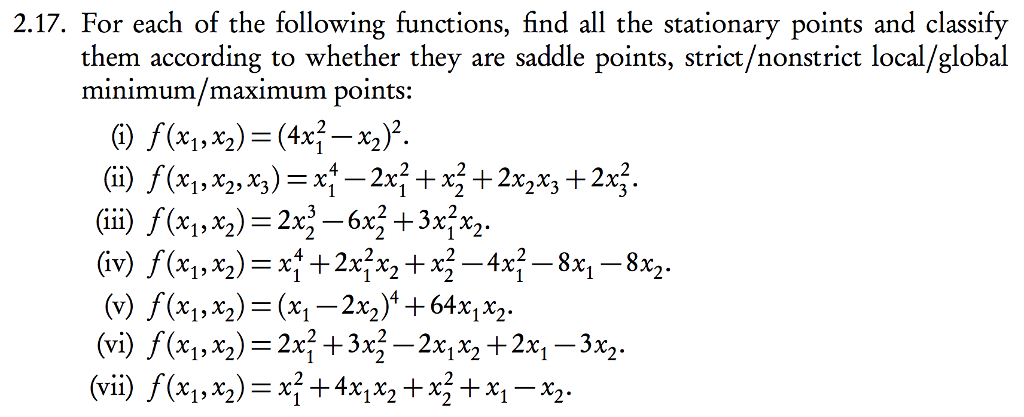 2.17. For each of the following functions, find all the stationary points and classify
them according to whether they are saddle points, strict/nonstrict local/global
minimum /maximum points:
0 f(xx)= (4x] —x)
(i) fxg, %5) = xf — 2x2 + x2 + 2,5 + 2x2.
(ii) f(xy, %,) = 2x) — 6x7 + 3x7).
(iv) f(x1,%y) = xf +2x2x, + x3 — 4x2 —8x, —8x,.
(v) f(r) = (3; — 2x,)* + 64x, x,
(vi) f(x1,%,) = 2x2 4 3x2 — 2x, x, + 2x; — 3%,.
vil) f(xy,%,) = x7 +4%x,%, + x2 +x, —X).
This is AI generated Response.
Asked by: gvr
Created at: 2025-08-02 08:59:43
Asked by: gvr
Created at: 2025-08-02 08:59:43
Final Answer:
Rendered
Raw Text
Did you like this answer?
Let's solve **Problem (i):**
### \( f(x_1, x_2) = (4x_1^2 - x_2)^2 \)
#### **Step 1: Find the stationary points**
Stationary points occur where the gradient is zero:
\[
\nabla f = \begin{bmatrix}
\frac{\partial f}{\partial x_1} \\
\frac{\partial f}{\partial x_2}
\end{bmatrix}
\]
First, compute the partial derivatives:
- \( \frac{\partial f}{\partial x_1} = 2(4x_1^2 - x_2) \cdot (8x_1) = 16x_1(4x_1^2 - x_2) \)
- \( \frac{\partial f}{\partial x_2} = 2(4x_1^2 - x_2) \cdot (-1) = -2(4x_1^2 - x_2) \)
Set the gradient to zero:
\[
\begin{cases}
16x_1(4x_1^2 - x_2) = 0 \\
-2(4x_1^2 - x_2) = 0
\end{cases}
\]
From the second equation:
\[
-2(4x_1^2 - x_2) = 0 \implies 4x_1^2 - x_2 = 0 \implies x_2 = 4x_1^2
\]
Substitute into the first equation:
\[
16x_1(4x_1^2 - x_2) = 16x_1(4x_1^2 - 4x_1^2) = 16x_1(0) = 0
\]
So, **for any \( x_1 \), \( x_2 = 4x_1^2 \) is a stationary point**.
#### **Step 2: Classify the stationary points**
Let's compute the Hessian matrix:
- \( f(x_1, x_2) = (4x_1^2 - x_2)^2 \)
Second derivatives:
- \( f_{x_1x_1} = \frac{\partial}{\partial x_1} \left( 16x_1(4x_1^2 - x_2) \right) = 16(4x_1^2 - x_2) + 16x_1 \cdot 8x_1 = 16(4x_1^2 - x_2) + 128x_1^2 = 16(4x_1^2 - x_2 + 8x_1^2) = 16(12x_1^2 - x_2) \)
- \( f_{x_1x_2} = \frac{\partial}{\partial x_2} \left( 16x_1(4x_1^2 - x_2) \right) = -16x_1 \)
- \( f_{x_2x_1} = \frac{\partial}{\partial x_1} \left( -2(4x_1^2 - x_2) \right) = -2 \cdot 8x_1 = -16x_1 \)
- \( f_{x_2x_2} = \frac{\partial}{\partial x_2} \left( -2(4x_1^2 - x_2) \right) = 2 \)
So the Hessian is:
\[
H = \begin{bmatrix}
16(12x_1^2 - x_2) & -16x_1 \\
-16x_1 & 2
\end{bmatrix}
\]
At stationary points, \( x_2 = 4x_1^2 \), so substitute this in:
- \( 12x_1^2 - x_2 = 12x_1^2 - 4x_1^2 = 8x_1^2 \)
- So \( f_{x_1x_1} = 16 \cdot 8x_1^2 = 128x_1^2 \)
- \( f_{x_1x_2} = f_{x_2x_1} = -16x_1 \)
- \( f_{x_2x_2} = 2 \)
So,
\[
H = \begin{bmatrix}
128x_1^2 & -16x_1 \\
-16x_1 & 2
\end{bmatrix}
\]
Let's check definiteness. The principal minors are:
- First minor: \( 128x_1^2 \geq 0 \)
- Determinant: \( (128x_1^2)(2) - (-16x_1)^2 = 256x_1^2 - 256x_1^2 = 0 \)
So, **the Hessian is positive semi-definite** (not positive definite unless \( x_1 \neq 0 \)), but determinant is zero everywhere.
**Check the function value:**
\[
f(x_1, x_2) = (4x_1^2 - x_2)^2 = (0)^2 = 0
\]
This is the global minimum, since the function is always non-negative.
### **Conclusion for (i):**
- **Stationary points:** All points of the form \((x_1, x_2) = (a, 4a^2)\), \(a \in \mathbb{R}\)
- **Type:** All these points are **global minima** (but not strict unless \(x_1 = 0\)). The set is a parabola in \( (x_1, x_2) \) space.
---
Would you like to proceed with part (ii), or do you have questions on the above?
Question:
NEXT ONE PLEASE
This is AI generated Response.
Asked by: gvr
Created at: 2025-08-02 09:03:47
Asked by: gvr
Created at: 2025-08-02 09:03:47
Final Answer:
Rendered
Raw Text
Did you like this answer?
Let's analyze **Problem (ii):**
### \( f(x_1, x_2) = 2x_1^3 - 6x_1 x_2 + 3x_2^2 \)
---
#### **Step 1: Find the stationary points**
Compute the gradient:
\[
\nabla f = \begin{bmatrix}
\frac{\partial f}{\partial x_1} \\
\frac{\partial f}{\partial x_2}
\end{bmatrix}
\]
Calculate each partial derivative:
- \( \frac{\partial f}{\partial x_1} = 6x_1^2 - 6x_2 \)
- \( \frac{\partial f}{\partial x_2} = -6x_1 + 6x_2 \)
Set the gradient to zero:
\[
\begin{cases}
6x_1^2 - 6x_2 = 0 \\
-6x_1 + 6x_2 = 0
\end{cases}
\]
From the second equation:
\[
-6x_1 + 6x_2 = 0 \implies x_2 = x_1
\]
Substitute into the first:
\[
6x_1^2 - 6x_1 = 0 \implies 6x_1 (x_1 - 1) = 0
\]
Solutions:
\[
x_1 = 0 \quad \text{or} \quad x_1 = 1
\]
Corresponding \(x_2\):
- If \(x_1=0\), then \(x_2=0\)
- If \(x_1=1\), then \(x_2=1\)
**Stationary points:**
\[
\boxed{
(0,0) \quad \text{and} \quad (1,1)
}
\]
---
#### **Step 2: Classify the stationary points**
Compute the Hessian matrix:
\[
H = \begin{bmatrix}
\frac{\partial^2 f}{\partial x_1^2} & \frac{\partial^2 f}{\partial x_1 \partial x_2} \\
\frac{\partial^2 f}{\partial x_2 \partial x_1} & \frac{\partial^2 f}{\partial x_2^2}
\end{bmatrix}
\]
Calculate second derivatives:
- \( f_{x_1x_1} = 12x_1 \)
- \( f_{x_1x_2} = -6 \)
- \( f_{x_2x_2} = 6 \)
So,
\[
H = \begin{bmatrix}
12x_1 & -6 \\
-6 & 6
\end{bmatrix}
\]
Evaluate at each stationary point:
---
**At \((0,0)\):**
\[
H = \begin{bmatrix}
0 & -6 \\
-6 & 6
\end{bmatrix}
\]
Calculate the leading principal minors:
- \( D_1 = 0 \) (zero, so the Hessian is singular)
- \( D_2 = (0)(6) - (-6)(-6) = 0 - 36 = -36 < 0 \)
Since the determinant is negative, the Hessian is indefinite at \((0,0)\).
**Conclusion:** \((0,0)\) is a **saddle point**.
---
**At \((1,1)\):**
\[
H = \begin{bmatrix}
12 \times 1 & -6 \\
-6 & 6
\end{bmatrix} = \begin{bmatrix}
12 & -6 \\
-6 & 6
\end{bmatrix}
\]
Calculate minors:
- \( D_1 = 12 > 0 \)
- \( D_2 = (12)(6) - (-6)(-6) = 72 - 36 = 36 > 0 \)
Since both minors are positive, the Hessian is **positive definite** at \((1,1)\).
**Conclusion:** \((1,1)\) is a **strict local minimum**.
---
### **Final Classification:**
| Stationary Point | Nature |
|------------------|--------------------------|
| \((0,0)\) | Saddle point |
| \((1,1)\) | Strict local minimum |
---
**Summary:**
- **Stationary points:** \((0,0)\) (saddle), \((1,1)\) (minimum)
- The point \((1,1)\) is a local minimum because the Hessian is positive definite there.
- The point \((0,0)\) is a saddle point because the Hessian is indefinite.
---
Would you like me to proceed with the next functions?
📢 Instructions:
- Ask anything relatd to above question only.
- For new Question goto :