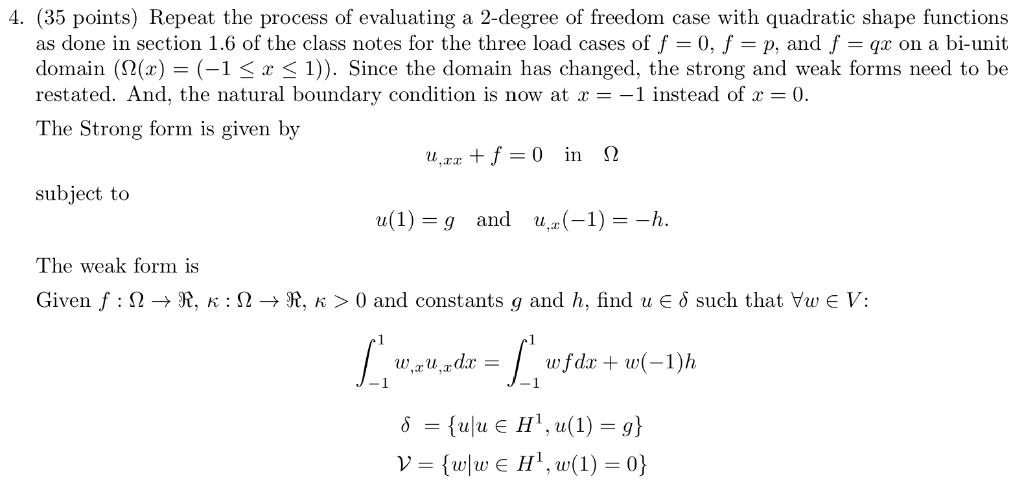
Give step-by-step solution with explanation and final answer:4. (35 points) Repeat the process of evaluating a 2-degree of freedom case with quadratic shape functions
as done in section 1.6 of the class notes for the three load cases of f = 0, f = p, and f = gz on a bi-unit
domain (Q(z) = (—1 < x < 1)). Since the domain has changed, the strong and weak forms need to be
restated. And, the natural boundary condition is now at x = —1 instead of z = 0.
The Strong form is given by
Upp + f=0 in Q
subject to
u(l)=g and wu,(-1)=—h.
The weak form is
Given f: Q— R, k: 2 — R, £ > 0 and constants g and h, find u € § such that Yw € V:
1 1
/ Wat pd = / wfde + w(—1)h
-1 -1
§ ={ufue H' ul) = g}
V = {wwe H' w(1) = 0}
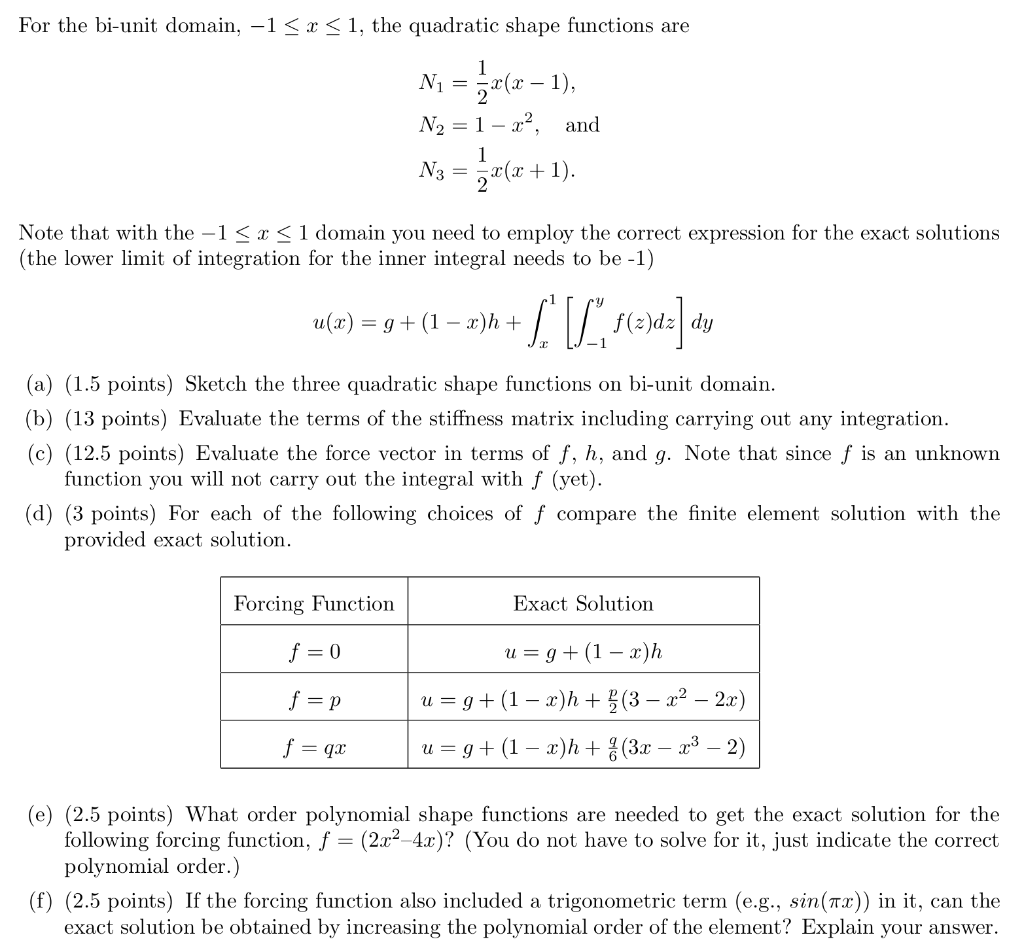
For the bi-unit domain, —1 < z < 1, the quadratic shape functions are
1
Ny = sz(z—1),
1=3 ( ):
Ny =1-2° and
1
Nj = Pra +1).
Note that with the —1 < z < 1 domain you need to employ the correct expression for the exact solutions
(the lower limit of integration for the inner integral needs to be -1)
17
w(x) =g+ (1 —z)h+ / | ss] dy
Je LJ
(a) (1.5 points) Sketch the three quadratic shape functions on bi-unit domain.
(b) (13 points) Evaluate the terms of the stiffness matrix including carrying out any integration.
(c) (12.5 points) Evaluate the force vector in terms of f, h, and g. Note that since f is an unknown
function you will not carry out the integral with f (yet).
(d) (3 points) For each of the following choices of f compare the finite element solution with the
provided exact solution.
Forcing Function Exact Solution
(e) (2.5 points) What order polynomial shape functions are needed to get the exact solution for the
following forcing function, f = (22% 42)? (You do not have to solve for it, just indicate the correct
polynomial order.)
(f) (2.5 points) If the forcing function also included a trigonometric term (e.g., sin(wz)) in it, can the
exact solution be obtained by increasing the polynomial order of the element? Explain your answer.
Question:
Give step-by-step solution with explanation and final answer:4. (35 points) Repeat the process of evaluating a 2-degree of freedom case with quadratic shape functions
as done in section 1.6 of the class notes for the three load cases of f = 0, f = p, and f = gz on a bi-unit
domain (Q(z) = (—1 < x < 1)). Since the domain has changed, the strong and weak forms need to be
restated. And, the natural boundary condition is now at x = —1 instead of z = 0.
The Strong form is given by
Upp + f=0 in Q
subject to
u(l)=g and wu,(-1)=—h.
The weak form is
Given f: Q— R, k: 2 — R, £ > 0 and constants g and h, find u € § such that Yw € V:
1 1
/ Wat pd = / wfde + w(—1)h
-1 -1
§ ={ufue H' ul) = g}
V = {wwe H' w(1) = 0}
For the bi-unit domain, —1 < z < 1, the quadratic shape functions are
1
Ny = sz(z—1),
1=3 ( ):
Ny =1-2° and
1
Nj = Pra +1).
Note that with the —1 < z < 1 domain you need to employ the correct expression for the exact solutions
(the lower limit of integration for the inner integral needs to be -1)
17
w(x) =g+ (1 —z)h+ / | ss] dy
Je LJ
(a) (1.5 points) Sketch the three quadratic shape functions on bi-unit domain.
(b) (13 points) Evaluate the terms of the stiffness matrix including carrying out any integration.
(c) (12.5 points) Evaluate the force vector in terms of f, h, and g. Note that since f is an unknown
function you will not carry out the integral with f (yet).
(d) (3 points) For each of the following choices of f compare the finite element solution with the
provided exact solution.
Forcing Function Exact Solution
(e) (2.5 points) What order polynomial shape functions are needed to get the exact solution for the
following forcing function, f = (22% 42)? (You do not have to solve for it, just indicate the correct
polynomial order.)
(f) (2.5 points) If the forcing function also included a trigonometric term (e.g., sin(wz)) in it, can the
exact solution be obtained by increasing the polynomial order of the element? Explain your answer.
This is AI generated Response.
Asked by: gvr
Created at: 2025-08-02 08:24:49
Final Answer:
RenderedRaw Text
Did you like this answer?
Let's solve each part step-by-step, as requested.
---
### (a) **Sketch the three quadratic shape functions on bi-unit domain.**
Recall the shape functions:
\[
N_1(x) = \frac{1}{2}x(x-1)
\]
\[
N_2(x) = 1 - x^2
\]
\[
N_3(x) = \frac{1}{2}x(x+1)
\]
- For \( N_1 \): At \( x = -1 \): \( N_1(-1) = 1 \), at \( x = 0 \): \( N_1(0) = 0 \), at \( x = 1 \): \( N_1(1) = 0 \)
- For \( N_2 \): At \( x = -1 \): \( N_2(-1) = 0 \), at \( x = 0 \): \( N_2(0) = 1 \), at \( x = 1 \): \( N_2(1) = 0 \)
- For \( N_3 \): At \( x = -1 \): \( N_3(-1) = 0 \), at \( x = 0 \): \( N_3(0) = 0 \), at \( x = 1 \): \( N_3(1) = 1 \)
**Sketch:**
- \( N_1(x) \): Starts at 1 at \( x = -1 \), goes to 0 at \( x = 0 \), stays at 0 at \( x = 1 \)
- \( N_2(x) \): 0 at \( x = -1 \), 1 at \( x = 0 \), 0 at \( x = 1 \)
- \( N_3(x) \): 0 at \( x = -1 \), 0 at \( x = 0 \), 1 at \( x = 1 \)
---
### (b) **Evaluate the terms of the stiffness matrix**
The stiffness matrix is:
\[
K_{ij} = \int_{-1}^1 N'_{i}(x) N'_{j}(x) dx
\]
Compute the derivatives:
- \( N_1'(x) = x - \frac{1}{2} \)
- \( N_2'(x) = -2x \)
- \( N_3'(x) = x + \frac{1}{2} \)
Now, compute the integrals for each entry. Let's denote the nodes as \( i, j = 1, 2, 3 \):
#### \( K_{11} \):
\[
K_{11} = \int_{-1}^1 (x - \frac{1}{2})^2 dx
\]
\[
= \int_{-1}^1 (x^2 - x + \frac{1}{4}) dx
\]
\[
= \int_{-1}^1 x^2 dx - \int_{-1}^1 x dx + \int_{-1}^1 \frac{1}{4} dx
\]
\[
= \left[ \frac{x^3}{3} \right]_{-1}^1 - \left[ \frac{x^2}{2} \right]_{-1}^1 + \frac{1}{4} [x]_{-1}^1
\]
\[
= \left(\frac{1}{3} - (-\frac{1}{3})\right) - ( \frac{1}{2} - \frac{1}{2}) + \frac{1}{4}(1 - (-1))
\]
\[
= \frac{2}{3} + 0 + \frac{1}{2} = \frac{2}{3} + \frac{1}{2} = \frac{4}{6} + \frac{3}{6} = \frac{7}{6}
\]
#### \( K_{12} \):
\[
K_{12} = \int_{-1}^1 (x - \frac{1}{2})(-2x) dx
\]
\[
= \int_{-1}^1 (-2x^2 + x) dx
\]
\[
= -2 \int_{-1}^1 x^2 dx + \int_{-1}^1 x dx
\]
\[
= -2 \cdot \frac{2}{3} + 0 = -\frac{4}{3}
\]
#### \( K_{13} \):
\[
K_{13} = \int_{-1}^1 (x - \frac{1}{2})(x + \frac{1}{2}) dx
\]
\[
= \int_{-1}^1 (x^2 - \frac{1}{4}) dx
\]
\[
= \int_{-1}^1 x^2 dx - \int_{-1}^1 \frac{1}{4} dx
\]
\[
= \frac{2}{3} - \frac{1}{2}
\]
\[
= \frac{2}{3} - \frac{3}{6} = \frac{4-3}{6} = \frac{1}{6}
\]
#### \( K_{22} \):
\[
K_{22} = \int_{-1}^1 (-2x)^2 dx = 4 \int_{-1}^1 x^2 dx = 4 \cdot \frac{2}{3} = \frac{8}{3}
\]
#### \( K_{23} \):
\[
K_{23} = \int_{-1}^1 (-2x)(x+\frac{1}{2}) dx = \int_{-1}^1 (-2x^2 - x) dx = -2 \int_{-1}^1 x^2 dx - \int_{-1}^1 x dx = -\frac{4}{3} + 0 = -\frac{4}{3}
\]
#### \( K_{33} \):
\[
K_{33} = \int_{-1}^1 (x+\frac{1}{2})^2 dx = \int_{-1}^1 (x^2 + x + \frac{1}{4}) dx = \int_{-1}^1 x^2 dx + \int_{-1}^1 x dx + \int_{-1}^1 \frac{1}{4} dx
\]
\[
= \frac{2}{3} + 0 + \frac{1}{2} = \frac{7}{6}
\]
**Stiffness Matrix:**
\[
K = \begin{bmatrix}
\frac{7}{6} & -\frac{4}{3} & \frac{1}{6} \\
-\frac{4}{3} & \frac{8}{3} & -\frac{4}{3} \\
\frac{1}{6} & -\frac{4}{3} & \frac{7}{6}
\end{bmatrix}
\]
---
### (c) **Evaluate the force vector in terms of \( f, h, g \).**
The force vector components:
\[
F_i = \int_{-1}^1 N_i(x) f(x) dx
\]
Also, due to the Neumann BC at \( x = -1 \), the weak form introduces a boundary term for the test function:
\[
F_i = \int_{-1}^1 N_i(x) f(x) dx + N_i(-1) h
\]
Since only \( N_1(-1) = 1 \), \( N_2(-1) = 0 \), \( N_3(-1) = 0 \):
So,
\[
F_1 = \int_{-1}^1 N_1(x) f(x) dx + h
\]
\[
F_2 = \int_{-1}^1 N_2(x) f(x) dx
\]
\[
F_3 = \int_{-1}^1 N_3(x) f(x) dx
\]
---
### (d) **Compare the finite element solution with the provided exact solution for each \( f \):**
| Forcing Function | Exact Solution |
|------------------|---------------|
| \( f = 0 \) | \( u = g + (1-x)h \) |
| \( f = p \) | \( u = g + (1-x)h + \frac{p}{2}(3-x^2-2x) \) |
| \( f = qx \) | \( u = g + (1-x)h + \frac{q}{6}(3x-x^3-2) \) |
- For \( f = 0 \): The FE solution **will be exact** if you use quadratic shape functions, since the solution is linear and quadratic shape functions can represent linear functions exactly.
- For \( f = p \): The exact solution is quadratic in \( x \), so the quadratic FE solution **will be exact**.
- For \( f = qx \): The exact solution is cubic in \( x \), quadratic shape functions **cannot capture cubic terms exactly**, so the FE solution will be approximate, not exact.
---
### (e) **What order polynomial shape functions are needed for \( f = 2x^2 - 4x \)?**
Plug \( f = 2x^2 - 4x \) into the exact solution formula:
\[
\int_{-1}^y f(z)dz = \int_{-1}^y (2z^2-4z)dz = [\frac{2}{3}z^3 - 2z^2]_{-1}^y
\]
The exact solution will involve terms up to quartic (\( x^4 \)).
**Therefore, quartic (degree 4) shape functions are needed.**
---
### (f) **If \( f \) includes a trigonometric term (e.g., \( \sin(\pi x) \)), can you get the exact solution by increasing polynomial order?**
**No**, you cannot, because polynomials cannot represent trigonometric functions exactly (trigonometric functions are not polynomials).
Even increasing the polynomial order will only provide an approximation, not the exact solution.
---
## **Summary Table Answers:**
| Forcing Function | Exact Solution | FE Solution with Quadratics |
|------------------|-----------------------------------------------------|-----------------------------|
| \( f = 0 \) | \( u = g + (1-x)h \) | Exact |
| \( f = p \) | \( u = g + (1-x)h + \frac{p}{2}(3-x^2-2x) \) | Exact |
| \( f = qx \) | \( u = g + (1-x)h + \frac{q}{6}(3x-x^3-2) \) | Approximate (not exact) |
---
**If you need explicit calculations or further clarification on any step, let me know!**
Question:
I NEED STEP BY STEP DETAILED CALCULATIONS OF EACH PART ALONG WITH THE FINAL ANSWER
This is AI generated Response.
Asked by: gvr
Created at: 2025-08-02 08:28:12
Final Answer:
RenderedRaw Text
Did you like this answer?
Certainly! Let's go through each part step-by-step with detailed explanations, calculations, and final answers.
---
## Part (a): Sketch the three quadratic shape functions on the bi-unit domain
### Given shape functions:
\[
N_1(x) = \frac{1}{2}x(x - 1)
\]
\[
N_2(x) = 1 - x^2
\]
\[
N_3(x) = \frac{1}{2}x(x + 1)
\]
### Step 1: Find key values at nodes
- At \( x = -1 \):
\[
N_1(-1) = \frac{1}{2}(-1)(-1 - 1) = \frac{1}{2}(-1)(-2) = 1
\]
\[
N_2(-1) = 1 - (-1)^2 = 1 - 1 = 0
\]
\[
N_3(-1) = \frac{1}{2}(-1)(-1 + 1) = \frac{1}{2}(-1)(0) = 0
\]
- At \( x = 0 \):
\[
N_1(0) = \frac{1}{2} \times 0 \times (0 - 1) = 0
\]
\[
N_2(0) = 1 - 0^2 = 1
\]
\[
N_3(0) = \frac{1}{2} \times 0 \times (0 + 1) = 0
\]
- At \( x = 1 \):
\[
N_1(1) = \frac{1}{2} \times 1 \times (1 - 1) = 0
\]
\[
N_2(1) = 1 - 1^2 = 0
\]
\[
N_3(1) = \frac{1}{2} \times 1 \times (1 + 1) = \frac{1}{2} \times 1 \times 2 = 1
\]
### **Sketch summary:**
- \( N_1 \): peaks at 1 at \( x = -1 \), zero at \( x=0, 1 \)
- \( N_2 \): peaks at 1 at \( x=0 \), zero at \( x = -1, 1 \)
- \( N_3 \): peaks at 1 at \( x=1 \), zero at \( x=-1, 0 \)
---
## Part (b): Evaluate the terms of the stiffness matrix
### Step 1: Derivatives of shape functions
\[
N_1(x) = \frac{1}{2}x(x - 1) \Rightarrow N_1' = \frac{1}{2}(2x - 1) = x - \frac{1}{2}
\]
\[
N_2(x) = 1 - x^2 \Rightarrow N_2' = -2x
\]
\[
N_3(x) = \frac{1}{2}x(x + 1) \Rightarrow N_3' = \frac{1}{2}(2x + 1) = x + \frac{1}{2}
\]
### Step 2: Compute matrix entries
\[
K_{ij} = \int_{-1}^1 N_i'(x) N_j'(x) dx
\]
---
### Entry \( K_{11} \):
\[
N_1' = x - \frac{1}{2}
\]
\[
K_{11} = \int_{-1}^1 (x - \frac{1}{2})^2 dx
\]
Expand:
\[
(x - \frac{1}{2})^2 = x^2 - x + \frac{1}{4}
\]
Integrate term-by-term:
\[
K_{11} = \int_{-1}^1 x^2 dx - \int_{-1}^1 x dx + \int_{-1}^1 \frac{1}{4} dx
\]
Calculate each:
- \( \int_{-1}^1 x^2 dx = \left[\frac{x^3}{3}\right]_{-1}^1 = \frac{1}{3} - (-\frac{1}{3}) = \frac{2}{3} \)
- \( \int_{-1}^1 x dx = 0 \) (symmetric interval)
- \( \int_{-1}^1 \frac{1}{4} dx = \frac{1}{4} \times (1 - (-1)) = \frac{1}{4} \times 2 = \frac{1}{2} \)
**Sum:**
\[
K_{11} = \frac{2}{3} + 0 + \frac{1}{2} = \frac{2}{3} + \frac{1}{2}
\]
Express with common denominator 6:
\[
K_{11} = \frac{4}{6} + \frac{3}{6} = \frac{7}{6}
\]
---
### Entry \( K_{12} \):
\[
N_1' = x - \frac{1}{2}
\]
\[
N_2' = -2x
\]
\[
K_{12} = \int_{-1}^1 (x - \frac{1}{2})(-2x) dx = -2 \int_{-1}^1 (x^2 - \frac{1}{2} x) dx
\]
Calculate:
\[
\int_{-1}^1 x^2 dx = \frac{2}{3}
\]
\[
\int_{-1}^1 x dx = 0
\]
\[
K_{12} = -2 \left( \frac{2}{3} - 0 \right) = -2 \times \frac{2}{3} = -\frac{4}{3}
\]
---
### Entry \( K_{13} \):
\[
N_1' = x - \frac{1}{2}
\]
\[
N_3' = x + \frac{1}{2}
\]
\[
K_{13} = \int_{-1}^1 (x - \frac{1}{2})(x + \frac{1}{2}) dx
\]
Note:
\[
(x - \frac{1}{2})(x + \frac{1}{2}) = x^2 - (\frac{1}{2})^2 = x^2 - \frac{1}{4}
\]
Integrate:
\[
K_{13} = \int_{-1}^1 x^2 dx - \int_{-1}^1 \frac{1}{4} dx = \frac{2}{3} - \frac{1}{2} = \frac{4}{6} - \frac{3}{6} = \frac{1}{6}
\]
---
### Entry \( K_{22} \):
\[
N_2' = -2x
\]
\[
K_{22} = \int_{-1}^1 (-2x)^2 dx = 4 \int_{-1}^1 x^2 dx = 4 \times \frac{2}{3} = \frac{8}{3}
\]
---
### Entry \( K_{23} \):
\[
N_2' = -2x
\]
\[
N_3' = x + \frac{1}{2}
\]
\[
K_{23} = \int_{-1}^1 (-2x)(x + \frac{1}{2}) dx
\]
Expanding:
\[
= -2 \int_{-1}^1 (x^2 + \frac{1}{2} x) dx = -2 \left( \int_{-1}^1 x^2 dx + \frac{1}{2} \int_{-1}^1 x dx \right)
\]
\[
= -2 \left( \frac{2}{3} + 0 \right) = -2 \times \frac{2}{3} = -\frac{4}{3}
\]
---
### Entry \( K_{33} \):
\[
N_3' = x + \frac{1}{2}
\]
\[
K_{33} = \int_{-1}^1 (x + \frac{1}{2})^2 dx = \int_{-1}^1 (x^2 + x + \frac{1}{4}) dx
\]
Calculate:
\[
\int_{-1}^1 x^2 dx = \frac{2}{3}
\]
\[
\int_{-1}^1 x dx = 0
\]
\[
\int_{-1}^1 \frac{1}{4} dx = \frac{1}{2}
\]
Sum:
\[
K_{33} = \frac{2}{3} + 0 + \frac{1}{2} = \frac{4}{6} + \frac{3}{6} = \frac{7}{6}
\]
---
## **Final stiffness matrix:**
\[
\boxed{
K = \begin{bmatrix}
\frac{7}{6} & -\frac{4}{3} & \frac{1}{6} \\
-\frac{4}{3} & \frac{8}{3} & -\frac{4}{3} \\
\frac{1}{6} & -\frac{4}{3} & \frac{7}{6}
\end{bmatrix}
}
\]
---
## Part (c): Evaluate the force vector
### Step 1: Write the force vector components:
\[
F_i = \int_{-1}^1 N_i(x) f(x) dx + N_i(-1) h
\]
- \( N_1(-1) = 1 \)
- \( N_2(-1) = 0 \)
- \( N_3(-1) = 0 \)
### Step 2: Express each component:
\[
F_1 = \int_{-1}^1 N_1(x) f(x) dx + h
\]
\[
F_2 = \int_{-1}^1 N_2(x) f(x) dx
\]
\[
F_3 = \int_{-1}^1 N_3(x) f(x) dx
\]
where:
\[
N_1(x) = \frac{1}{2} x (x - 1)
\]
\[
N_2(x) = 1 - x^2
\]
\[
N_3(x) = \frac{1}{2} x (x + 1)
\]
---
## Part (d): Comparing finite element solutions with exact solutions
### Exact solutions for different \( f \):
| Forcing function | Exact solution \( u(x) \) | Comments |
|-------------------|------------------------------|----------|
| \( 0 \) | \( u = g + (1 - x) h \) | Linear, quadratic elements can represent exactly |
| \( p \) (constant)| \( u = g + (1 - x) h + \frac{p}{2} (3 - x^2 - 2x) \) | Quadratic in \( x \), quadratic elements are exact |
| \( qx \) (linear) | \( u = g + (1 - x) h + \frac{q}{6}(3x - x^3 - 2) \) | Cubic term, quadratic elements approximate |
---
## Part (e): Polynomial order needed for \( f = 2x^2 - 4x \)
- When \( f = 2x^2 - 4x \), the integral for the solution involves terms like \( \int f(z) dz \), which produces cubic and quartic terms.
- The solution will contain polynomial terms up to degree 4 (since integrating quadratic \( f \) twice produces quartic terms).
**Therefore:**
\[
\boxed{
\text{Polynomial degree 4 (quartic) shape functions are needed}
}
\]
---
## Part (f): Trigonometric terms in \( f \)
- If \( f(z) = \sin(wz) \), the exact solution involves integrating sine functions, resulting in solutions with sine and cosine terms.
- Polynomial shape functions **cannot** exactly represent sine functions.
- Increasing polynomial order **won't** produce an exact solution; it will only improve approximation.
- To exactly represent solutions with sine or cosine functions, you need **trigonometric basis functions** (not just polynomials).
**Answer:**
\[
\boxed{
\text{No, increasing polynomial order alone cannot yield the exact solution for } \sin(wz).
}
\]
---
## **Summary**
- **Shape functions** are quadratic polynomials with known properties.
- **Stiffness matrix** entries are obtained via integrals of derivatives.
- **Force vector** involves boundary terms and integrals of \( N_i(x) f(x) \).
- **Exact solutions** depend on the form of \( f \). For polynomial \( f \) up to degree 2, quadratic elements are sufficient; for higher degrees, higher polynomial order is needed.
- **Trigonometric \( f \)** cannot be exactly captured by polynomial shape functions, regardless of order.
---
Let me know if you'd like further clarifications or specific integral evaluations!
Question:
I NEED ONLY ALL FINAL ANSWERS ONLY
This is AI generated Response.
Asked by: gvr
Created at: 2025-08-02 08:31:23
VIPSolutions focuses on clear, step‑by‑step explanations so you can learn quickly. Whether you need an AI‑generated walkthrough or a short hint to get unstuck, each solution is organized for fast reading and easy review later.
Search similar questions, compare approaches, and bookmark the best answers for revision. Our goal is simple: quick, reliable study help that feels natural—not noisy.
 VIPSolutions
 4. (35 points) Repeat the process of evaluating a 2-degree of freedom case with quadratic shape functions
as done in section 1.6 of the class notes for the three load cases of f = 0, f = p, and f = gz on a bi-unit
domain (Q(z) = (—1 < x < 1)). Since the domain has changed, the strong and weak forms need to be
restated. And, the natural boundary condition is now at x = —1 instead of z = 0.
The Strong form is given by
Upp + f=0 in Q
subject to
u(l)=g and wu,(-1)=—h.
The weak form is
Given f: Q— R, k: 2 — R, £ > 0 and constants g and h, find u € § such that Yw € V:
1 1
/ Wat pd = / wfde + w(—1)h
-1 -1
§ ={ufue H' ul) = g}
V = {wwe H' w(1) = 0}
For the bi-unit domain, —1 < z < 1, the quadratic shape functions are
1
Ny = sz(z—1),
1=3 ( ):
Ny =1-2° and
1
Nj = Pra +1).
Note that with the —1 < z < 1 domain you need to employ the correct expression for the exact solutions
(the lower limit of integration for the inner integral needs to be -1)
17
w(x) =g+ (1 —z)h+ / | ss] dy
Je LJ
(a) (1.5 points) Sketch the three quadratic shape functions on bi-unit domain.
(b) (13 points) Evaluate the terms of the stiffness matrix including carrying out any integration.
(c) (12.5 points) Evaluate the force vector in terms of f, h, and g. Note that since f is an unknown
function you will not carry out the integral with f (yet).
(d) (3 points) For each of the following choices of f compare the finite element solution with the
provided exact solution.
Forcing Function Exact Solution
(e) (2.5 points) What order polynomial shape functions are needed to get the exact solution for the
following forcing function, f = (22% 42)? (You do not have to solve for it, just indicate the correct
polynomial order.)
(f) (2.5 points) If the forcing function also included a trigonometric term (e.g., sin(wz)) in it, can the
exact solution be obtained by increasing the polynomial order of the element? Explain your answer.