 VIPSolutions
Give step-by-step solution with explanation and final answer:Go Ar st rs rr ro en rd Fai FR EH Gt | lines partes pres
Question:
Give step-by-step solution with explanation and final answer: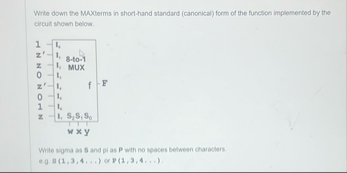 Go Ar st rs rr ro en rd
Fai
FR
EH
Gt |
lines
partes pres
This is AI generated Response.
Asked by: gvr
Created at: 2025-08-02 05:16:55
Asked by: gvr
Created at: 2025-08-02 05:16:55
Final Answer:
Rendered
Raw Text
Did you like this answer?
Let's solve the problem step by step:
---
### **Step 1: Understanding the MUX**
The circuit uses an **8-to-1 Multiplexer**.
- The inputs are labeled from \(I_0\) to \(I_7\).
- The select lines are \(x\), \(y\), and \(z\) (which correspond to \(S_2, S_1, S_0\) respectively).
### **Step 2: Mapping Inputs**
From the diagram, the MUX inputs are connected as follows:
- \(I_0 = 1\)
- \(I_1 = 1\)
- \(I_2 = 0\)
- \(I_3 = 1\)
- \(I_4 = 0\)
- \(I_5 = 0\)
- \(I_6 = 1\)
- \(I_7 = 1\)
### **Step 3: MAXTERMS (Canonical POS) Form**
To write the function in **maxterms** (standard canonical form), we need to find the minterms where the output is **0** (i.e., where the MUX input is 0).
Looking at the input assignments:
- Output is 0 at \(I_2\), \(I_4\), and \(I_5\).
So, the corresponding select inputs are:
- \(I_2\): 010 (\(x=0, y=1, z=0\))
- \(I_4\): 100 (\(x=1, y=0, z=0\))
- \(I_5\): 101 (\(x=1, y=0, z=1\))
### **Step 4: MAXTERM Indices**
The maxterm indices are the indices where the output is 0:
- \(I_2\): 2
- \(I_4\): 4
- \(I_5\): 5
### **Step 5: Final Answer in Sigma/Pi Notation**
Since the question asks for the MAXTERMS in shorthand standard (canonical) form, use the \(\Pi\) (product) notation:
\[
F(x, y, z) = \Pi(2, 4, 5)
\]
---
## **Final Answer**
\[
\boxed{\Pi(2,4,5)}
\]
Or, in plain text:
> **Π(2,4,5)**
---
**Explanation:**
- We wrote the output as 0 at \(I_2\), \(I_4\), and \(I_5\) (the positions where MUX input = 0).
- The canonical maxterms form is the product of maxterms at these indices.
📢 Instructions:
- Ask anything relatd to above question only.
- For new Question goto :