This is AI generated Response.
Asked by: gvr
Created at: 2025-08-02 01:36:47
Final Answer:
RenderedRaw Text
Did you like this answer?
Let's solve the series step-by-step:
Given series:
\[
\sum_{n=0}^{\infty} \frac{(2x-3)^{2n+1}}{\left(\frac{3}{2}\right)^n}
\]
### **Step 1: Rewrite the General Term**
\[
a_n = \frac{(2x-3)^{2n+1}}{\left(\frac{3}{2}\right)^n}
= (2x-3)^{2n+1} \cdot \left(\frac{2}{3}\right)^n
= (2x-3) \cdot \left[(2x-3)^2 \cdot \frac{2}{3}\right]^n
\]
### **Step 2: Identify as a Power Series**
Let \( y = (2x-3)^2 \cdot \frac{2}{3} \), so the series is:
\[
\sum_{n=0}^{\infty} (2x-3) \cdot y^n
\]
But since the first power is odd, let's focus on the root or ratio test for the original form.
### **Step 3: Use the Ratio Test to Find Radius and Interval of Convergence**
Let’s use the root test (easier for powers):
\[
\lim_{n \to \infty} \sqrt[n]{|a_n|}
= \lim_{n \to \infty} \sqrt[n]{|(2x-3)^{2n+1}|} \cdot \sqrt[n]{\left(\frac{2}{3}\right)^n}
= |2x-3|^2 \cdot \frac{2}{3}
\]
For convergence, we need:
\[
|2x-3|^2 \cdot \frac{2}{3} < 1
\]
\[
|2x-3|^2 < \frac{3}{2}
\]
\[
|2x-3| < \sqrt{\frac{3}{2}}
\]
\[
-\sqrt{\frac{3}{2}} < 2x-3 < \sqrt{\frac{3}{2}}
\]
So:
\[
3 - \sqrt{\frac{3}{2}} < 2x < 3 + \sqrt{\frac{3}{2}}
\]
\[
\frac{3 - \sqrt{\frac{3}{2}}}{2} < x < \frac{3 + \sqrt{\frac{3}{2}}}{2}
\]
**Interval of convergence:**
\[
\left( \frac{3 - \sqrt{3/2}}{2}, \frac{3 + \sqrt{3/2}}{2} \right)
\]
**Radius of convergence:**
\[
R = \frac{\sqrt{3/2}}{2}
\]
---
### **Step 4: Absolute and Conditional Convergence**
The series converges absolutely **inside** the interval (excluding endpoints).
To check for **conditional** convergence, check the endpoints:
#### **Check \( x_1 = \frac{3 - \sqrt{3/2}}{2} \):**
At this point, \( |2x-3| = \sqrt{3/2} \), so the general term becomes:
\[
a_n = (\pm \sqrt{3/2})^{2n+1} \cdot \left(\frac{2}{3}\right)^n = (\pm 1)^{2n+1} \cdot (\sqrt{3/2}) \cdot 1^n
\]
But \( (\pm 1)^{2n+1} = \pm 1 \), so \( a_n \) does **not tend to zero**; it oscillates and doesn't diminish. **So it diverges at endpoints.**
#### **Check \( x_2 = \frac{3 + \sqrt{3/2}}{2} \):**
Similar reasoning as above, the term does not go to zero.
**So, the series does not converge conditionally at any point; it only converges absolutely inside the interval.**
---
## **Final Answers:**
### (a) The interval of convergence is:
\[
\left( \frac{3 - \sqrt{3/2}}{2}, \frac{3 + \sqrt{3/2}}{2} \right)
\]
The radius of convergence is:
\[
\frac{\sqrt{3/2}}{2}
\]
### (b) The series converges absolutely on:
\[
\left( \frac{3 - \sqrt{3/2}}{2}, \frac{3 + \sqrt{3/2}}{2} \right)
\]
### (c) For what values of \( x \) does the series converge conditionally?
\[
\boxed{\text{B. The series does not converge conditionally.}}
\]
---
**Boxed summary for direct input:**
- (a) Interval of convergence: \(\left(\frac{3-\sqrt{3/2}}{2}, \frac{3+\sqrt{3/2}}{2}\right)\)
- Radius of convergence: \(\frac{\sqrt{3/2}}{2}\)
- (b) Absolutely: \(\left(\frac{3-\sqrt{3/2}}{2}, \frac{3+\sqrt{3/2}}{2}\right)\)
- (c) **B. The series does not converge conditionally.**
VIPSolutions focuses on clear, step‑by‑step explanations so you can learn quickly. Whether you need an AI‑generated walkthrough or a short hint to get unstuck, each solution is organized for fast reading and easy review later.
Search similar questions, compare approaches, and bookmark the best answers for revision. Our goal is simple: quick, reliable study help that feels natural—not noisy.
 VIPSolutions
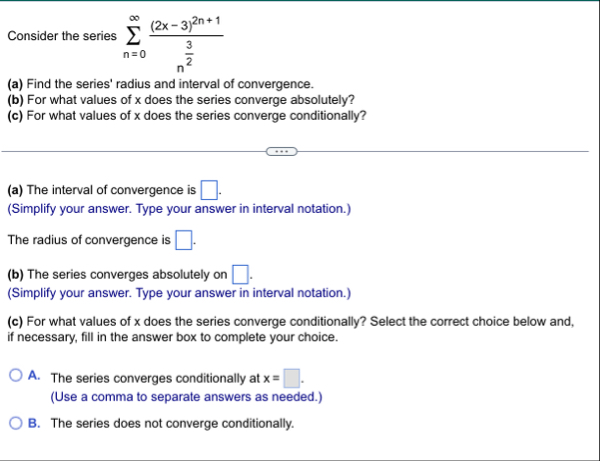 S @x-apnt!
Consider the series. z B
oz
(a) Find the series’ radius and interval of convergence.
(b) For what values of x does the series converge absolutely?
(c) For what values of x does the series converge conditionally?
=
(a) The interval of convergence is |_|.
(Simplity your answer. Type your answer in interval notation.)
‘The radius of convergence is [|
(b) The series converges absolutely on |.
(Simplity your answer. Type your answer in interval notation.)
(c) For what values of x does the series converge conditionally? Select the correct choice below and,
if necessary, fil in the answer box to complete your choice.
© A. The series converges conditionally at x= |.
(Use a comma to separate answers as needed.)
OB. The series does not converge conditionally.