 VIPSolutions
Give step-by-step solution with explanation and final answer:1. (3 pts) Particles A and B start at the origin and move in the zy-plane. Particle A has velocity = 7 —37, while Particle B moves in a direction perpendicular to 7. After 1 unit of time, the two particles are v/26 units apart, and Particle B lies in the first quadrant. What is the velocity of Particle B? . P 2 02 . 2. (3pts) A point mass is placed on the tangent plane to z° +4 7 = —1 at the point (1,2.3). Three forces net simultancously on the object: Pr=-T+37 +2, Fa=27T +57 + %, and Fy =47 — 27 +a¥k. For what value of a can the object remain on the tangent plane?
Question:
Give step-by-step solution with explanation and final answer: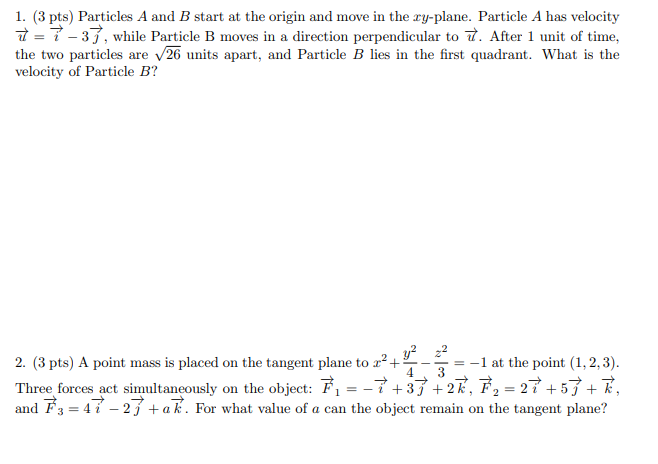 1. (3 pts) Particles A and B start at the origin and move in the zy-plane. Particle A has velocity
= 7 —37, while Particle B moves in a direction perpendicular to 7. After 1 unit of time,
the two particles are v/26 units apart, and Particle B lies in the first quadrant. What is the
velocity of Particle B?
. P 2 02 .
2. (3pts) A point mass is placed on the tangent plane to z° +4 7 = —1 at the point (1,2.3).
Three forces net simultancously on the object: Pr=-T+37 +2, Fa=27T +57 + %,
and Fy =47 — 27 +a¥k. For what value of a can the object remain on the tangent plane?
This is AI generated Response.
Asked by: gvr
Created at: 2025-08-01 21:17:41
Asked by: gvr
Created at: 2025-08-01 21:17:41
Final Answer:
Rendered
Raw Text
Did you like this answer?
Let's solve each problem step-by-step.
---
### **Problem 1**
#### **Given:**
- Particles \( A \) and \( B \) start at the origin.
- Particle \( A \) velocity: \( \vec{v}_A = \hat{i} - 3\hat{j} \)
- Particle \( B \) moves perpendicular to \( \vec{v}_A \) and is in the first quadrant after 1 unit time.
- After 1 unit time, they are \( \sqrt{26} \) units apart.
#### **Step 1: Find velocity direction for \( B \)**
- \( \vec{v}_B \) is perpendicular to \( \vec{v}_A \).
- If \( \vec{v}_B = a\hat{i} + b\hat{j} \), then \( \vec{v}_A \cdot \vec{v}_B = 0 \):
\[
(1)(a) + (-3)(b) = 0 \implies a - 3b = 0 \implies a = 3b
\]
- Since B is in the first quadrant, both \( a > 0 \) and \( b > 0 \).
So, \( \vec{v}_B = 3b\hat{i} + b\hat{j} \).
#### **Step 2: After 1 unit time, position vectors:**
- \( \vec{r}_A = \vec{v}_A \times 1 = \hat{i} - 3\hat{j} \)
- \( \vec{r}_B = \vec{v}_B \times 1 = 3b\hat{i} + b\hat{j} \)
#### **Step 3: Distance between A and B after 1 unit time:**
\[
|\vec{r}_A - \vec{r}_B| = \sqrt{[(1 - 3b)]^2 + [(-3) - b]^2}
\]
Set this equal to \( \sqrt{26} \):
\[
[(1 - 3b)]^2 + [(-3) - b]^2 = 26
\]
Expand:
\[
(1 - 3b)^2 + (-3 - b)^2 = 26
\]
\[
(1 - 6b + 9b^2) + (9 + 6b + b^2) = 26
\]
\[
(1 + 9) + (-6b + 6b) + (9b^2 + b^2) = 26
\]
\[
10 + 0 + 10b^2 = 26
\]
\[
10b^2 = 16 \implies b^2 = \frac{8}{5} \implies b = \frac{2\sqrt{10}}{5}
\]
Remember \( a = 3b \):
\[
a = 3 \times \frac{2\sqrt{10}}{5} = \frac{6\sqrt{10}}{5}
\]
#### **Step 4: Velocity of Particle B**
\[
\vec{v}_B = a\hat{i} + b\hat{j} = \frac{6\sqrt{10}}{5}\hat{i} + \frac{2\sqrt{10}}{5}\hat{j}
\]
**Final Answer (boxed):**
\[
\boxed{\vec{v}_B = \frac{6\sqrt{10}}{5}\hat{i} + \frac{2\sqrt{10}}{5}\hat{j}}
\]
---
### **Problem 2**
#### **Given:**
- Tangent plane to \( x^2 + \frac{y^2}{4} - \frac{z^2}{3} = -1 \) at \( (1, 2, 3) \).
- Three forces:
\[
\vec{F}_1 = -\hat{i} + 3\hat{j} + 2\hat{k}
\]
\[
\vec{F}_2 = 2\hat{i} + 5\hat{j} + \hat{k}
\]
\[
\vec{F}_3 = 4\hat{i} - 2\hat{j} + a\hat{k}
\]
Object remains on the tangent plane if the total force is perpendicular to the normal vector of the tangent plane.
#### **Step 1: Find the normal vector to the surface at (1, 2, 3)**
Given surface:
\[
F(x, y, z) = x^2 + \frac{y^2}{4} - \frac{z^2}{3}
\]
Gradient:
\[
\nabla F = \left(2x, \frac{y}{2}, -\frac{2z}{3}\right)
\]
At \( (1, 2, 3) \):
\[
\nabla F = \left(2, 1, -2\right)
\]
#### **Step 2: Net force**
\[
\vec{F}_{\text{net}} = \vec{F}_1 + \vec{F}_2 + \vec{F}_3
\]
Sum components:
- \( \hat{i} \): \( -1 + 2 + 4 = 5 \)
- \( \hat{j} \): \( 3 + 5 - 2 = 6 \)
- \( \hat{k} \): \( 2 + 1 + a = a + 3 \)
So,
\[
\vec{F}_{\text{net}} = 5\hat{i} + 6\hat{j} + (a+3)\hat{k}
\]
#### **Step 3: Force perpendicular to normal**
Condition: \( \vec{F}_{\text{net}} \cdot \nabla F = 0 \):
\[
(5)(2) + (6)(1) + (a+3)(-2) = 0
\]
\[
10 + 6 - 2(a+3) = 0
\]
\[
16 - 2a - 6 = 0
\]
\[
10 - 2a = 0 \implies 2a = 10 \implies a = 5
\]
**Final Answer (boxed):**
\[
\boxed{a = 5}
\]
---
**Summary of Answers:**
1. \(\boxed{\vec{v}_B = \frac{6\sqrt{10}}{5}\hat{i} + \frac{2\sqrt{10}}{5}\hat{j}}\)
2. \(\boxed{a = 5}\)
📢 Instructions:
- Ask anything relatd to above question only.
- For new Question goto :