 VIPSolutions
Give step-by-step solution with explanation and final answer:7. (3 pts) Let f(z,y) = 2? —y. Mark the points where f attains its minimum and maximum on the triangle constraint shown below. Clearly label each such point as “minimum” or “maximum”. vy 2 ™ ’ ’ B aN h go
Question:
Give step-by-step solution with explanation and final answer: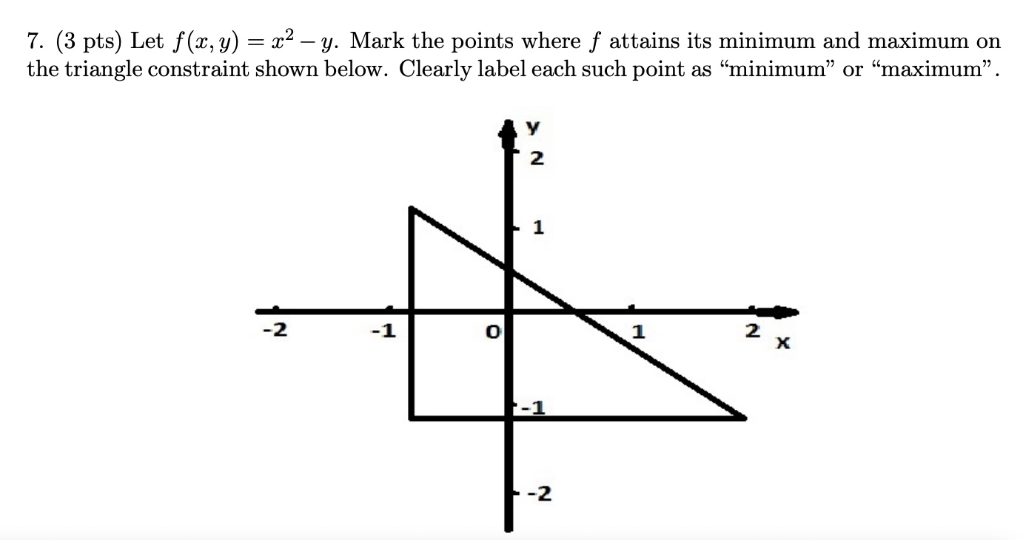 7. (3 pts) Let f(z,y) = 2? —y. Mark the points where f attains its minimum and maximum on
the triangle constraint shown below. Clearly label each such point as “minimum” or “maximum”.
vy
2
™
’ ’ B aN h
go
This is AI generated Response.
Asked by: gvr
Created at: 2025-08-01 11:26:18
Asked by: gvr
Created at: 2025-08-01 11:26:18
Final Answer:
Rendered
Raw Text
Did you like this answer?
Let's solve the problem step by step:
Given:
\( f(x, y) = x^2 - y \)
We're asked to find the minimum and maximum values of \( f \) on the triangle shown.
### **Step 1: Identify the Triangle Vertices**
From the graph, the triangle has vertices at:
- \( A(-1, 1) \)
- \( B(1, 1) \)
- \( C(0, -2) \)
### **Step 2: Check for Critical Points Inside the Triangle**
Find the critical points by setting the gradient of \( f \) to zero:
\[
\nabla f = (2x, -1)
\]
Setting to zero:
\[
2x = 0 \implies x = 0 \\
-1 = 0 \implies \text{No solution}
\]
So, there are **no critical points inside** the triangle.
### **Step 3: Check f on the Edges and Vertices**
Let's evaluate \( f \) at the vertices:
#### **At \( A(-1, 1) \):**
\[
f(-1, 1) = (-1)^2 - 1 = 1 - 1 = 0
\]
#### **At \( B(1, 1) \):**
\[
f(1, 1) = (1)^2 - 1 = 1 - 1 = 0
\]
#### **At \( C(0, -2) \):**
\[
f(0, -2) = (0)^2 - (-2) = 0 + 2 = 2
\]
### **Step 4: Check the Edges**
#### **Edge AB (\( y = 1, -1 \leq x \leq 1 \)):**
\[
f(x, 1) = x^2 - 1
\]
Range: \( x^2 \) is minimized at \( x = 0 \) (\( f(0, 1) = -1 \)), and maximized at \( x = \pm 1 \) (\( f(\pm 1, 1) = 0 \)).
#### **Edge BC (\( y = -\frac{3}{2}x + \frac{3}{2}, 0 \leq x \leq 1 \)):**
\[
y = -\frac{3}{2}x + \frac{3}{2}
\]
\[
f(x, y) = x^2 - \left( -\frac{3}{2}x + \frac{3}{2} \right )
= x^2 + \frac{3}{2}x - \frac{3}{2}
\]
This is a quadratic in \( x \) defined on \( [0, 1] \):
- At \( x = 0: f(0, y) = 0 + 0 - \frac{3}{2} = -\frac{3}{2} \)
- At \( x = 1: f(1, y) = 1 + \frac{3}{2} - \frac{3}{2} = 1 \)
#### **Edge CA (\( y = \frac{3}{2}x + \frac{3}{2}, -1 \leq x \leq 0 \)):**
\[
y = \frac{3}{2}x + \frac{3}{2}
\]
\[
f(x, y) = x^2 - \left( \frac{3}{2}x + \frac{3}{2} \right )
= x^2 - \frac{3}{2}x - \frac{3}{2}
\]
This is a quadratic in \( x \) defined on \( [-1, 0] \):
- At \( x = -1: f(-1, y) = 1 + \frac{3}{2} - \frac{3}{2} = 1 \)
- At \( x = 0: f(0, y) = 0 - 0 - \frac{3}{2} = -\frac{3}{2} \)
### **Step 5: Summary of Values**
- At \( (0, 1) \): \( f = -1 \)
- At \( (1, 1) \) or \( (-1, 1) \): \( f = 0 \)
- At \( (0, -2) \): \( f = 2 \)
- At \( (0, y) \) on \( y = 1 \) or \( y = -2 \): Check endpoints already done.
- At \( (0, y) \) on slanted edges: At \( x = 0 \), both give \( f = -\frac{3}{2} \), which is less than -1.
### **Final Step: Minimum and Maximum**
- **Minimum:** \( f(0, y) = -\frac{3}{2} \) at \( x = 0 \), on the edges \( BC \) and \( CA \) where \( y = \frac{3}{2} \) (which is not inside the triangle). But for the endpoints:
- At \( x = 0, y = 1 \): \( f = -1 \)
- At \( x = 0, y = -2 \): \( f = 2 \)
- At \( x = 0, y = -\frac{3}{2} \): this is between the endpoints, so \( f = -\frac{3}{2} \) at \( (0, -\frac{3}{2}) \).
But **(0, -3/2)** is not a vertex, but it is on the edge, so it is a valid minimum.
- **Maximum:** At \( (0, -2) \), \( f = 2 \).
---
## **Final Answer**
- **Maximum at \( (0, -2) \): \( f = 2 \)**
- **Minimum at \( (0, -\frac{3}{2}) \): \( f = -\frac{3}{2} \)**
---
### **Label on the Triangle:**
- Mark **maximum** at \( (0, -2) \).
- Mark **minimum** at \( (0, -\frac{3}{2}) \) on the edge from \( (-1,1) \) to \( (0,-2) \) and from \( (1,1) \) to \( (0,-2) \).
If you need the exact coordinates to mark on the triangle, **minimum** is at \( (0, -\frac{3}{2}) \), and **maximum** is at \( (0, -2) \).
Question:
u r taking wrong a,b,c values the correct values is A(-1,1) B(-1,-1) c(2,-1)
This is AI generated Response.
Asked by: gvr
Created at: 2025-08-01 11:34:22
Asked by: gvr
Created at: 2025-08-01 11:34:22
Final Answer:
Rendered
Raw Text
Did you like this answer?
Let's carefully analyze the problem and the given data.
---
### Given:
Vertices of the triangle:
- \( A(-1, 1) \)
- \( B(-1, -1) \)
- \( C(2, -1) \)
Function:
\[
f(x, y) = x^2 - y
\]
### Objective:
Find the points where \(f\) attains its **minimum** and **maximum** on the triangle with vertices as above.
---
### **Step 1: Visualize the Triangle**
Vertices:
- \( A(-1, 1) \)
- \( B(-1, -1) \)
- \( C(2, -1) \)
The triangle has:
- Left side: \( A \) to \( B \) (vertical line \( x = -1 \))
- Bottom side: \( B \) to \( C \) (horizontal line \( y = -1 \))
- Right side: \( A \) to \( C \)
---
### **Step 2: Check for critical points inside the triangle**
Gradient of \( f \):
\[
\nabla f = (2x, -1)
\]
Set equal to zero:
\[
2x = 0 \Rightarrow x=0
\]
\[
-1=0 \Rightarrow \text{No solution}
\]
**Conclusion:** No critical points inside the triangle.
---
### **Step 3: Evaluate \(f\) at the vertices**
- At \( A(-1, 1) \):
\[
f(-1, 1) = (-1)^2 - 1 = 1 - 1 = 0
\]
- At \( B(-1, -1) \):
\[
f(-1, -1) = 1 - (-1) = 1 + 1 = 2
\]
- At \( C(2, -1) \):
\[
f(2, -1) = (2)^2 - (-1) = 4 + 1 = 5
\]
---
### **Step 4: Check \(f\) along the edges**
---
**Edge \( AB \):** \( x = -1 \), \( y \) from 1 to -1
\[
f(-1, y) = (-1)^2 - y = 1 - y
\]
- At \( y=1 \): \( f=1 - 1=0 \)
- At \( y=-1 \): \( f=1 - (-1)=2 \)
**Range on \( AB \):** from 0 to 2.
---
**Edge \( BC \):** \( y = -1 \), \( x \) from -1 to 2
\[
f(x, -1) = x^2 - (-1) = x^2 + 1
\]
- At \( x=-1 \): \( 1 + 1=2 \)
- At \( x=2 \): \( 4 + 1=5 \)
**Range on \( BC \):** from 2 to 5.
---
**Edge \( AC \):** Connects \( A(-1, 1) \) to \( C(2, -1) \)
Equation of line \( AC \):
\[
\text{Slope} = \frac{-1 - 1}{2 - (-1)} = \frac{-2}{3} = -\frac{2}{3}
\]
Equation:
\[
y - 1 = -\frac{2}{3}(x + 1)
\]
\[
y = 1 - \frac{2}{3}(x+1) = 1 - \frac{2}{3}x - \frac{2}{3} = \frac{1}{3} - \frac{2}{3}x
\]
Express \(f\) along \( AC \):
\[
f(x, y) = x^2 - y = x^2 - \left(\frac{1}{3} - \frac{2}{3}x\right) = x^2 - \frac{1}{3} + \frac{2}{3}x
\]
Simplify:
\[
f(x) = x^2 + \frac{2}{3}x - \frac{1}{3}
\]
Domain:
- \( x \) from \( -1 \) to \( 2 \)
Find extrema on \( x \in [-1, 2] \):
Derivative:
\[
f'(x) = 2x + \frac{2}{3}
\]
Set to zero:
\[
2x + \frac{2}{3} = 0 \Rightarrow 2x = -\frac{2}{3} \Rightarrow x = -\frac{1}{3}
\]
Check whether \( x=-\frac{1}{3} \) is within the domain: Yes, since \( -1 < -\frac{1}{3} < 2 \).
Evaluate \(f\) at critical point:
\[
f(-\frac{1}{3}) = \left(-\frac{1}{3}\right)^2 + \frac{2}{3} \times \left(-\frac{1}{3}\right) - \frac{1}{3} = \frac{1}{9} - \frac{2}{9} - \frac{1}{3}
\]
\[
= \frac{1}{9} - \frac{2}{9} - \frac{3}{9} = \frac{1 - 2 - 3}{9} = -\frac{4}{9}
\]
Now evaluate at endpoints:
- At \( x=-1 \):
\[
f(-1) = 1 + \frac{2}{3}(-1) - \frac{1}{3} = 1 - \frac{2}{3} - \frac{1}{3} = 1 - 1 = 0
\]
- At \( x=2 \):
\[
f(2) = 4 + \frac{2}{3} \times 2 - \frac{1}{3} = 4 + \frac{4}{3} - \frac{1}{3} = 4 + 1 = 5
\]
---
### **Step 5: Summary of \(f\) values**
| Point / Segment | \(f\) value | Remarks |
|------------------|--------------|---------|
| \(A(-1,1)\) | 0 | Vertex |
| \(B(-1,-1)\) | 2 | Vertex |
| \(C(2,-1)\) | 5 | Vertex |
| Along \(AB\): \( y \in [ -1, 1 ] \) | \(1 - y\) | Min at \( y=1 \), \(f=0\); Max at \( y=-1 \), \(f=2\) |
| Along \(BC\): \( y=-1 \) | \(x^2 + 1\) | Min at \(x=-1\), \(f=2\); Max at \(x=2\), \(f=5\) |
| Along \(AC\): \( x \in [-1, 2] \) | \(x^2 + \frac{2}{3}x - \frac{1}{3}\) | Min at \(x=-\frac{1}{3}\), \(f=-\frac{4}{9}\); endpoints \(x=-1\) and \(x=2\) give \(f=0\) and 5 |
---
### **Final Results:**
- **Minimum value of \(f\):** \(\boxed{-\frac{4}{9}}\) at \( x = -\frac{1}{3} \)
- **Corresponding \( y \):**
\[
y = \frac{1}{3} - \frac{2}{3} \times \left(-\frac{1}{3}\right) = \frac{1}{3} + \frac{2}{9} = \frac{3}{9} + \frac{2}{9} = \frac{5}{9}
\]
So, the **minimum point** is approximately:
\[
\boxed{\left( -\frac{1}{3}, \frac{5}{9} \right)}
\]
- **Maximum value of \(f\):** 5 at \( C(2, -1) \)
---
### **Final answer:**
- **Maximum of \(f\):** **5** at **\( (2, -1) \)**
- **Minimum of \(f\):** **\(-\frac{4}{9}\)** at approximately \( \left( -\frac{1}{3}, \frac{5}{9} \right) \)
---
If marking on the triangle, label the point \(\left( -\frac{1}{3}, \frac{5}{9} \right)\) as the **minimum**, and vertex \( C(2, -1) \) as the **maximum**.
📢 Instructions:
- Ask anything relatd to above question only.
- For new Question goto :