Question:
Give step-by-step solution with explanation and final answer:
Did you like this answer?
👍 0
👎 0
Let's solve each problem step by step:
---
## **Problem 1: Disk/Washer Method**
**Given:**
- Bounded by \( y = x^2 \) and \( y = x^3 \)
- Rotate about the x-axis.
**Step 1: Find intersection points.**
Set \( x^2 = x^3 \)
\[
x^2 = x^3 \implies x^3 - x^2 = 0 \implies x^2(x-1) = 0 \implies x = 0, 1
\]
**Step 2: Set up the integral.**
Since \( x^2 \geq x^3 \) for \( x \in [0,1] \), the outer radius is \( x^2 \), inner radius is \( x^3 \):
\[
V = \pi \int_{0}^{1} \left[ (x^2)^2 - (x^3)^2 \right] dx
= \pi \int_{0}^{1} [x^4 - x^6] dx
\]
**Step 3: Integrate.**
\[
= \pi \left[ \frac{x^5}{5} - \frac{x^7}{7} \right]_{0}^{1}
= \pi \left( \frac{1}{5} - \frac{1}{7} \right)
= \pi \left( \frac{7-5}{35} \right)
= \pi \left( \frac{2}{35} \right)
\]
**Final Answer:**
\[
\boxed{\frac{2\pi}{35}}
\]
---
## **Problem 2: Cylinders/Shell Method**
**Given:**
- \( y = x^2 - 6x + 9 \) and \( y = -x^2 + 6x - 1 \)
- Rotated about \( x = 8 \)
**Step 1: Find intersection points.**
Set \( x^2 - 6x + 9 = -x^2 + 6x - 1 \):
\[
x^2 - 6x + 9 = -x^2 + 6x - 1 \\
x^2 + x^2 - 6x - 6x + 9 + 1 = 0 \\
2x^2 - 12x + 10 = 0 \\
x^2 - 6x + 5 = 0 \\
(x-5)(x-1) = 0 \implies x = 1, 5
\]
**Step 2: Shell radius and height.**
- Radius from \( x \) to \( x = 8 \) is \( r = 8 - x \)
- Height: \( H = [-x^2 + 6x - 1] - [x^2 - 6x + 9] \)
\[
H = -x^2 + 6x - 1 - x^2 + 6x - 9 = -2x^2 + 12x - 10
\]
**Step 3: Set up the shell integral.**
\[
V = 2\pi \int_{x=1}^{5} (8-x) \left[ -2x^2 + 12x - 10 \right] dx
\]
Expand:
\[
(8-x)(-2x^2 + 12x - 10) = 8(-2x^2 + 12x - 10) - x(-2x^2 + 12x - 10)
= -16x^2 + 96x - 80 + 2x^3 - 12x^2 + 10x
= 2x^3 - 28x^2 + 106x - 80
\]
So,
\[
V = 2\pi \int_{1}^{5} [2x^3 - 28x^2 + 106x - 80] dx
\]
**Step 4: Integrate.**
\[
\int [2x^3 - 28x^2 + 106x - 80] dx = \frac{2x^4}{4} - \frac{28x^3}{3} + 53x^2 - 80x
= \frac{x^4}{2} - \frac{28}{3}x^3 + 53x^2 - 80x
\]
Evaluate from 1 to 5:
For \( x=5 \):
\[
\frac{5^4}{2} - \frac{28}{3} \cdot 125 + 53 \cdot 25 - 80 \cdot 5 = \frac{625}{2} - \frac{3500}{3} + 1325 - 400
\]
For \( x=1 \):
\[
\frac{1}{2} - \frac{28}{3} + 53 - 80
\]
Subtract (upper - lower):
\[
\left(\frac{625}{2} - \frac{3500}{3} + 1325 - 400\right) - \left(\frac{1}{2} - \frac{28}{3} + 53 - 80\right)
\]
\[
= \left(\frac{625-1}{2}\right) - \left(\frac{3500-28}{3}\right) + (1325-53) - (400-80)
= \frac{624}{2} - \frac{3472}{3} + 1272 - 320
= 312 - \frac{3472}{3} + 1272 - 320
= (312 + 1272 - 320) - \frac{3472}{3}
= (1564 - 320) - \frac{3472}{3}
= 1244 - \frac{3472}{3}
\]
\[
V = 2\pi \left(1244 - \frac{3472}{3}\right)
= 2\pi \left(\frac{3732 - 3472}{3}\right)
= 2\pi \left(\frac{732}{3}\right)
= 2\pi \times 244 = 488\pi
\]
**Final Answer:**
\[
\boxed{488\pi}
\]
---
## **Problem 3: Arc Length**
Given \( f(x) = 3 + \cosh(x) \), from \( x=0 \) to \( x=2 \)
Arc length formula:
\[
L = \int_{a}^{b} \sqrt{1 + [f'(x)]^2} dx
\]
\( f'(x) = \sinh(x) \)
\[
L = \int_{0}^{2} \sqrt{1 + \sinh^2(x)} dx
\]
But \( 1 + \sinh^2(x) = \cosh^2(x) \)
So,
\[
L = \int_{0}^{2} \cosh(x) dx
= \sinh(x) \Big|_{0}^{2}
= \sinh(2) - \sinh(0)
= \sinh(2) - 0
= \sinh(2)
\]
**Final Answer:**
\[
\boxed{\sinh(2)}
\]
---
## **Problem 4: Parametric Curves**
Given \( x = t^2, y = t^3 - t \)
### a) **Concavity**
First, find \( \frac{dy}{dx} \):
\( \frac{dx}{dt} = 2t \), \( \frac{dy}{dt} = 3t^2 - 1 \)
\[
\frac{dy}{dx} = \frac{dy/dt}{dx/dt} = \frac{3t^2 - 1}{2t}
\]
Second derivative:
\[
\frac{d^2y}{dx^2} = \frac{d}{dt}\left(\frac{dy}{dx}\right) \div \frac{dx}{dt}
\]
\[
\frac{d}{dt}\left(\frac{3t^2-1}{2t}\right) = \frac{6t \cdot 2t - (3t^2-1)\cdot 2}{(2t)^2} = \frac{12t^2 - [6t^2-2]}{4t^2} = \frac{12t^2 - 6t^2 + 2}{4t^2} = \frac{6t^2 + 2}{4t^2}
\]
\[
\frac{d^2y}{dx^2} = \frac{6t^2+2}{4t^2} \div 2t = \frac{6t^2+2}{4t^2} \cdot \frac{1}{2t} = \frac{6t^2+2}{8t^3}
\]
Set \( \frac{6t^2+2}{8t^3} = 0 \Rightarrow 6t^2+2 = 0 \Rightarrow t^2 = -\frac{1}{3} \)
But this has **no real solutions** for \( t \).
- For \( t > 0 \), numerator \( > 0 \), denominator \( > 0 \): positive (curve is **concave up**).
- For \( t < 0 \), numerator \( > 0 \), denominator \( < 0 \): negative (**concave down**).
**So,**
- **Concave up** for \( t > 0 \)
- **Concave down** for \( t < 0 \)
---
### b) **Sketch for \( t = -1 \) to \( t = 2 \) with arrow**
- At \( t = -1: x = 1, y = -1 + 1 = 0 \) → (1, 0)
- At \( t = 0: x = 0, y = 0 \) → (0, 0)
- At \( t = 1: x = 1, y = 1 - 1 = 0 \) → (1, 0)
- At \( t = 2: x = 4, y = 8 - 2 = 6 \) → (4, 6)
Plot these points and draw a smooth curve from (1, 0) through (0, 0), back to (1, 0), up to (4, 6). Draw an **arrow** in the direction of increasing \( t \).
---
### c) **Convert to Cartesian**
Given:
\[
x = t^2 \implies t = \pm \sqrt{x}
\]
\[
y = t^3 - t = t(t^2 - 1)
\]
Substitute:
\[
y = t^3 - t = (\pm\sqrt{x})^3 - (\pm\sqrt{x}) = \pm x^{3/2} \mp x^{1/2}
\]
So:
\[
y = t^3 - t = t(t^2 - 1) = t(t-1)(t+1)
\]
So, in terms of \( x \):
\[
y = (\sqrt{x})^3 - \sqrt{x} = x^{3/2} - x^{1/2}
\]
or
\[
y = -x^{3/2} + x^{1/2}
\]
So, the full Cartesian equation is:
\[
\boxed{y = x^{3/2} - x^{1/2} \text{ or } y = -x^{3/2} + x^{1/2}}
\]
---
## **Summary of Final Answers**
1. **Volume**: \( \boxed{\frac{2\pi}{35}} \)
2. **Volume**: \( \boxed{488\pi} \)
3. **Exact length**: \( \boxed{\sinh(2)} \)
4. a) Concave up for \( t > 0 \), concave down for \( t < 0 \)
b) See explanation for sketch
c) \( \boxed{y = x^{3/2} - x^{1/2} \text{ or } y = -x^{3/2} + x^{1/2}} \)
 VIPSolutions
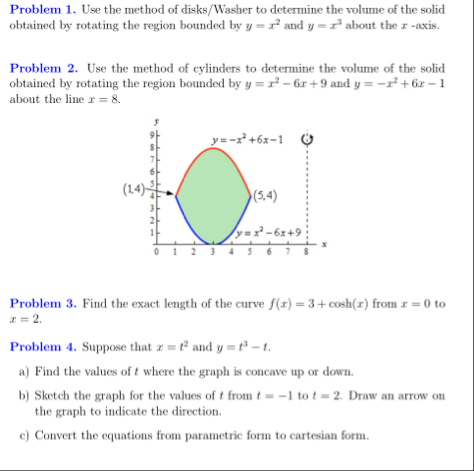 Problem 1. Use the method of disks/Washer to determine the volume of the solid
obtained by rotating the region bounded by y = 1% and y = =* about the r -axis.
Problem 2. Use the method of cylinders to determine the volume of the solid
obtained by rotating the region bounded by y = r* 6x + 9 and y = —x* + 62 — 1
about the line r = 8.
i
K yeast Q
o :
H i
(erg Ga)
3) H
3 i
i fy=xi-6x49
DEE EOE EOE
Problem 3. Find the exact length of the curve f(x) = 3 + cosh(r) from x = 0 to
1-2
Problem 4. Suppose that 7 = ¢ and y = £1.
) Find the values of ¢ where the graph i concave up or down.
b) Sketch the graph for the values of f from f = ~1 to t = 2. Draw an arrow on.
the graph to indicate the direction
©) Convert the equations from parametric form to cartesian form.