 VIPSolutions
Give step-by-step solution with explanation and final answer:A soda canning company peoduces cans that have a capacity of 16 fluid ounces. The cans are right circular cylinders. The material costs of the side and bottoes is 4 cents per square inch and the top is 2 cents per square inch. Find the radius and helght of the can that minimines cost. Unit conversion of fluid ounces to cubic incles. Volame equation. Cost function. Derivative of cost fusetion. First and/or second derivative test (sign chart) to determine minimam cost baeed on rallius and/or hright. The radius and beight that minimiers cost.
Question:
Give step-by-step solution with explanation and final answer: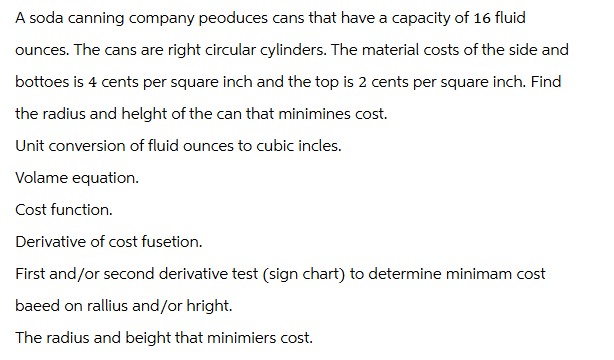 A soda canning company peoduces cans that have a capacity of 16 fluid
ounces. The cans are right circular cylinders. The material costs of the side and
bottoes is 4 cents per square inch and the top is 2 cents per square inch. Find
the radius and helght of the can that minimines cost.
Unit conversion of fluid ounces to cubic incles.
Volame equation.
Cost function.
Derivative of cost fusetion.
First and/or second derivative test (sign chart) to determine minimam cost
baeed on rallius and/or hright.
The radius and beight that minimiers cost.
This is AI generated Response.
Asked by: gvr
Created at: 2025-07-31 22:57:00
Asked by: gvr
Created at: 2025-07-31 22:57:00
Final Answer:
Rendered
Raw Text
Did you like this answer?
Let's go step by step as requested:
---
## **Step 1: Unit Conversion**
**Given:**
Capacity = 16 fluid ounces
**Conversion:**
1 US fluid ounce = 1.80469 cubic inches
So,
\[ 16 \text{ fl oz} = 16 \times 1.80469 = 28.875 \text{ cubic inches} \]
---
## **Step 2: Volume Equation for Can**
Let:
- \( r \) = radius (in inches)
- \( h \) = height (in inches)
**Volume of cylinder:**
\[
V = \pi r^2 h = 28.875
\]
---
## **Step 3: Cost Function**
- **Side area:** \( 2\pi r h \) (cost: 4 cents/in²)
- **Bottom area:** \( \pi r^2 \) (cost: 4 cents/in²)
- **Top area:** \( \pi r^2 \) (cost: 2 cents/in²)
**Total cost function:**
\[
C = 4(2\pi r h) + 4(\pi r^2) + 2(\pi r^2)
\]
\[
C = 8\pi r h + 4\pi r^2 + 2\pi r^2
\]
\[
C = 8\pi r h + 6\pi r^2
\]
---
## **Step 4: Express Cost in Single Variable**
From step 2:
\[
h = \frac{28.875}{\pi r^2}
\]
Substitute \( h \) into cost function:
\[
C(r) = 8\pi r \left(\frac{28.875}{\pi r^2}\right) + 6\pi r^2
\]
\[
C(r) = 8 \cdot 28.875 \frac{1}{r} + 6\pi r^2
\]
\[
C(r) = 231 \frac{1}{r} + 6\pi r^2
\]
---
## **Step 5: Derivative of Cost Function**
\[
C(r) = \frac{231}{r} + 6\pi r^2
\]
\[
C'(r) = -231r^{-2} + 12\pi r
\]
Set \( C'(r) = 0 \) to find the minimum:
\[
-231r^{-2} + 12\pi r = 0
\]
\[
12\pi r = \frac{231}{r^2}
\]
\[
12\pi r^3 = 231
\]
\[
r^3 = \frac{231}{12\pi}
\]
\[
r = \left(\frac{231}{12\pi}\right)^{1/3}
\]
---
## **Step 6: Second Derivative Test**
\[
C''(r) = 462r^{-3} + 12\pi
\]
Since both terms are positive for \( r > 0 \), the function is concave up, confirming a minimum.
---
## **Step 7: Find the Radius and Height**
\[
r = \left(\frac{231}{12\pi}\right)^{1/3}
\]
Calculate numerically:
- \( 12\pi \approx 37.6991 \)
- \( 231 / 37.6991 \approx 6.129 \)
- \( r = 6.129^{1/3} \approx 1.838 \) inches
Now, find \( h \):
\[
h = \frac{28.875}{\pi r^2}
\]
\[
r^2 \approx (1.838)^2 \approx 3.378
\]
\[
h = \frac{28.875}{\pi \cdot 3.378}
\]
\[
h \approx \frac{28.875}{10.616}
\]
\[
h \approx 2.72 \text{ inches}
\]
---
## **Step 8: Final Answers**
**Radius that minimizes cost:**
\[
\boxed{1.84 \text{ inches}}
\]
**Height that minimizes cost:**
\[
\boxed{2.72 \text{ inches}}
\]
---
**Summary Table:**
| Quantity | Value (rounded to 2 decimal places) |
|----------|-------------------------------------|
| Radius | 1.84 inches |
| Height | 2.72 inches |
Let me know if you need the answer in exact form or further clarification!
📢 Instructions:
- Ask anything relatd to above question only.
- For new Question goto :