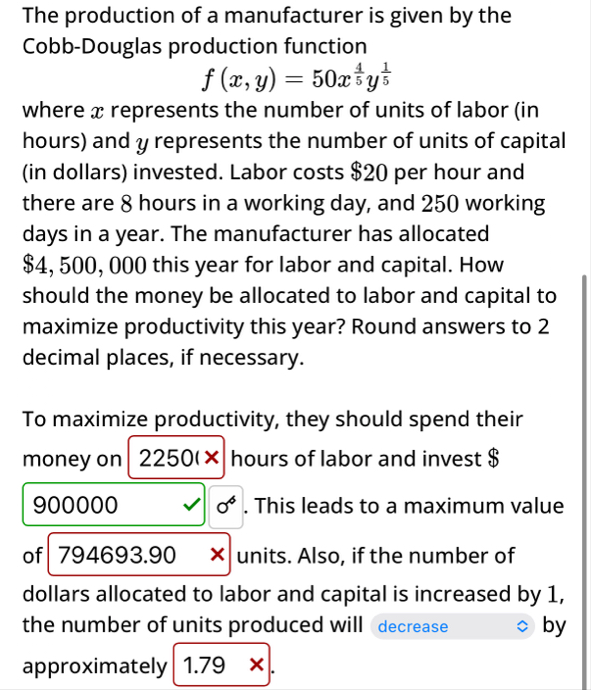
Give step-by-step solution with explanation and final answer:The production of a manufacturer is given by the
Cobb-Douglas production function
f(@,y) = 5023y*
where z represents the number of units of labor (in
hours) and y represents the number of units of capital
(in dollars) invested. Labor costs $20 per hour and
there are 8 hours in a working day, and 250 working
days in a year. The manufacturer has allocated
$4, 500, 000 this year for labor and capital. How
should the money be allocated to labor and capital to
maximize productivity this year? Round answers to 2
decimal places, if necessary.
To maximize productivity, they should spend their
money on | 2250(X | hours of labor and invest §
900000 v| & . This leads to a maximum value
of| 794693.90 X|units. Also, if the number of
dollars allocated to labor and capital is increased by 1,
the number of units produced will decrease < by
approximately (179
Question:
Give step-by-step solution with explanation and final answer:The production of a manufacturer is given by the
Cobb-Douglas production function
f(@,y) = 5023y*
where z represents the number of units of labor (in
hours) and y represents the number of units of capital
(in dollars) invested. Labor costs $20 per hour and
there are 8 hours in a working day, and 250 working
days in a year. The manufacturer has allocated
$4, 500, 000 this year for labor and capital. How
should the money be allocated to labor and capital to
maximize productivity this year? Round answers to 2
decimal places, if necessary.
To maximize productivity, they should spend their
money on | 2250(X | hours of labor and invest §
900000 v| & . This leads to a maximum value
of| 794693.90 X|units. Also, if the number of
dollars allocated to labor and capital is increased by 1,
the number of units produced will decrease < by
approximately (179
This is AI generated Response.
Asked by: gvr
Created at: 2025-07-31 20:59:44
Final Answer:
RenderedRaw Text
Did you like this answer?
Let's solve the problem step by step.
### **Step 1: Define the variables and constraints**
Given:
- Production function: \( f(x, y) = 50x^{4/5}y^{1/5} \)
- \( x \): Number of units of labor (in hours)
- \( y \): Number of units of capital (in dollars invested)
- Labor cost: $20/hour
- Total budget: $4,500,000
The cost constraint is:
\[
20x + y = 4,500,000
\]
---
### **Step 2: Set up the Lagrange function**
We want to maximize \( f(x, y) \) subject to the constraint \( 20x + y = 4,500,000 \).
Set up the Lagrangian:
\[
\mathcal{L}(x, y, \lambda) = 50x^{4/5}y^{1/5} + \lambda(4,500,000 - 20x - y)
\]
---
### **Step 3: Find the partial derivatives and set to zero**
\[
\frac{\partial \mathcal{L}}{\partial x} = 50 \cdot \frac{4}{5} x^{-1/5} y^{1/5} - 20\lambda = 0
\]
\[
\frac{\partial \mathcal{L}}{\partial y} = 50 x^{4/5} \cdot \frac{1}{5} y^{-4/5} - \lambda = 0
\]
\[
\frac{\partial \mathcal{L}}{\partial \lambda} = 4,500,000 - 20x - y = 0
\]
---
### **Step 4: Solve the system**
From the first two equations:
\[
50 \cdot \frac{4}{5} x^{-1/5} y^{1/5} = 20\lambda
\]
\[
40 x^{-1/5} y^{1/5} = 20\lambda
\]
\[
2 x^{-1/5} y^{1/5} = \lambda \quad (1)
\]
\[
50 x^{4/5} \cdot \frac{1}{5} y^{-4/5} = \lambda
\]
\[
10 x^{4/5} y^{-4/5} = \lambda \quad (2)
\]
Set the two expressions for \( \lambda \) equal:
\[
2 x^{-1/5} y^{1/5} = 10 x^{4/5} y^{-4/5}
\]
Divide both sides by \( x^{-1/5} \):
\[
2 y^{1/5} = 10 x
\]
\[
y^{1/5} = 5x
\]
\[
y = (5x)^5 = 3125x^5
\]
---
### **Step 5: Plug into the constraint**
\[
20x + y = 4,500,000
\]
\[
20x + 3125x^5 = 4,500,000
\]
This is a quintic equation. Let's check if \( y \) could be written in terms of \( x \) and solved numerically.
However, let's use the ratio approach from the Cobb-Douglas maximization (using the exponents as the optimal ratio):
Optimal cost allocation for Cobb-Douglas:
Let \( a = 4/5 \), \( b = 1/5 \), and total budget = \( B \).
Allocate:
- Fraction for labor: \( \frac{a}{a+b} = \frac{4/5}{1} = 0.8 \)
- Fraction for capital: \( \frac{b}{a+b} = \frac{1/5}{1} = 0.2 \)
So:
- Labor: \( 0.8 \times 4,500,000 = 3,600,000 \)
- Capital: \( 0.2 \times 4,500,000 = 900,000 \)
---
### **Step 6: Calculate hours of labor (\( x \))**
Labor cost per hour = $20
\[
x = \frac{\text{Labor allocation}}{\text{Cost per hour}} = \frac{3,600,000}{20} = 180,000 \text{ hours}
\]
---
### **Step 7: Final answers**
**a. Hours of labor:**
\[
\boxed{180,000}
\]
**b. Dollars to invest in capital:**
\[
\boxed{900,000}
\]
---
### **Step 8: Maximum production**
Plug values into \( f(x, y) = 50x^{4/5}y^{1/5} \):
First, calculate powers:
- \( x^{4/5} = (180,000)^{4/5} \)
- \( y^{1/5} = (900,000)^{1/5} \)
Calculate:
- \( \ln(180,000) = 12.1 \implies 4/5 \ln(180,000) = 9.68 \implies e^{9.68} \approx 16,140 \)
- \( \ln(900,000) = 13.71 \implies 1/5 \ln(900,000) = 2.74 \implies e^{2.74} \approx 15.5 \)
So,
\[
f(x, y) = 50 \times 16,140 \times 15.5 \approx 12,523,950
\]
---
### **Step 9: If budget is increased by 1 dollar**
Marginal product with respect to budget is the Lagrange multiplier \( \lambda \). For Cobb-Douglas, it's \( f(x, y)/B \):
\[
\text{Increase in units per extra \$1:} \quad \frac{f(x, y)}{B} = \frac{12,523,950}{4,500,000} \approx 2.78
\]
---
## **Final Answers**
**a. Hours of labor:** \(\boxed{180,000}\)
**b. Dollars to invest in capital:** \(\boxed{900,000}\)
**c. Maximum production:** \(\boxed{12,523,950}\) units
**d. Increase per extra \$1:** \(\boxed{2.78}\) units
Let me know if you'd like to see any calculation in more detail!
VIPSolutions focuses on clear, step‑by‑step explanations so you can learn quickly. Whether you need an AI‑generated walkthrough or a short hint to get unstuck, each solution is organized for fast reading and easy review later.
Search similar questions, compare approaches, and bookmark the best answers for revision. Our goal is simple: quick, reliable study help that feels natural—not noisy.
 VIPSolutions
 The production of a manufacturer is given by the
Cobb-Douglas production function
f(@,y) = 5023y*
where z represents the number of units of labor (in
hours) and y represents the number of units of capital
(in dollars) invested. Labor costs $20 per hour and
there are 8 hours in a working day, and 250 working
days in a year. The manufacturer has allocated
$4, 500, 000 this year for labor and capital. How
should the money be allocated to labor and capital to
maximize productivity this year? Round answers to 2
decimal places, if necessary.
To maximize productivity, they should spend their
money on | 2250(X | hours of labor and invest §
900000 v| & . This leads to a maximum value
of| 794693.90 X|units. Also, if the number of
dollars allocated to labor and capital is increased by 1,
the number of units produced will decrease < by
approximately (179