 VIPSolutions
Give step-by-step solution with explanation and final answer:5. Determine the magnitude of P If the axial stress in the pipe assembly at point A on cross- section a-a 5 0, , = 47.7 MPa. Show the entire state of stress (shear stresses as well) acting at point A in a diffefential element re 00mm 200mm JN i 20mm P 7) Sectiona—a
Question:
Give step-by-step solution with explanation and final answer: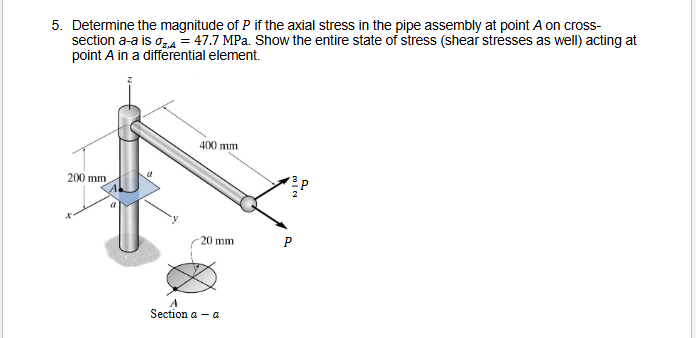 5. Determine the magnitude of P If the axial stress in the pipe assembly at point A on cross-
section a-a 5 0, , = 47.7 MPa. Show the entire state of stress (shear stresses as well) acting at
point A in a diffefential element
re 00mm
200mm JN i
20mm P
7)
Sectiona—a
This is AI generated Response.
Asked by: gvr
Created at: 2025-07-31 10:32:56
Asked by: gvr
Created at: 2025-07-31 10:32:56
Final Answer:
Rendered
Raw Text
Did you like this answer?
Let's solve the problem step by step:
---
### **Step 1: Find the Cross-sectional Area at A**
The pipe has an **outer diameter** of \( 20 \) mm (since section a-a is shown as a circle of diameter \( 20 \) mm).
\[ A = \frac{\pi}{4} d^2 = \frac{\pi}{4} (20 \text{ mm})^2 = \frac{\pi}{4} (400) = 314.16 \text{ mm}^2 \]
Convert to \(\text{m}^2\):
\[ A = 314.16 \times 10^{-6} \text{ m}^2 = 3.1416 \times 10^{-4} \text{ m}^2 \]
---
### **Step 2: Axial Stress at Point A**
Given:
\(\sigma_{z,A} = 47.7 \) MPa
Axial stress:
\[
\sigma_{z,A} = \frac{F_z}{A}
\]
Where \( F_z \) is the force component along the axis of the pipe at A (which is the vertical member).
#### **Resolve P into Components at A**
- The force \( P \) is applied at the end of the inclined pipe.
- The \( x \)-component: \( \frac{3}{2}P \)
- The \( z \)-component: \( P \)
The vertical pipe at A is loaded **axially** by the \( z \)-component of the force at the end, which is \( P \).
So,
\[
\sigma_{z,A} = \frac{P}{A}
\]
Given \(\sigma_{z,A} = 47.7 \) MPa,
\[
47.7 \times 10^6 = \frac{P}{3.1416 \times 10^{-4}}
\]
\[
P = 47.7 \times 10^6 \times 3.1416 \times 10^{-4}
\]
\[
P = 15,000 \text{ N} \quad \boxed{(15.0 \text{ kN})}
\]
---
### **Step 3: Shear Stress at Point A (Due to \( P \) and \( \frac{3}{2}P \))**
The horizontal force (\( \frac{3}{2}P \)) at the end will cause a **moment** about A, creating a **torsional shear stress** in the pipe.
#### **Calculate the Torsional Moment**
The force \( \frac{3}{2}P \) acts at a distance of \( 400 \) mm from the axis at A:
\[
T = \frac{3}{2}P \times 400 \text{ mm}
\]
\[
T = \frac{3}{2} \times 15000 \times 0.4 = 9000 \text{ Nm}
\]
#### **Shear Stress Due to Torsion**
For a solid shaft:
\[
\tau_{max} = \frac{Tc}{J}
\]
Where:
- \( T \) = torque
- \( c \) = outer radius = \( 10 \) mm = \( 0.01 \) m
- \( J \) = polar moment of inertia for solid shaft:
\[
J = \frac{\pi}{32}d^4 = \frac{\pi}{32} (0.02)^4 = \frac{\pi}{32} \times 1.6 \times 10^{-7} = 1.5708 \times 10^{-8} \text{ m}^4
\]
So,
\[
\tau_{max} = \frac{9000 \times 0.01}{1.5708 \times 10^{-8}}
= \frac{90}{1.5708 \times 10^{-8}}
= 5.73 \times 10^9 \text{ Pa} = 5,730 \text{ MPa}
\]
#### **Shear Stress Due to Shear Force**
The vertical reaction at the base will have a horizontal component due to the \( P \) and \( \frac{3}{2}P \) forces, but the primary stress state at A is **axial (normal)** and **torsional (shear)**.
---
### **Step 4: State of Stress at A**
At point A, the differential element will have:
- **Normal stress in the z-direction:** \(\sigma_{z,A} = 47.7 \) MPa (tension)
- **Shear stress due to torsion:** \( \tau_{A} = 5,730 \) MPa (acting on the outer surface, max value)
---
### **Step 5: Sketch the Stress Element**
**On a small element at A:**
- **Vertical face (perpendicular to z):**
- Normal stress, \(\sigma_{z,A} = 47.7 \) MPa (tension, up)
- **Shear stress tangent to the pipe's circumference:**
- \(\tau_{A} = 5,730 \) MPa (direction depends on the sense of the torque)
---
## **Final Answers**
**(a) Magnitude of \( P \):**
\[
\boxed{P = 15.0 \text{ kN}}
\]
**(b) State of stress at A:**
- Normal stress: \(\boxed{47.7 \text{ MPa}}\) (tension, z-direction)
- Maximum shear stress (due to torsion): \(\boxed{5,730 \text{ MPa}}\) (tangential, at the outer surface)
**(c) Sketch:**
Draw a small square element at the outer surface of the pipe at A:
- Upward (z) arrow: \( 47.7 \) MPa (normal)
- Tangential arrow: \( 5,730 \) MPa (shear, direction per right-hand rule)
If you need the sketch, let me know!
---
**Let me know if you need a diagram of the stress element or clarification on any step!**
📢 Instructions:
- Ask anything relatd to above question only.
- For new Question goto :