 VIPSolutions
Give step-by-step solution with explanation and final answer:25. Air Traffic Control An air traffic controller spots two planes at the same altitude converging on a point as they fly at right angles to each other (see figure). One plane is 225 miles from the point moving at 450 miles per hour. The other plane is 300 miles from the point moving at 600 miles per hour. (a) Atwhat rate is the distance between the planes decreasing? (b) How much time does the air traffic controller have to get one of the planes on a different flight path? y y [ER IE PE i 300 Oy } a 5 ” 5 mi J 2 200 NY A 100 AN N x I x 100 200 400 Distance (in miles) Figure for 25 Figure for 26
Question:
Give step-by-step solution with explanation and final answer: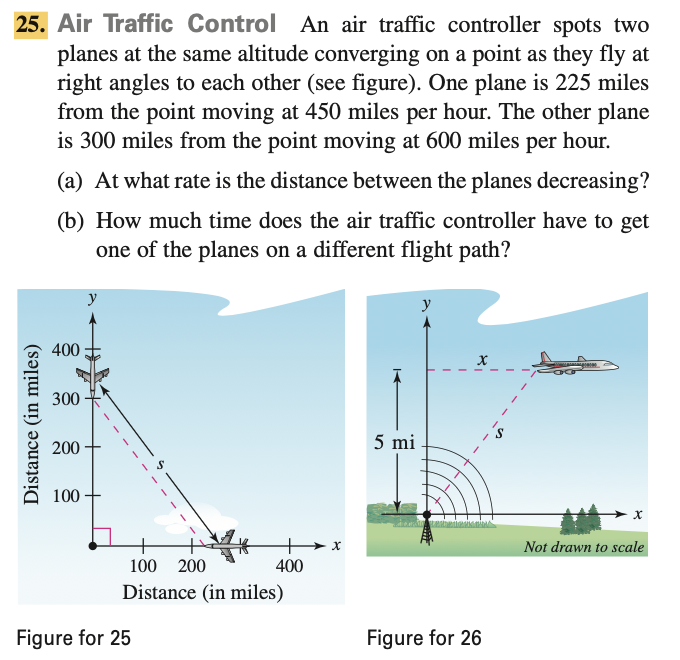 25. Air Traffic Control An air traffic controller spots two
planes at the same altitude converging on a point as they fly at
right angles to each other (see figure). One plane is 225 miles
from the point moving at 450 miles per hour. The other plane
is 300 miles from the point moving at 600 miles per hour.
(a) Atwhat rate is the distance between the planes decreasing?
(b) How much time does the air traffic controller have to get
one of the planes on a different flight path?
y y
[ER IE PE
i 300 Oy } a
5 ” 5 mi J
2 200 NY
A 100 AN
N x
I x
100 200 400
Distance (in miles)
Figure for 25 Figure for 26
This is AI generated Response.
Asked by: gvr
Created at: 2025-07-31 09:34:31
Asked by: gvr
Created at: 2025-07-31 09:34:31
Final Answer:
Rendered
Raw Text
Did you like this answer?
Let's solve the problem step by step:
### **Given:**
- Plane 1 is 225 miles from the intersection moving at **450 miles/hour**.
- Plane 2 is 300 miles from the intersection moving at **600 miles/hour**.
- They are converging at right angles.
Let:
- \( x \) = distance of plane 1 from the intersection (initially 225 miles)
- \( y \) = distance of plane 2 from the intersection (initially 300 miles)
- \( s \) = distance between the planes
Their rates:
- \( \frac{dx}{dt} = -450 \) mi/hr (negative because \( x \) is **decreasing**)
- \( \frac{dy}{dt} = -600 \) mi/hr (negative because \( y \) is **decreasing**)
---
## (a) **At what rate is the distance between the planes decreasing?**
Use the Pythagorean Theorem:
\[
s^2 = x^2 + y^2
\]
Differentiate both sides with respect to \( t \):
\[
2s \frac{ds}{dt} = 2x \frac{dx}{dt} + 2y \frac{dy}{dt}
\]
\[
s \frac{ds}{dt} = x \frac{dx}{dt} + y \frac{dy}{dt}
\]
\[
\frac{ds}{dt} = \frac{x \frac{dx}{dt} + y \frac{dy}{dt}}{s}
\]
### Plug in the values at the instant:
- \( x = 225 \) miles
- \( y = 300 \) miles
- \( \frac{dx}{dt} = -450 \) mi/hr
- \( \frac{dy}{dt} = -600 \) mi/hr
First, calculate \( s \):
\[
s = \sqrt{x^2 + y^2} = \sqrt{225^2 + 300^2} = \sqrt{50625 + 90000} = \sqrt{140625} = 375 \text{ miles}
\]
Calculate numerator:
\[
x \frac{dx}{dt} + y \frac{dy}{dt} = 225 \cdot (-450) + 300 \cdot (-600)
= -101250 + (-180000)
= -281250
\]
Calculate \( \frac{ds}{dt} \):
\[
\frac{ds}{dt} = \frac{-281250}{375} = -750 \text{ mi/hr}
\]
### **Final Answer for (a):**
\[
\boxed{750 \text{ miles per hour \ (the distance between the planes is decreasing at this rate)}}
\]
---
## (b) **How much time does the air traffic controller have before the planes converge?**
We need the time when **either \( x \) or \( y \) reaches 0** (i.e., the first one to reach the intersection).
- For Plane 1: \( x = 225 \) miles, speed \( 450 \) mi/hr
- For Plane 2: \( y = 300 \) miles, speed \( 600 \) mi/hr
Time for each to reach the intersection:
\[
t_1 = \frac{225}{450} = 0.5 \text{ hr}
\]
\[
t_2 = \frac{300}{600} = 0.5 \text{ hr}
\]
**Both will reach the intersection at the same time: 0.5 hr = 30 minutes.**
### **Final Answer for (b):**
\[
\boxed{0.5 \text{ hours, or 30 minutes}}
\]
The controller has 30 minutes to get one of the planes on a different flight path.
📢 Instructions:
- Ask anything relatd to above question only.
- For new Question goto :