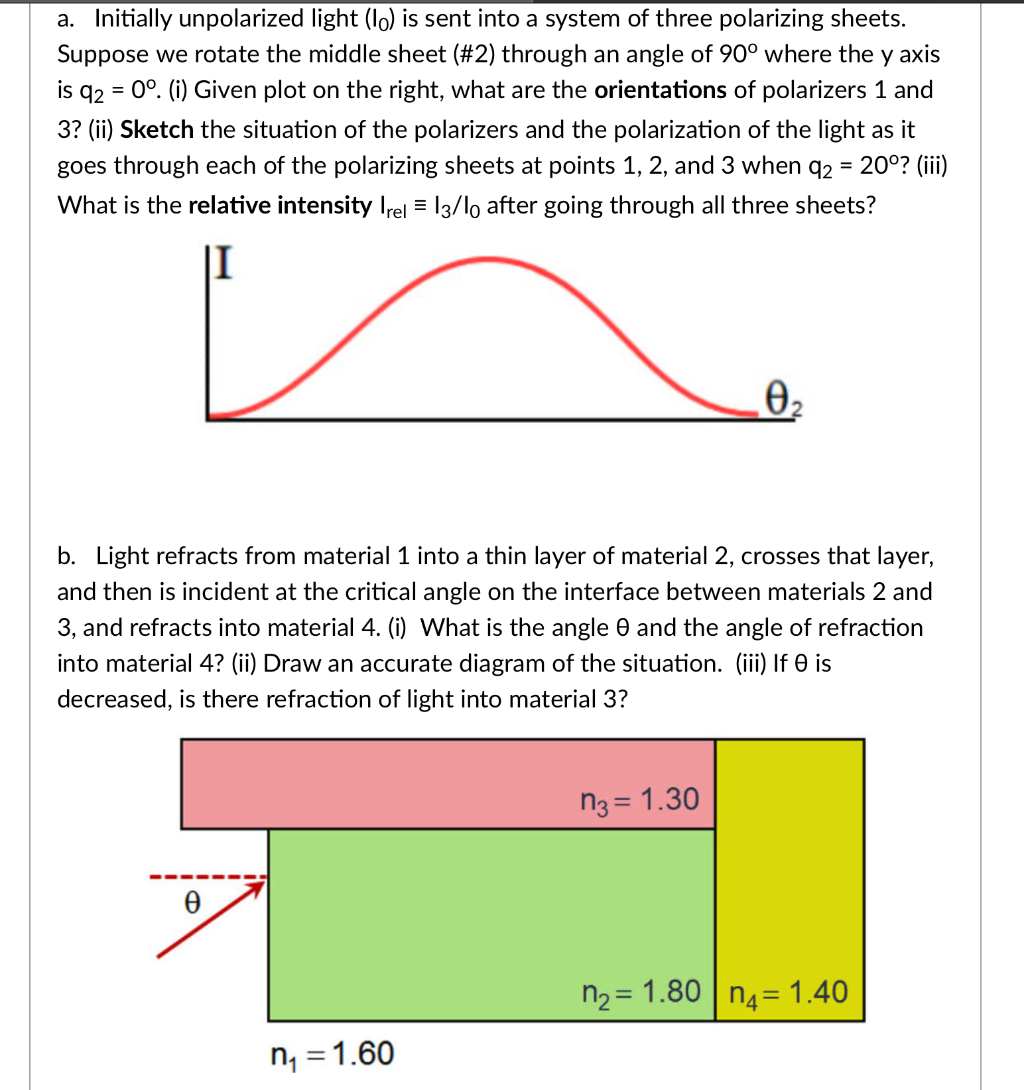
Give step-by-step solution with explanation and final answer:a. Initially unpolarized light (lp) is sent into a system of three polarizing sheets.
Suppose we rotate the middle sheet (#2) through an angle of 90° where the y axis
is gp = 0°. (i) Given plot on the right, what are the orientations of polarizers 1 and
37? (ii) Sketch the situation of the polarizers and the polarization of the light as it
goes through each of the polarizing sheets at points 1, 2, and 3 when q, = 20°? (iii)
What is the relative intensity |. = 13/1 after going through all three sheets?
b. Light refracts from material 1 into a thin layer of material 2, crosses that layer,
and then is incident at the critical angle on the interface between materials 2 and
3, and refracts into material 4. (i) What is the angle 6 and the angle of refraction
into material 4? (ii) Draw an accurate diagram of the situation. (iii) If 8 is
decreased, is there refraction of light into material 3?
=
n,=1.60
Question:
Give step-by-step solution with explanation and final answer:a. Initially unpolarized light (lp) is sent into a system of three polarizing sheets.
Suppose we rotate the middle sheet (#2) through an angle of 90° where the y axis
is gp = 0°. (i) Given plot on the right, what are the orientations of polarizers 1 and
37? (ii) Sketch the situation of the polarizers and the polarization of the light as it
goes through each of the polarizing sheets at points 1, 2, and 3 when q, = 20°? (iii)
What is the relative intensity |. = 13/1 after going through all three sheets?
b. Light refracts from material 1 into a thin layer of material 2, crosses that layer,
and then is incident at the critical angle on the interface between materials 2 and
3, and refracts into material 4. (i) What is the angle 6 and the angle of refraction
into material 4? (ii) Draw an accurate diagram of the situation. (iii) If 8 is
decreased, is there refraction of light into material 3?
=
n,=1.60
This is AI generated Response.
Asked by: gvr
Created at: 2025-07-31 09:05:27
Final Answer:
RenderedRaw Text
Did you like this answer?
Let's solve both parts step-by-step:
---
## **a. Polarizing Sheets**
### **i. Orientations of Polarizers 1 and 3**
Given:
- There are three polarizing sheets.
- The middle sheet (#2) can be rotated, and its angle is denoted by θ₂.
- When θ₂ = 90°, the plot shows maximum intensity, so polarizers 1 and 3 must be parallel.
**Orientations:**
- Let’s set the y-axis as 0°.
- Given the plot, **polarizer 1** is at 0°.
- When θ₂ = 90°, maximum intensity means **polarizer 3** is also at 90°.
- But generally:
- **Polarizer 1:** 0°
- **Polarizer 2:** θ₂
- **Polarizer 3:** 90°
---
### **ii. Sketch Situation at θ₂ = 20°**
**Drawing:**
- Draw three sheets.
- Sheet 1: vertical lines (0°)
- Sheet 2: lines at 20° from vertical
- Sheet 3: horizontal lines (90°)
- Light polarization:
- After Sheet 1: vertical (0°)
- After Sheet 2: 20°
- After Sheet 3: 90° (horizontal)
---
### **iii. Relative Intensity After All Three Sheets**
**Formula:**
- Unpolarized light through first polarizer:
\( I_1 = \frac{I_0}{2} \)
- After sheet 2 (Malus' Law):
\( I_2 = I_1 \cos^2(\theta_2 - \theta_1) = \frac{I_0}{2} \cos^2(20°-0°) \)
- After sheet 3:
\( I_3 = I_2 \cos^2(\theta_3 - \theta_2) = \frac{I_0}{2} \cos^2(20°) \cos^2(90°-20°) \)
- \( \cos^2(70°) \approx 0.116 \), \( \cos^2(20°) \approx 0.883 \)
**Calculation:**
\[
I_3 = \frac{I_0}{2} (0.883)(0.116) \approx \frac{I_0}{2} \times 0.102 \approx 0.051 I_0
\]
**Relative Intensity \( I_{rel} = \frac{I_3}{I_0} \):**
\[
I_{rel} \approx 0.051
\]
---
## **b. Refraction and Critical Angle**
### **i. Find Critical Angle and Angle of Refraction**
#### **Critical Angle at Interface (n₂ to n₃):**
- \( n_2 = 1.80 \), \( n_3 = 1.30 \)
- Critical angle \( \theta_c \) is defined by:
\[
\sin \theta_c = \frac{n_3}{n_2} = \frac{1.30}{1.80} = 0.722
\]
\[
\theta_c = \arcsin(0.722) \approx 46.1°
\]
So, **θ = 46.1°**.
#### **Angle of Refraction into Material 4 (n₄ = 1.40):**
- At critical angle, light *just grazes* the interface, so it refracts into n₄.
- Use Snell's Law:
\[
n_2 \sin \theta = n_4 \sin \theta_4
\]
\[
1.80 \sin(46.1°) = 1.40 \sin \theta_4
\]
\[
1.80 \times 0.722 = 1.40 \sin \theta_4
\]
\[
1.2996 = 1.40 \sin \theta_4
\]
\[
\sin \theta_4 = \frac{1.2996}{1.40} \approx 0.928
\]
\[
\theta_4 = \arcsin(0.928) \approx 68.3°
\]
---
### **ii. Accurate Diagram**
**Draw four regions:**
- 1 (n₁ = 1.60): leftmost region, light enters at angle θ.
- 2 (n₂ = 1.80): thin layer, same angle θ.
- 3 (n₃ = 1.30): above layer 2, light arrives at the critical angle.
- 4 (n₄ = 1.40): right region, light refracts at θ₄.
Show ray going from 1 → 2 → at the interface between 2 and 3 at θ = 46.1°, and then refracting into 4 at θ₄ = 68.3°.
---
### **iii. If θ is Decreased**
- If **θ is decreased below the critical angle**, total internal reflection does **not** occur.
- Therefore, **some light refracts into material 3** (n₃), not just into material 4.
---
## **Final Answers**
### **a.**
(i) **Orientations:**
- Polarizer 1: 0°, Polarizer 2: θ₂, Polarizer 3: 90°
(ii) **Sketch:**
- Show three sheets at 0°, 20°, 90°; polarization direction changes at each sheet.
(iii) **Relative Intensity:**
\[
I_{rel} \approx 0.051
\]
---
### **b.**
(i) **Critical angle θ:** \( 46.1° \); **Angle of refraction into n₄:** \( 68.3° \)
(ii) **Diagram:**
- Show four regions, ray path as described.
(iii) **If θ is decreased:**
- **Yes,** there is refraction into material 3.
---
**Let me know if you'd like any step explained further or want a hand-drawn sketch!**
VIPSolutions focuses on clear, step‑by‑step explanations so you can learn quickly. Whether you need an AI‑generated walkthrough or a short hint to get unstuck, each solution is organized for fast reading and easy review later.
Search similar questions, compare approaches, and bookmark the best answers for revision. Our goal is simple: quick, reliable study help that feels natural—not noisy.
 VIPSolutions
 a. Initially unpolarized light (lp) is sent into a system of three polarizing sheets.
Suppose we rotate the middle sheet (#2) through an angle of 90° where the y axis
is gp = 0°. (i) Given plot on the right, what are the orientations of polarizers 1 and
37? (ii) Sketch the situation of the polarizers and the polarization of the light as it
goes through each of the polarizing sheets at points 1, 2, and 3 when q, = 20°? (iii)
What is the relative intensity |. = 13/1 after going through all three sheets?
b. Light refracts from material 1 into a thin layer of material 2, crosses that layer,
and then is incident at the critical angle on the interface between materials 2 and
3, and refracts into material 4. (i) What is the angle 6 and the angle of refraction
into material 4? (ii) Draw an accurate diagram of the situation. (iii) If 8 is
decreased, is there refraction of light into material 3?
=
n,=1.60