Give step-by-step solution with explanation and final answer:PYRE
3 A
-§-y 3-23 a GEC (1
-a
BE)
Ns — =
FELT)
— Se
~> 3 LL A busy (
eR
BR
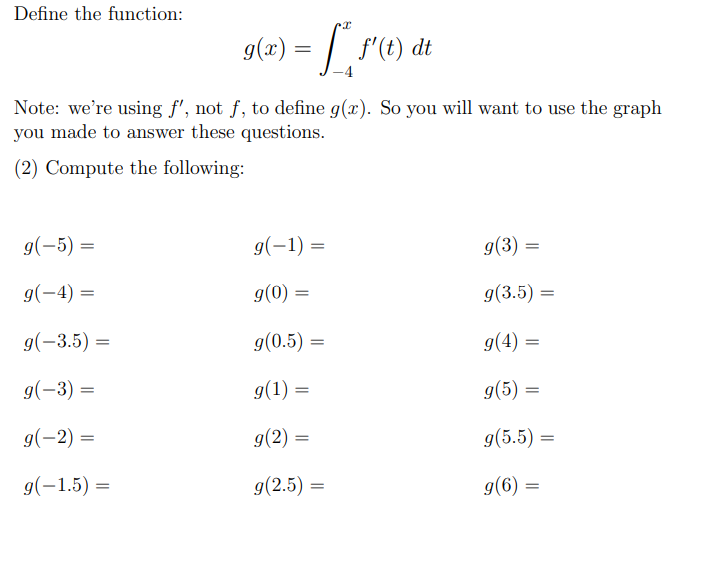
Define the function: -
ow = [ roa
Note: we're using 7, not f, to define g(x). So you will want to use the graph
you made to answer these questions.
(2) Compute the following:
9(=5) = 9(=1) = 9(3) =
9(—4) = 9(0) = 9(3.5) =
9(-35) = 9(0.5) = 9(4) =
9(=3) = 9(1) = 9(5) =
9(=2) = 92) = 9(5.5) =
9(=15) = 9(2:5) = 9(6) =
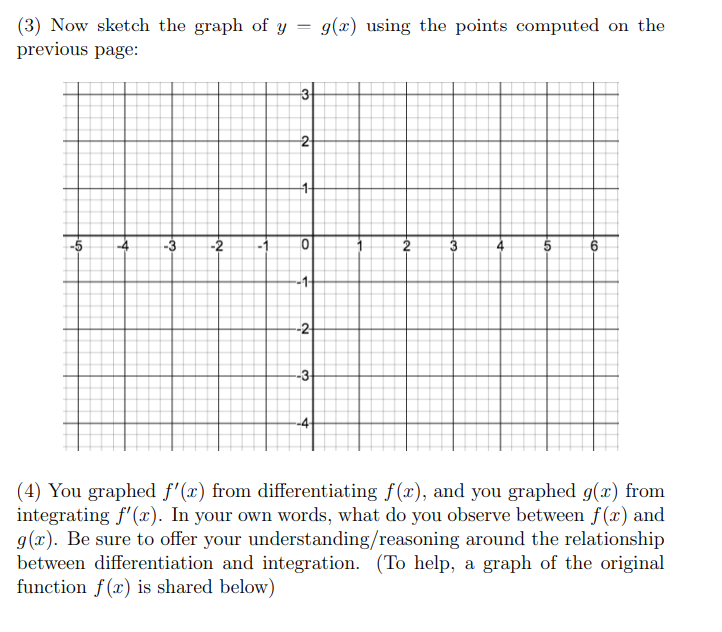
(3) Now sketch the graph of y = g(z) using the points computed on the
previous page:
1
HESS ESSS SHEARS She HSE HR RHE EREHESTERD
BE de tea
(4) You graphed f(z) from differentiating f(z), and you graphed g(x) from
integrating f(z). In your own words, what do you observe between f(z) and
g(x). Be sure to offer your understanding reasoning around the relationship
between differentiation and integration. (To help, a graph of the original
function f(z) is shared below)
Question:
Give step-by-step solution with explanation and final answer:PYRE
3 A
-§-y 3-23 a GEC (1
-a
BE)
Ns — =
FELT)
— Se
~> 3 LL A busy (
eR
BR
Define the function: -
ow = [ roa
Note: we're using 7, not f, to define g(x). So you will want to use the graph
you made to answer these questions.
(2) Compute the following:
9(=5) = 9(=1) = 9(3) =
9(—4) = 9(0) = 9(3.5) =
9(-35) = 9(0.5) = 9(4) =
9(=3) = 9(1) = 9(5) =
9(=2) = 92) = 9(5.5) =
9(=15) = 9(2:5) = 9(6) =
(3) Now sketch the graph of y = g(z) using the points computed on the
previous page:
1
HESS ESSS SHEARS She HSE HR RHE EREHESTERD
BE de tea
(4) You graphed f(z) from differentiating f(z), and you graphed g(x) from
integrating f(z). In your own words, what do you observe between f(z) and
g(x). Be sure to offer your understanding reasoning around the relationship
between differentiation and integration. (To help, a graph of the original
function f(z) is shared below)
This is AI generated Response.
Asked by: gvr
Created at: 2025-07-31 06:53:42
Final Answer:
RenderedRaw Text
Did you like this answer?
Let's break this down step by step using the information and graphs provided.
---
## **Step 1: Understanding the Definitions**
You are given:
\[ g(x) = \int_{-4}^{x} f'(t) \, dt \]
By the **Fundamental Theorem of Calculus**, integrating \( f'(t) \) from \(-4\) to \(x\) gives you \( f(x) - f(-4) \):
\[
g(x) = f(x) - f(-4)
\]
So \( g(x) \) is just the value of \( f(x) \) shifted vertically by \( -f(-4) \).
---
## **Step 2: Find \( f(-4) \) from the Graph**
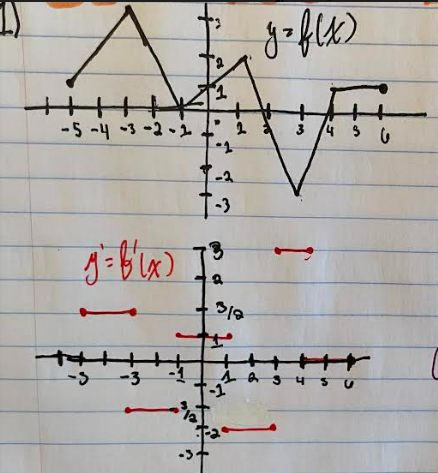
From the graph of \( f(x) \):
- At \( x = -4 \), \( f(-4) = 2 \).
---
## **Step 3: Calculate \( g(x) \) for Each Value**
For each \( x \), use:
\[
g(x) = f(x) - 2
\]
Now, read off \( f(x) \) from the graph for each value and subtract 2.
---
### **Detailed Calculations**
#### **Left Column**
- \( g(-5) = f(-5) - 2 = 0 - 2 = -2 \)
- \( g(-4) = f(-4) - 2 = 2 - 2 = 0 \)
- \( g(-3.5) = f(-3.5) - 2 \)
From the graph, \( f(-3.5) \approx 2.5 \Rightarrow 2.5 - 2 = 0.5 \)
- \( g(-3) = f(-3) - 2 = 3 - 2 = 1 \)
- \( g(-2) = f(-2) - 2 = 1 - 2 = -1 \)
- \( g(-1.5) = f(-1.5) - 2 \)
From the graph, \( f(-1.5) \approx 0 \Rightarrow 0 - 2 = -2 \)
#### **Middle Column**
- \( g(-1) = f(-1) - 2 = -1 - 2 = -3 \)
- \( g(0) = f(0) - 2 = 0 - 2 = -2 \)
- \( g(0.5) = f(0.5) - 2 \)
\( f(0.5) \approx 0.5 \Rightarrow 0.5 - 2 = -1.5 \)
- \( g(1) = f(1) - 2 = 1 - 2 = -1 \)
- \( g(2) = f(2) - 2 = 2 - 2 = 0 \)
- \( g(2.5) = f(2.5) - 2 \)
\( f(2.5) \approx 0.5 \Rightarrow 0.5 - 2 = -1.5 \)
#### **Right Column**
- \( g(3) = f(3) - 2 = -1 - 2 = -3 \)
- \( g(3.5) = f(3.5) - 2 \)
\( f(3.5) \approx -2 \Rightarrow -2 - 2 = -4 \)
- \( g(4) = f(4) - 2 = 0 - 2 = -2 \)
- \( g(5) = f(5) - 2 = 1 - 2 = -1 \)
- \( g(5.5) = f(5.5) - 2 \)
\( f(5.5) \approx 1.5 \Rightarrow 1.5 - 2 = -0.5 \)
- \( g(6) = f(6) - 2 = 1 - 2 = -1 \)
---
### **Final Answers Table**
| \( x \) | \( g(x) \) |
|--------------|------------|
| -5 | -2 |
| -4 | 0 |
| -3.5 | 0.5 |
| -3 | 1 |
| -2 | -1 |
| -1.5 | -2 |
| -1 | -3 |
| 0 | -2 |
| 0.5 | -1.5 |
| 1 | -1 |
| 2 | 0 |
| 2.5 | -1.5 |
| 3 | -3 |
| 3.5 | -4 |
| 4 | -2 |
| 5 | -1 |
| 5.5 | -0.5 |
| 6 | -1 |
---
## **Step 4: Sketch the Graph of \( y = g(x) \)**
- Plot the above points on the provided graph.
- Connect the points smoothly, noting that the shape of \( g(x) \) follows \( f(x) \) but shifted down by 2 units.
---
## **Step 5: Relationship Between \( f(x) \) and \( g(x) \)**
### **Observation**
- \( g(x) \) is just \( f(x) \) shifted vertically downward by 2 units (\( f(-4) \)).
- This illustrates the **Fundamental Theorem of Calculus**: Integrating the derivative \( f'(x) \) gives back the original function \( f(x) \), up to an additive constant (here, \( -f(-4) \)).
- **Differentiation and integration are inverse processes** (up to a constant).
---
If you need the graph sketched or any further clarification, let me know!
VIPSolutions focuses on clear, step‑by‑step explanations so you can learn quickly. Whether you need an AI‑generated walkthrough or a short hint to get unstuck, each solution is organized for fast reading and easy review later.
Search similar questions, compare approaches, and bookmark the best answers for revision. Our goal is simple: quick, reliable study help that feels natural—not noisy.
 VIPSolutions
 PYRE
3 A
-§-y 3-23 a GEC (1
-a
BE)
Ns — =
FELT)
— Se
~> 3 LL A busy (
eR
BR
Define the function: -
ow = [ roa
Note: we're using 7, not f, to define g(x). So you will want to use the graph
you made to answer these questions.
(2) Compute the following:
9(=5) = 9(=1) = 9(3) =
9(—4) = 9(0) = 9(3.5) =
9(-35) = 9(0.5) = 9(4) =
9(=3) = 9(1) = 9(5) =
9(=2) = 92) = 9(5.5) =
9(=15) = 9(2:5) = 9(6) =
(3) Now sketch the graph of y = g(z) using the points computed on the
previous page:
1
HESS ESSS SHEARS She HSE HR RHE EREHESTERD
BE de tea
(4) You graphed f(z) from differentiating f(z), and you graphed g(x) from
integrating f(z). In your own words, what do you observe between f(z) and
g(x). Be sure to offer your understanding reasoning around the relationship
between differentiation and integration. (To help, a graph of the original
function f(z) is shared below)