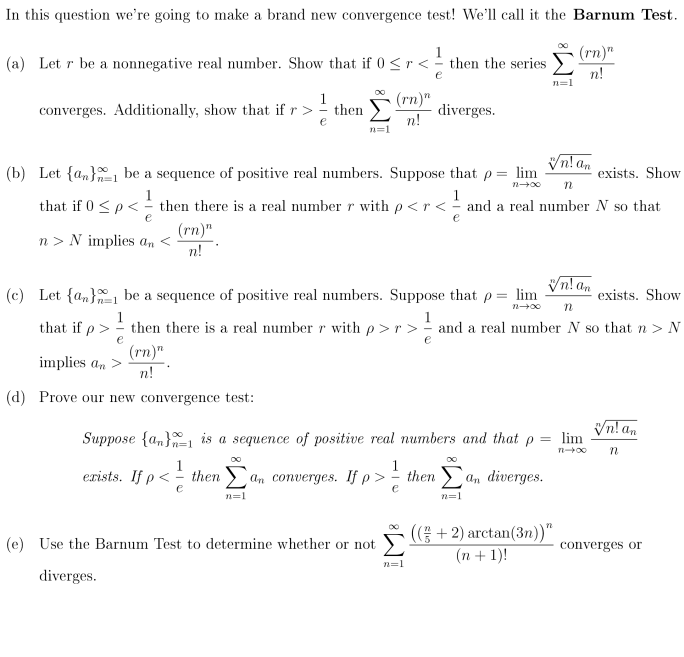
Give step-by-step solution with explanation and final answer:In this question we're going to make a brand new convergence test! We'll call it the Barnum Test.
1 EL (rn)
(a) Let r be a nonnegative real number. Show that if 0 < 7 < = then the series »_ ~~
3 ul
p=1
1 = (rn)"
converges. Additionally, show that if 7 > ~ then “~~ diverges.
Be y - > PY] 5
- i. nla,
(b) Let {a}: be a sequence of positive real numbers. Suppose that p = lim ~—* exists. Show
=
1 1
that if 0 < p< _ then there is a real number r with p {7°
ul
(d) Prove our new convergence test:
. Vila,
Suppose {an }:2, is a sequence of positive real numbers and that p = lim =
we
1 . 1 o-
eaists. If p< ~ then 3 a, converges. If p> = then Sa, diverges
lfo< > wes If p> + > ry
B SN (2 +2) arctan(3n)"
(¢) Use the Barnum Test to determine whether or not (+2) arctan(sm)" converges or
= (n+1)!
diverges.
Question:
Give step-by-step solution with explanation and final answer:In this question we're going to make a brand new convergence test! We'll call it the Barnum Test.
1 EL (rn)
(a) Let r be a nonnegative real number. Show that if 0 < 7 < = then the series »_ ~~
3 ul
p=1
1 = (rn)"
converges. Additionally, show that if 7 > ~ then “~~ diverges.
Be y - > PY] 5
- i. nla,
(b) Let {a}: be a sequence of positive real numbers. Suppose that p = lim ~—* exists. Show
=
1 1
that if 0 < p< _ then there is a real number r with p {7°
ul
(d) Prove our new convergence test:
. Vila,
Suppose {an }:2, is a sequence of positive real numbers and that p = lim =
we
1 . 1 o-
eaists. If p< ~ then 3 a, converges. If p> = then Sa, diverges
lfo< > wes If p> + > ry
B SN (2 +2) arctan(3n)"
(¢) Use the Barnum Test to determine whether or not (+2) arctan(sm)" converges or
= (n+1)!
diverges.
This is AI generated Response.
Asked by: gvr
Created at: 2025-07-31 06:27:40
Final Answer:
RenderedRaw Text
Did you like this answer?
Let's tackle each part **step by step**:
---
### **(a) Convergence and Divergence of \(\sum_{n=1}^{\infty} \frac{(rn)^n}{n!}\)**
#### **Convergence (\(0 \leq r < \frac{1}{e}\))**
Consider the general term \(a_n = \frac{(rn)^n}{n!}\).
Let's use the **Ratio Test**:
\[
\lim_{n \to \infty} \frac{a_{n+1}}{a_n}
= \lim_{n \to \infty} \frac{(r(n+1))^{n+1}}{(n+1)!} \cdot \frac{n!}{(rn)^n}
= \lim_{n \to \infty} \frac{(r(n+1))^{n+1}}{(n+1)(rn)^n}
\]
Let's simplify:
\[
= \lim_{n \to \infty} \frac{r^{n+1} (n+1)^{n+1}}{(n+1) r^n n^n}
= \lim_{n \to \infty} r \cdot \frac{(n+1)^{n+1}}{(n+1)n^n}
= r \lim_{n \to \infty} \frac{(n+1)^n}{n^n}
= r \lim_{n \to \infty} \left( \frac{n+1}{n} \right)^n
= r \lim_{n \to \infty} \left( 1 + \frac{1}{n} \right)^n
= r \cdot e
\]
**By the ratio test:**
- If \(re < 1\) (\(r < \frac{1}{e}\)), the series converges.
- If \(re > 1\) (\(r > \frac{1}{e}\)), the series diverges.
---
### **(b) If \(0 \leq \rho < \frac{1}{e}\), then \(a_n < \frac{(rn)^n}{n!}\) for large \(n\)**
Given \(\rho = \lim_{n \to \infty} \sqrt[n]{\frac{n! a_n}{n^n}}\) and \(\rho < \frac{1}{e}\):
- Pick \(r\) with \(\rho < r < \frac{1}{e}\).
- By the definition of limit, there exists \(N\) such that for all \(n > N\):
\[
\sqrt[n]{\frac{n! a_n}{n^n}} < r
\implies \frac{n! a_n}{n^n} < r^n
\implies a_n < \frac{(r n)^n}{n!}
\]
- Therefore, for all \(n > N\), \(a_n < \frac{(r n)^n}{n!}\).
---
### **(c) If \(\rho > \frac{1}{e}\), then \(a_n > \frac{(rn)^n}{n!}\) for large \(n\)**
Given \(\rho = \lim_{n \to \infty} \sqrt[n]{\frac{n! a_n}{n^n}}\) and \(\rho > \frac{1}{e}\):
- Pick \(r\) with \(\frac{1}{e} < r < \rho\).
- By the definition of limit, there exists \(N\) such that for all \(n > N\):
\[
\sqrt[n]{\frac{n! a_n}{n^n}} > r
\implies \frac{n! a_n}{n^n} > r^n
\implies a_n > \frac{(r n)^n}{n!}
\]
- Therefore, for all \(n > N\), \(a_n > \frac{(r n)^n}{n!}\).
---
### **(d) Prove the Barnum Test**
**Statement:**
Suppose \(\{a_n\}_{n=1}^\infty\) is a sequence of positive real numbers and \(\rho = \lim_{n \to \infty} \sqrt[n]{\frac{n! a_n}{n^n}}\) exists.
- If \(\rho < \frac{1}{e}\), then \(\sum a_n\) converges.
- If \(\rho > \frac{1}{e}\), then \(\sum a_n\) diverges.
**Proof:**
- From (b): If \(\rho < \frac{1}{e}\), for some \(r < \frac{1}{e}\), \(a_n < \frac{(r n)^n}{n!}\) for large \(n\). The series \(\sum \frac{(r n)^n}{n!}\) converges (from part a), so by comparison, \(\sum a_n\) converges.
- From (c): If \(\rho > \frac{1}{e}\), for some \(r > \frac{1}{e}\), \(a_n > \frac{(r n)^n}{n!}\) for large \(n\). The series \(\sum \frac{(r n)^n}{n!}\) diverges, so by comparison, \(\sum a_n\) diverges.
---
### **(e) Apply the Barnum Test to:**
\[
\sum_{n=1}^\infty \frac{\left( \frac{n^2 + 2}{n + 1} \arctan(3n) \right)^n}{(n+1)!}
\]
Let \(a_n = \frac{\left( \frac{n^2 + 2}{n + 1} \arctan(3n) \right)^n}{(n+1)!}\).
Compute
\[
\rho = \lim_{n \to \infty} \sqrt[n]{\frac{n! a_n}{n^n}}
\]
First, write \(a_n\) in terms of \(n!:\)
\[
a_n = \frac{\left( \frac{n^2 + 2}{n + 1} \arctan(3n) \right)^n}{(n+1)!}
\]
\[
\Rightarrow n! a_n = \frac{n!}{(n+1)!} \left( \frac{n^2 + 2}{n + 1} \arctan(3n) \right)^n = \frac{1}{n+1} \left( \frac{n^2 + 2}{n + 1} \arctan(3n) \right)^n
\]
So
\[
\frac{n! a_n}{n^n} = \frac{1}{n+1} \left( \frac{n^2 + 2}{n + 1} \frac{\arctan(3n)}{n} \right)^n
\]
Now,
- \(\arctan(3n) \to \frac{\pi}{2}\) as \(n \to \infty\),
- \(\frac{n^2 + 2}{n + 1} \sim n\).
Thus,
\[
\frac{n^2 + 2}{n + 1} \sim n,
\]
\[
\frac{n^2 + 2}{n + 1} \cdot \frac{\arctan(3n)}{n} \sim \frac{n \cdot \frac{\pi}{2}}{n} = \frac{\pi}{2}
\]
So,
\[
\frac{n! a_n}{n^n} \sim \frac{1}{n+1} \left( \frac{\pi}{2} \right)^n
\]
Now,
\[
\sqrt[n]{\frac{n! a_n}{n^n}} \sim \left( \frac{\pi}{2} \right) \cdot (n+1)^{-1/n}
\]
As \(n \to \infty\), \((n+1)^{-1/n} \to 1\).
Therefore,
\[
\rho = \frac{\pi}{2}
\]
Since \(\frac{\pi}{2} > \frac{1}{e}\) (since \(\frac{1}{e} \approx 0.3679\) and \(\frac{\pi}{2} \approx 1.5708\)),
**By the Barnum Test, the series diverges.**
---
## **Summary of Answers**
**(a)** The series \(\sum_{n=1}^\infty \frac{(rn)^n}{n!}\) converges if \(0 \leq r < \frac{1}{e}\) and diverges if \(r > \frac{1}{e}\).
**(b)** For \(0 \leq \rho < \frac{1}{e}\), there exists \(r < \frac{1}{e}\) and \(N\) so that for \(n > N\), \(a_n < \frac{(rn)^n}{n!}\).
**(c)** For \(\rho > \frac{1}{e}\), there exists \(r > \frac{1}{e}\) and \(N\) so that for \(n > N\), \(a_n > \frac{(rn)^n}{n!}\).
**(d)** If \(\rho < \frac{1}{e}\), \(\sum a_n\) converges; if \(\rho > \frac{1}{e}\), \(\sum a_n\) diverges.
**(e) Final Answer:**
\[
\sum_{n=1}^\infty \frac{\left(\frac{n^2+2}{n+1} \arctan(3n)\right)^n}{(n+1)!}
\]
**diverges** by the Barnum Test, since \(\rho = \frac{\pi}{2} > \frac{1}{e}\).
---
Let me know if you want a more detailed explanation on any specific step!
VIPSolutions focuses on clear, step‑by‑step explanations so you can learn quickly. Whether you need an AI‑generated walkthrough or a short hint to get unstuck, each solution is organized for fast reading and easy review later.
Search similar questions, compare approaches, and bookmark the best answers for revision. Our goal is simple: quick, reliable study help that feels natural—not noisy.
 VIPSolutions
 In this question we're going to make a brand new convergence test! We'll call it the Barnum Test.
1 EL (rn)
(a) Let r be a nonnegative real number. Show that if 0 < 7 < = then the series »_ ~~
3 ul
p=1
1 = (rn)"
converges. Additionally, show that if 7 > ~ then “~~ diverges.
Be y - > PY] 5
- i. nla,
(b) Let {a}: be a sequence of positive real numbers. Suppose that p = lim ~—* exists. Show
=
1 1
that if 0 < p< _ then there is a real number r with p {7°
ul
(d) Prove our new convergence test:
. Vila,
Suppose {an }:2, is a sequence of positive real numbers and that p = lim =
we
1 . 1 o-
eaists. If p< ~ then 3 a, converges. If p> = then Sa, diverges
lfo< > wes If p> + > ry
B SN (2 +2) arctan(3n)"
(¢) Use the Barnum Test to determine whether or not (+2) arctan(sm)" converges or
= (n+1)!
diverges.