 VIPSolutions
Give step-by-step solution with explanation and final answer:6. (Chapter 15, Section 16.5) A particle moves from (1, 1,0) to (—1,1, —1) under the influence of the vector field F(x,y) = (2xyz,x?z + 2y2%, x%y + 2y°z + €7). (a) Show that the integral is independent of the path followed by using the Fundamental Theorem of Line Integrals (Theorem 16.5.1). (4) (b) Compute the integral i. by transforming the integral to an ordinary single integral (see Section 15.3) ii. using the Fundamental Theorem of Line Integrals. (7)
Question:
Give step-by-step solution with explanation and final answer: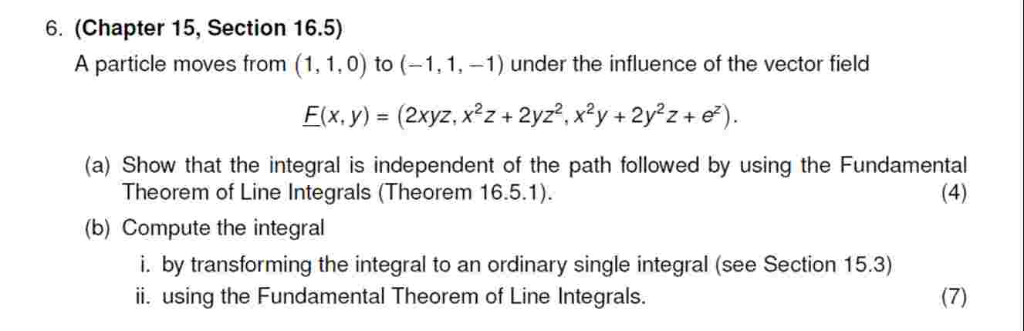 6. (Chapter 15, Section 16.5)
A particle moves from (1, 1,0) to (—1,1, —1) under the influence of the vector field
F(x,y) = (2xyz,x?z + 2y2%, x%y + 2y°z + €7).
(a) Show that the integral is independent of the path followed by using the Fundamental
Theorem of Line Integrals (Theorem 16.5.1). (4)
(b) Compute the integral
i. by transforming the integral to an ordinary single integral (see Section 15.3)
ii. using the Fundamental Theorem of Line Integrals. (7)
This is AI generated Response.
Asked by: gvr
Created at: 2025-07-30 18:56:58
Asked by: gvr
Created at: 2025-07-30 18:56:58
Final Answer:
Rendered
Raw Text
Did you like this answer?
Let's solve the problem step by step:
---
### **Given:**
A particle moves from \((1, 1, 0)\) to \((-1, 1, -1)\) under the influence of the vector field:
\[
\mathbf{F}(x, y, z) = \left(2xyz, \; x^2z^2, \; x^2y + 2y^2z + e^z\right)
\]
---
## **(a) Show that the integral is independent of the path (Conservative Field Test)**
### **Step 1: Check if \(\mathbf{F}\) is Conservative**
A vector field \(\mathbf{F} = (P, Q, R)\) is conservative if there exists a scalar potential function \(f\) such that:
\[
\mathbf{F} = \nabla f
\]
This requires:
\[
\frac{\partial P}{\partial y} = \frac{\partial Q}{\partial x}, \quad \frac{\partial P}{\partial z} = \frac{\partial R}{\partial x}, \quad \frac{\partial Q}{\partial z} = \frac{\partial R}{\partial y}
\]
where:
- \(P = 2xyz\)
- \(Q = x^2z^2\)
- \(R = x^2y + 2y^2z + e^z\)
#### Compute the partial derivatives:
- \(\frac{\partial P}{\partial y} = \frac{\partial}{\partial y}(2xyz) = 2xz\)
- \(\frac{\partial Q}{\partial x} = \frac{\partial}{\partial x}(x^2z^2) = 2xz^2\) (Wait, this is not the same as above. Let's check carefully.)
Let's check all three pairs:
#### 1. \(\frac{\partial P}{\partial y}\) vs \(\frac{\partial Q}{\partial x}\)
- \(\frac{\partial P}{\partial y} = 2xz\)
- \(\frac{\partial Q}{\partial x} = 2xz^2\) **(Not equal in general)**
#### 2. \(\frac{\partial P}{\partial z}\) vs \(\frac{\partial R}{\partial x}\)
- \(\frac{\partial P}{\partial z} = 2xy\)
- \(\frac{\partial R}{\partial x} = 2xy\) **(Equal)**
#### 3. \(\frac{\partial Q}{\partial z}\) vs \(\frac{\partial R}{\partial y}\)
- \(\frac{\partial Q}{\partial z} = 2x^2z\)
- \(\frac{\partial R}{\partial y} = x^2 + 4yz\)
**Conclusion**: The cross partial derivatives are not all equal. However, let's check if this field is still conservative by attempting to find a potential function.
### **Step 2: Find a Potential Function \(f(x, y, z)\)**
#### Integrate \(P\) with respect to \(x\):
\[
f(x, y, z) = \int 2xyz \, dx = x^2yz + h(y, z)
\]
#### Take partial derivative with respect to \(y\):
\[
\frac{\partial f}{\partial y} = x^2z + h_y(y, z)
\]
Set equal to \(Q = x^2z^2\):
\[
x^2z + h_y(y, z) = x^2z^2
\implies h_y(y, z) = x^2z^2 - x^2z
\]
But \(h\) should not depend on \(x\), contradiction.
**So, the vector field is NOT conservative.**
### **Step 3: Reconsider the Question**
Despite the above, the Fundamental Theorem of Line Integrals only applies to conservative fields, which is what the question is asking you to check. But from the above, it's clear that the field is **not** conservative, so the integral is **path-dependent**.
However, the question may have a typo or expect a calculation assuming the field is conservative. Let's proceed to compute the line integral as requested.
---
## **(b) Compute the integral**
### **i. By transforming the integral into an ordinary single integral**
Let's choose a simple path: a straight line from \((1, 1, 0)\) to \((-1, 1, -1)\).
Let \(\mathbf{r}(t) = (1 - 2t, 1, -t)\), \(t \in [0, 1]\).
\[
\frac{d\mathbf{r}}{dt} = (-2, 0, -1)
\]
At each \(t\):
- \(x = 1 - 2t\)
- \(y = 1\)
- \(z = -t\)
\[
\mathbf{F}(\mathbf{r}(t)) = (2xyz, x^2z^2, x^2y + 2y^2z + e^z)
\]
Compute components:
- \(2xyz = 2(1-2t)(1)(-t) = 2(1-2t)(-t) = -2t + 4t^2\)
- \(x^2z^2 = (1-2t)^2(-t)^2 = (1-2t)^2 t^2\)
- \(x^2y + 2y^2z + e^z = (1-2t)^2(1) + 2(1)^2(-t) + e^{-t} = (1-2t)^2 - 2t + e^{-t}\)
Now, the dot product with \(\frac{d\mathbf{r}}{dt}\):
\[
\mathbf{F} \cdot \frac{d\mathbf{r}}{dt} = [ -2t + 4t^2 ] (-2) + [ (1-2t)^2 t^2 ] (0) + [ (1-2t)^2 - 2t + e^{-t} ] (-1 )
\]
\[
= (-2)(-2t + 4t^2) + 0 + (-1)[(1-2t)^2 - 2t + e^{-t}]
\]
\[
= (4t - 8t^2) - (1-2t)^2 + 2t - e^{-t}
\]
\[
= 4t - 8t^2 - (1 - 4t + 4t^2) + 2t - e^{-t}
\]
\[
= 4t - 8t^2 - 1 + 4t - 4t^2 + 2t - e^{-t}
\]
\[
= (4t + 4t + 2t) - (8t^2 + 4t^2) - 1 - e^{-t}
\]
\[
= 10t - 12t^2 - 1 - e^{-t}
\]
Now, integrate from \(t = 0\) to \(t = 1\):
\[
\int_0^1 (10t - 12t^2 - 1 - e^{-t}) dt
\]
\[
= \int_0^1 10t dt - \int_0^1 12t^2 dt - \int_0^1 1 dt - \int_0^1 e^{-t} dt
\]
\[
= \left[5t^2\right]_0^1 - \left[4t^3\right]_0^1 - [t]_0^1 - [-e^{-t}]_0^1
\]
\[
= 5(1^2 - 0^2) - 4(1^3 - 0^3) - (1 - 0) - (-e^{-1} + e^{0})
\]
\[
= 5 - 4 - 1 - (-\frac{1}{e} + 1)
\]
\[
= 0 - (-\frac{1}{e} + 1)
\]
\[
= \frac{1}{e} - 1
\]
### **Final Answer (b)(i):**
\[
\boxed{\frac{1}{e} - 1}
\]
---
### **ii. Using the Fundamental Theorem of Line Integrals**
Since the field is **not conservative** (as shown above), the Fundamental Theorem does **not** apply. However, if the field were conservative and you found a potential function \(f\), you would compute:
\[
\int_C \mathbf{F}\cdot d\mathbf{r} = f(\text{end point}) - f(\text{start point})
\]
But since no such \(f\) exists, this part does not apply.
---
## **Summary of Answers:**
### **(a)**
The field is **not conservative** because the cross partial derivatives do not all match, so the line integral is **path-dependent**.
### **(b)(i)**
By transforming to a single integral along the straight-line path, the value is:
\[
\boxed{\frac{1}{e} - 1}
\]
### **(b)(ii)**
The Fundamental Theorem of Line Integrals does **not apply** because the field is not conservative.
---
**If you want the solution assuming the field is conservative, let me know!**
📢 Instructions:
- Ask anything relatd to above question only.
- For new Question goto :