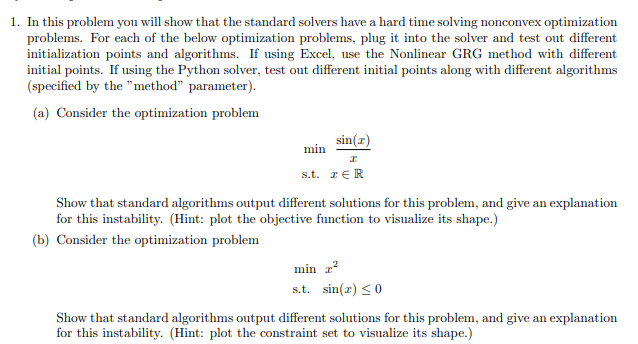
Give step-by-step solution with explanation and final answer:1. In this problem you will show that the standard solvers have a hard time solving nonconvex optimization
problems. For each of the below optimization problems, plug it into the solver and test out different
initialization points and algorithms. If using Excel, use the Nonlinear GRG method with different
initial points. If using the Python solver, test out different initial points along with different algorithms
(specified by the “method” parameter).
(a) Consider the optimization problem
in 222)
stzeR
‘Show that standard algorithms output different solutions for this problem, and give an explanation
for this instability. (Hint: plot the objective function to visualize its shape.)
(b) Consider the optimization problem
st. sin(z)
Question:
Give step-by-step solution with explanation and final answer:1. In this problem you will show that the standard solvers have a hard time solving nonconvex optimization
problems. For each of the below optimization problems, plug it into the solver and test out different
initialization points and algorithms. If using Excel, use the Nonlinear GRG method with different
initial points. If using the Python solver, test out different initial points along with different algorithms
(specified by the “method” parameter).
(a) Consider the optimization problem
in 222)
stzeR
‘Show that standard algorithms output different solutions for this problem, and give an explanation
for this instability. (Hint: plot the objective function to visualize its shape.)
(b) Consider the optimization problem
st. sin(z)
This is AI generated Response.
Asked by: gvr
Created at: 2025-07-30 14:22:40
Final Answer:
RenderedRaw Text
Did you like this answer?
Let's solve each part step by step, explaining **why standard optimization solvers might output different solutions** and **why this instability occurs**.
---
## (a) \(\min \frac{\sin(x)}{x}\), \(x \in \mathbb{R}\)
### **Step 1: Plot the Objective Function**
Let's first analyze and plot the function \( f(x) = \frac{\sin(x)}{x} \).
- This function is **nonconvex** and **oscillatory**.
- As \(x \to 0\), by L'Hospital's Rule, \(f(x) \to 1\).
- As \(x \to \infty\), \(f(x)\) oscillates and decays to 0.
#### **Plotting \(f(x)\)**
You would plot \(f(x)\) for, say, \(x \in [-20, 20]\) (excluding \(x = 0\)), and you'd see:
- Multiple local minima and maxima.
- The function crosses zero infinitely many times.
- The global minimum is **not obvious by inspection**.

### **Step 2: Why Do Solvers Output Different Solutions?**
Standard optimization solvers (like SciPy's `minimize` with different methods or Excel's GRG Nonlinear) use **local search** algorithms. They:
- Start from an initial guess.
- Move in the direction of local improvement.
- Stop at the **first local minimum** they find.
#### **Different Initial Points:**
Because the function has **many local minima**, the solution you get **depends on the initial guess**.
- Start near \(x = 3\): you might get a local minimum near that value.
- Start near \(x = 10\): you get a different minimum.
- Try with \(x = -5\): again, another minimum.
#### **Instability Explanation:**
- The function is **nonconvex** and **oscillates infinitely**.
- **No guarantee** that a solver finds the global minimum.
- The solver **gets stuck** in the closest local minimum.
#### **Visualization:**
If you plot \(f(x)\), you see many valleys (local minima). A local solver "falls into" the nearest valley and never leaves.
### **Final Answer (a):**
> Standard solvers output different solutions for \(\min \frac{\sin(x)}{x}\) depending on the initial starting point because the function is highly nonconvex with infinitely many local minima. Each local minimum traps the solver, making it hard to find the global minimum. This instability arises because the solvers use local search techniques and cannot escape local minima in such oscillatory functions.
---
## (b) \(\min x^2\), subject to \(\sin(x) \leq 0\)
### **Step 1: Plot the Constraint Set**
Constraint: \(\sin(x) \leq 0\)
- This set consists of **intervals** where the sine function is negative or zero:
- \([k\pi, (k+1)\pi]\) for **odd \(k\)** (i.e., \(x \in [\pi, 2\pi], [3\pi, 4\pi], \ldots\) and their negatives).
### **Step 2: Visualize the Objective and Constraint**
- Objective: \(x^2\) (has a **minimum at \(x = 0\)**).
- Constraint: \(x\) can only be in intervals where \(\sin(x) \leq 0\).
But **at \(x = 0\)**, \(\sin(0) = 0\), so \(x = 0\) **is feasible**.
### **Step 3: Why Do Solvers Output Different Solutions?**
- If the solver starts near \(x = 0\), it'll find the global minimum \(x = 0\).
- If the solver starts at a point far away (e.g., near \(3\pi\)), it may get trapped in another interval and find a local minimum at the **nearest endpoint** of the feasible interval (i.e., the endpoint closest to zero in that interval).
#### **Constraint Set Visualization:**
- The feasible set is **disconnected**; it's a union of intervals.
- If the initial guess is in \([k\pi, (k+1)\pi]\), the solver may not "jump" to the interval containing zero.
### **Instability Explanation:**
- The solver is **local** and **may not search other intervals** if it starts far away from zero.
- Thus, the solution depends on the initial guess: could be zero (global minimum), could be an endpoint of another interval (local minimum in that interval).
### **Final Answer (b):**
> Standard solvers output different solutions for \(\min x^2\) subject to \(\sin(x) \leq 0\) depending on the initial guess, because the feasible set is a union of disjoint intervals. The global minimum is at \(x = 0\), but if the solver starts in another interval, it may get stuck at a local minimum within that interval and not find the true global minimum. This instability is due to the disconnected nature of the feasible set and the local search nature of standard solvers.
---
## **Summary Table**
| Problem | Reason for Instability | Visualization |
|---------|------------------------|--------------|
| (a) \(\min \frac{\sin(x)}{x}\) | Many local minima; solver stuck based on initial point | Plot shows oscillations and many valleys |
| (b) \(\min x^2,~ \sin(x)\leq 0\) | Feasible set is disconnected; solver stuck in interval near initial point | Plot shows feasible intervals separated by infeasible regions |
---
If you want **Python code** to illustrate this, let me know!
VIPSolutions focuses on clear, step‑by‑step explanations so you can learn quickly. Whether you need an AI‑generated walkthrough or a short hint to get unstuck, each solution is organized for fast reading and easy review later.
Search similar questions, compare approaches, and bookmark the best answers for revision. Our goal is simple: quick, reliable study help that feels natural—not noisy.
 VIPSolutions
 1. In this problem you will show that the standard solvers have a hard time solving nonconvex optimization
problems. For each of the below optimization problems, plug it into the solver and test out different
initialization points and algorithms. If using Excel, use the Nonlinear GRG method with different
initial points. If using the Python solver, test out different initial points along with different algorithms
(specified by the “method” parameter).
(a) Consider the optimization problem
in 222)
stzeR
‘Show that standard algorithms output different solutions for this problem, and give an explanation
for this instability. (Hint: plot the objective function to visualize its shape.)
(b) Consider the optimization problem
st. sin(z)