 VIPSolutions
Give step-by-step solution with explanation and final answer:2 Question 6: Graph the functiony = — .Find domain, the range, the equations of all possible asymptotes, local maxima, local minima if there is one. Find the intervals where the function is increasing, decreasing. Find the inflection point if it exists. Show your work. (10 pts)
Question:
Give step-by-step solution with explanation and final answer: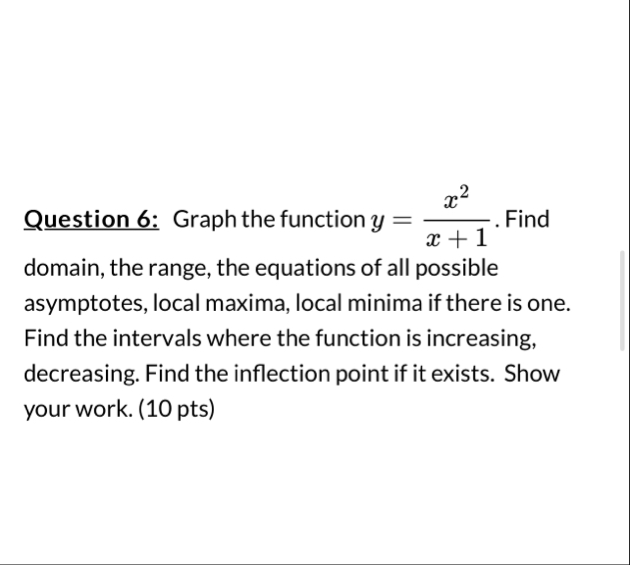 2
Question 6: Graph the functiony = — .Find
domain, the range, the equations of all possible
asymptotes, local maxima, local minima if there is one.
Find the intervals where the function is increasing,
decreasing. Find the inflection point if it exists. Show
your work. (10 pts)
This is AI generated Response.
Asked by: gvr
Created at: 2025-07-30 12:37:10
Asked by: gvr
Created at: 2025-07-30 12:37:10
Final Answer:
Rendered
Raw Text
Did you like this answer?
Let's solve step-by-step for the function \( y = \frac{x^2}{x+1} \):
---
### 1. **Domain**
The function is undefined when the denominator is zero:
\[ x + 1 = 0 \implies x = -1 \]
**Domain:** \( (-\infty, -1) \cup (-1, \infty) \)
---
### 2. **Vertical Asymptote**
Vertical asymptotes occur where the denominator is zero (and numerator is nonzero):
\[ x = -1 \]
---
### 3. **Horizontal/Oblique Asymptote**
For large \( |x| \), compare degrees (numerator degree is 2, denominator is 1):
- Since the degree of the numerator is one more than the denominator, there is an **oblique (slant) asymptote**.
- Perform polynomial division: \( x^2 \div (x + 1) \):
\[
\frac{x^2}{x+1} = x - 1 + \frac{1}{x+1}
\]
So the **slant asymptote** is \( y = x - 1 \).
---
### 4. **Intercepts**
- **x-intercept:** Set \( y = 0 \implies x^2 = 0 \implies x = 0 \)
- So, \( (0, 0) \) is the x-intercept.
- **y-intercept:** Set \( x = 0 \implies y = 0 \)
- So, \( (0, 0) \) is also the y-intercept.
---
### 5. **Local Maxima/Minima (Critical Points)**
Find where \( y' = 0 \):
\[
y = \frac{x^2}{x+1}
\]
Use quotient rule:
\[
y' = \frac{(x+1) \cdot 2x - x^2 \cdot 1}{(x+1)^2}
= \frac{2x(x+1) - x^2}{(x+1)^2}
= \frac{2x^2 + 2x - x^2}{(x+1)^2}
= \frac{x^2 + 2x}{(x+1)^2}
= \frac{x(x+2)}{(x+1)^2}
\]
Set numerator to zero:
\[
x(x+2) = 0 \implies x = 0 \text{ or } x = -2
\]
- At \( x = 0 \): \( y = 0 \)
- At \( x = -2 \): \( y = \frac{(-2)^2}{-2+1} = \frac{4}{-1} = -4 \)
---
### 6. **Increasing/Decreasing Intervals**
Check sign of \( y' \):
- \( x(x+2) > 0 \) when \( x < -2 \) or \( x > 0 \) (**increasing**)
- \( x(x+2) < 0 \) when \( -2 < x < 0 \) (**decreasing**)
But remember \( x = -1 \) is not in the domain.
So:
- **Increasing:** \( (-\infty, -2) \cup (0, -1) \cup (0, \infty) \)
- **Decreasing:** \( (-2, -1) \cup (-1, 0) \)
---
### 7. **Second Derivative (Concavity & Inflection Point)**
Differentiate \( y' \):
\[
y' = \frac{x(x+2)}{(x+1)^2}
\]
Let \( u = x(x+2),\ v = (x+1)^2 \):
\[
y'' = \frac{v \cdot u' - u \cdot v'}{v^2}
\]
\[
u' = 2x+2
\]
\[
v' = 2(x+1)
\]
\[
y'' = \frac{(x+1)^2(2x+2) - x(x+2) \cdot 2(x+1)}{(x+1)^4}
\]
Factor \( (x+1) \):
\[
= \frac{(x+1)[(x+1)(2x+2) - 2x(x+2)]}{(x+1)^4}
\]
\[
(x+1)(2x+2) = 2x^2 + 2x + 2x + 2 = 2x^2 + 4x + 2
\]
\[
2x(x+2) = 2x^2 + 4x
\]
\[
= \frac{(x+1)[2x^2 + 4x + 2 - (2x^2 + 4x)]}{(x+1)^4}
= \frac{(x+1)[2]}{(x+1)^4}
= \frac{2(x+1)}{(x+1)^4}
= \frac{2}{(x+1)^3}
\]
Set \( y'' = 0 \):
\[
\frac{2}{(x+1)^3} = 0
\]
But this never equals zero. So **no inflection point**.
---
### 8. **Range**
- As \( x \to \infty \), \( y \to x-1 \to \infty \)
- As \( x \to -\infty \), \( y \to x-1 \to -\infty \)
- At \( x = -2 \), \( y = -4 \) (local minimum)
- At \( x = 0 \), \( y = 0 \) (local maximum)
- Function can take all real values except possibly between the local min/max, but because the function is continuous on both sides and goes to \(\pm\infty\), **the range is \( (-\infty, \infty) \)**.
---
### 9. **Summary Table**
| Property | Value/Equation |
|---------------------------|------------------------------|
| **Domain** | \( (-\infty, -1) \cup (-1, \infty) \) |
| **Vertical Asymptote** | \( x = -1 \) |
| **Slant Asymptote** | \( y = x - 1 \) |
| **x- and y-Intercept** | \( (0,0) \) |
| **Local Minimum** | \( x = -2,\, y = -4 \) |
| **Local Maximum** | \( x = 0,\, y = 0 \) |
| **Increasing** | \( (-\infty, -2) \cup (0, -1) \cup (0, \infty) \) |
| **Decreasing** | \( (-2, -1) \cup (-1, 0) \) |
| **Inflection Points** | None |
| **Range** | \( (-\infty, \infty) \) |
---
### 10. **Graph**
- Vertical asymptote at \( x = -1 \)
- Slant asymptote \( y = x-1 \)
- Local minimum at \( (-2, -4) \), local maximum at \( (0,0) \)
---
**Final answer**: All the above properties, and you can sketch the graph using this information. If you need the graph plotted, let me know!
📢 Instructions:
- Ask anything relatd to above question only.
- For new Question goto :