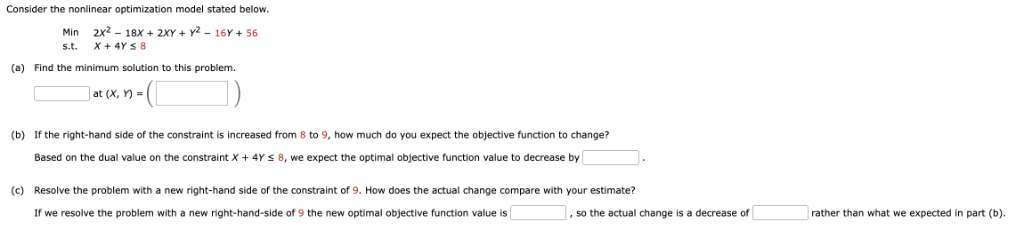
Give step-by-step solution with explanation and final answer:Consider the nonlinear optimization model stated below.
Min 2x7 — 18X + 27 + ¥2 ~ 16Y + 56
sto xearss
(8) Find the minimum solution to ths problem.
atx mn -( )
(b) Ifthe right-hand ide of the constraint i Increased from § t0.9, how much do you expect the objective function to change?
Based on the dual value on the constrant X + 4Y < §, we expect the optimal objective function value to decrease by .
(6) Resolve the problem with a new right-hand side of the constraint of 5. How does the actual change compare with your estimate?
1 we resolve the problem with 2 new ight-hand-side of the new optimal objective function value is +50 the actual change i a decrease of father than what we expected In part (b).
Question:
Give step-by-step solution with explanation and final answer:Consider the nonlinear optimization model stated below.
Min 2x7 — 18X + 27 + ¥2 ~ 16Y + 56
sto xearss
(8) Find the minimum solution to ths problem.
atx mn -( )
(b) Ifthe right-hand ide of the constraint i Increased from § t0.9, how much do you expect the objective function to change?
Based on the dual value on the constrant X + 4Y < §, we expect the optimal objective function value to decrease by .
(6) Resolve the problem with a new right-hand side of the constraint of 5. How does the actual change compare with your estimate?
1 we resolve the problem with 2 new ight-hand-side of the new optimal objective function value is +50 the actual change i a decrease of father than what we expected In part (b).
This is AI generated Response.
Asked by: gvr
Created at: 2025-07-30 11:32:51
Final Answer:
RenderedRaw Text
Did you like this answer?
Let's solve the problem step by step.
---
### **Given Problem:**
\[
\text{Minimize: } 2x^2 - 18x + 2xy + y^2 - 16y + 56
\]
\[
\text{Subject to: } x + 4y \leq 8
\]
---
## **(a) Find the minimum solution to this problem.**
We have a quadratic objective function with a linear constraint.
### **Step 1: Formulate the Lagrangian**
Let \(\lambda\) be the Lagrange multiplier for the constraint \(x + 4y \leq 8\):
\[
L(x, y, \lambda) = 2x^2 - 18x + 2xy + y^2 - 16y + 56 + \lambda(x + 4y - 8)
\]
### **Step 2: Take partial derivatives and set to zero**
Find stationary points by setting the gradients to zero:
\[
\frac{\partial L}{\partial x} = 4x - 18 + 2y + \lambda = 0
\]
\[
\frac{\partial L}{\partial y} = 2x + 2y - 16 + 4\lambda = 0
\]
\[
\frac{\partial L}{\partial \lambda} = x + 4y - 8 \leq 0, \quad \lambda \geq 0, \quad \lambda(x + 4y - 8) = 0
\]
### **Step 3: Solve the unconstrained minimum**
First, try the unconstrained minimum (set \(\lambda = 0\)):
\[
4x - 18 + 2y = 0 \implies 4x + 2y = 18 \tag{1}
\]
\[
2x + 2y - 16 = 0 \implies x + y = 8 \tag{2}
\]
From (2): \(x + y = 8 \implies y = 8 - x\)
Substitute into (1):
\[
4x + 2(8-x) = 18 \implies 4x + 16 - 2x = 18 \implies 2x = 2 \implies x = 1
\]
\[
y = 8 - 1 = 7
\]
Check if this point satisfies the constraint:
\[
x + 4y = 1 + 4 \times 7 = 1 + 28 = 29 > 8
\]
So it **violates the constraint**.
### **Step 4: The constraint is binding**
So the minimum will be on the boundary \(x + 4y = 8\).
Let’s substitute \(x = 8 - 4y\) into the objective function and minimize with respect to \(y\):
\[
f(x, y) = 2x^2 - 18x + 2xy + y^2 - 16y + 56
\]
Plugging \(x = 8 - 4y\):
\[
f(y) = 2(8-4y)^2 - 18(8-4y) + 2(8-4y)y + y^2 - 16y + 56
\]
Let’s expand step by step:
\[
(8-4y)^2 = 64 - 64y + 16y^2
\]
So,
\[
2(8-4y)^2 = 2 \times (64 - 64y + 16y^2) = 128 - 128y + 32y^2
\]
\[
-18(8-4y) = -144 + 72y
\]
\[
2(8-4y)y = 16y - 8y^2
\]
\[
y^2 = y^2
\]
\[
-16y
\]
\[
+56
\]
Sum all terms:
\[
f(y) = [128 - 128y + 32y^2] + [-144 + 72y] + [16y - 8y^2] + y^2 - 16y + 56
\]
Combine like terms:
- Constants: \(128 - 144 + 56 = 40\)
- \(y\) terms: \(-128y + 72y + 16y - 16y = -56y\)
- \(y^2\) terms: \(32y^2 - 8y^2 + y^2 = 25y^2\)
So:
\[
f(y) = 40 - 56y + 25y^2
\]
Now, minimize this quadratic function. The minimum is at:
\[
y^* = -\frac{b}{2a} = -\frac{-56}{2 \times 25} = \frac{56}{50} = 1.12
\]
Now, \(x^* = 8 - 4y^* = 8 - 4 \times 1.12 = 8 - 4.48 = 3.52\)
Plug these into the constraint to check:
\[
x^* + 4y^* = 3.52 + 4 \times 1.12 = 3.52 + 4.48 = 8 \quad \text{(satisfies constraint)}
\]
Now, compute the minimum value:
\[
f(y^*) = 40 - 56 \times 1.12 + 25 \times (1.12)^2 = 40 - 62.72 + 31.36 = 8.64
\]
So:
\[
\boxed{8.64 \text{ at } (x, y) = (3.52, 1.12)}
\]
---
## **(b) If the right-hand side of the constraint increases from 8 to 9, how much do you expect the objective function to change?**
This is the **dual value (shadow price)** at the constraint.
Recall that when the constraint is binding, the dual variable \(\lambda\) equals the rate of change of the optimal value with respect to the constraint.
We had the Lagrangian stationarity conditions:
\[
4x - 18 + 2y + \lambda = 0
\]
\[
2x + 2y - 16 + 4\lambda = 0
\]
Plug in \(x^*=3.52, y^*=1.12\):
First equation:
\[
4(3.52) - 18 + 2(1.12) + \lambda = 0 \implies 14.08 - 18 + 2.24 + \lambda = 0 \implies -1.68 + \lambda = 0 \implies \lambda = 1.68
\]
So, the objective function is expected to **decrease by 1.68** for an increase of 1 in the right-hand side.
\[
\boxed{1.68}
\]
---
## **(c) Resolve the problem with a new right-hand side of the constraint of 9.**
Now, constraint: \(x + 4y = 9\)
Let \(x = 9 - 4y\), plug into the objective function:
\[
f(y) = 2(9-4y)^2 - 18(9-4y) + 2(9-4y)y + y^2 - 16y + 56
\]
First, expand \((9-4y)^2 = 81 - 72y + 16y^2\):
\[
2(81 - 72y + 16y^2) = 162 - 144y + 32y^2
\]
\[
-18(9-4y) = -162 + 72y
\]
\[
2(9-4y)y = 18y - 8y^2
\]
\[
y^2
\]
\[
-16y
\]
\[
+56
\]
Sum all:
\[
f(y) = [162 - 144y + 32y^2] + [-162 + 72y] + [18y - 8y^2] + y^2 - 16y + 56
\]
Constants: \(162 - 162 + 56 = 56\)
\(y\) terms: \(-144y + 72y + 18y - 16y = -70y\)
\(y^2\) terms: \(32y^2 - 8y^2 + y^2 = 25y^2\)
\[
f(y) = 56 - 70y + 25y^2
\]
Minimizing:
\[
y^* = \frac{70}{50} = 1.4
\]
\[
x^* = 9 - 4 \times 1.4 = 9 - 5.6 = 3.4
\]
Check constraint: \(x^* + 4y^* = 3.4 + 5.6 = 9\)
Compute the minimum value:
\[
f(y^*) = 56 - 70 \times 1.4 + 25 \times (1.4)^2 = 56 - 98 + 49 = 7
\]
So the new minimum value is \(\boxed{7}\).
**Actual decrease:** \(8.64 - 7 = 1.64\)
This is slightly less than the estimated \(1.68\) from the dual value.
---
### **Final Answers (for filling in the blanks):**
**(a)**
\[
\boxed{8.64} \text{ at } (x, y) = (\boxed{3.52},\,\boxed{1.12})
\]
**(b)**
\[
\boxed{1.68}
\]
**(c)**
\[
\boxed{7},\ \boxed{1.64}
\]
---
**Summary Table:**
| Part | Answer |
|---|---|
| (a) | 8.64 at (3.52, 1.12) |
| (b) | 1.68 |
| (c) | 7, 1.64 |
VIPSolutions focuses on clear, step‑by‑step explanations so you can learn quickly. Whether you need an AI‑generated walkthrough or a short hint to get unstuck, each solution is organized for fast reading and easy review later.
Search similar questions, compare approaches, and bookmark the best answers for revision. Our goal is simple: quick, reliable study help that feels natural—not noisy.
 VIPSolutions
 Consider the nonlinear optimization model stated below.
Min 2x7 — 18X + 27 + ¥2 ~ 16Y + 56
sto xearss
(8) Find the minimum solution to ths problem.
atx mn -( )
(b) Ifthe right-hand ide of the constraint i Increased from § t0.9, how much do you expect the objective function to change?
Based on the dual value on the constrant X + 4Y < §, we expect the optimal objective function value to decrease by .
(6) Resolve the problem with a new right-hand side of the constraint of 5. How does the actual change compare with your estimate?
1 we resolve the problem with 2 new ight-hand-side of the new optimal objective function value is +50 the actual change i a decrease of father than what we expected In part (b).